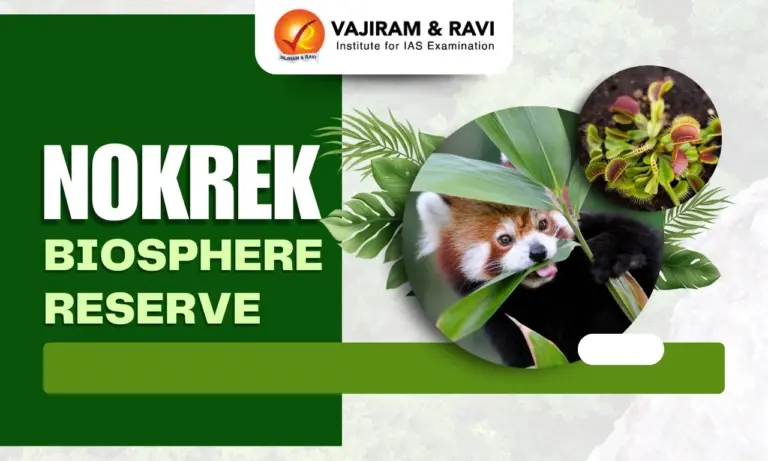
The Nokrek Biosphere Reserve is a protected natural area known for its rich biodiversity and scenic landscapes. It represents an important effort to conserve forests, wildlife, and natural ecosystems while maintaining a balance between human activities and nature. Located in the northeastern part of India, it highlights the importance of ecological conservation and sustainable development.
Nokrek Biosphere Reserve Location and Physical Features
- The Nokrek Biosphere Reserve is situated in the Garo Hills region of Meghalaya, forming a part of the Tura Range of the Meghalaya Plateau, which is known for its rugged terrain and rich natural beauty. It lies in the north-eastern part of India, making it an important ecological zone of the region.
- The area is largely mountainous, with an average elevation of about 600 metres, while Nokrek Peak (1,412 metres) stands as the highest point in the Garo Hills, offering significant geographical importance.
- The terrain shows clear diversity, with gently undulating hills in the north and steep slopes and dense forests in the south, creating varied habitats for different species.
- The reserve is also part of an important river catchment system, with rivers like Simsang (longest), Ganol, and Dareng originating here and supporting both ecosystems and nearby settlements.
- These rivers ultimately connect to the Brahmaputra basin, highlighting the reserve’s role in regional water security and hydrological balance.
Also Read : National Parks in Meghalaya
Nokrek Biosphere Reserve Climate
- The biosphere reserve experiences a tropical monsoon climate, characterized by high humidity, heavy rainfall, and consistently warm temperatures, which together create ideal conditions for dense vegetation growth.
- The monsoon season lasts from April to October, bringing abundant rainfall that sustains rivers, forests, and wildlife throughout the year.
- Due to these favorable conditions, nearly 90% of the area is covered with thick tropical evergreen forests, along with semi-evergreen and moist deciduous patches.
- At lower altitudes, bamboo forests and grasslands are also found, adding to habitat diversity and supporting different ecological niches.
- The climate also supports the growth of rare and endemic plant species, making the region ecologically sensitive and valuable.


Nokrek Biosphere Reserve Flora
- Nokrek Biosphere Reserve is a rich repository of plant biodiversity, especially known for its endemic species and diverse forest types.
- A key highlight is the presence of Indian wild orange (Citrus indica), considered one of the most primitive citrus species, making the area important for genetic and agricultural research.
- The forests include tree species such as Bombax ceiba (cotton tree), Sterculia villosa, Cassia fistula (golden shower tree), along with wild bananas, orchids, and medicinal plants.
- The presence of bamboo groves and subtropical vegetation further enriches the plant diversity and supports local livelihoods.
- Many of these plants have economic, medicinal, and ecological value, contributing to both conservation and sustainable use.
Nokrek Biosphere Reserve Fauna
- The reserve is home to a wide range of wildlife species, including several that are endangered, rare, or endemic to the region.
- Important species include the hoolock gibbon (India’s only ape), slow loris, pig-tailed macaque, stump-tailed macaque, and giant flying squirrel, all of which are ecologically significant.
- Larger mammals like Asian elephants, tigers, and leopards are also found, indicating the richness of the habitat.
- The region supports a large variety of bird species (over 200), including hornbills, pheasants, and migratory birds, making it a hotspot for birdwatching.
- The diversity of fauna reflects the healthy ecosystem and balanced food chains within the biosphere reserve.
Ecological Importance and Conservation
- Nokrek Biosphere Reserve was recognized as a UNESCO Biosphere Reserve in 2009, highlighting its global ecological significance and conservation value.
- It acts as a biodiversity hotspot, preserving a wide range of plant and animal species, many of which are not found elsewhere.
- The reserve plays a crucial role in maintaining ecological balance, conserving genetic diversity, and protecting endangered species.
- It also supports water conservation, as its forests help regulate river flow and prevent soil erosion.
- The inclusion of Nokrek National Park as a core zone ensures stricter protection and scientific management of natural resources.
Nokrek Biosphere Reserve Socio-Economic Features
- The local population, mainly tribal communities, depends on forest-based resources like timber, honey, wax, and medicinal plants for their daily needs and income.
- Shifting cultivation (jhum farming) is the primary agricultural practice, covering a significant portion of land, though it can lead to deforestation and soil degradation if not managed properly.
- Main crops grown in the region include rice, bananas, cashew nuts, and tea, which also serve as important commercial products.
- To improve livelihoods, authorities are promoting alternative economic activities such as beekeeping, horticulture, and sustainable agriculture practices.
- Development initiatives also aim to balance economic growth with environmental conservation, ensuring long-term sustainability.
Cultural Significance and Indigenous Communities
- The biosphere reserve is home to the Garo tribe (Achik Mande), whose name means “people of the hills,” reflecting their deep connection with the landscape.
- The Garo people have traditional knowledge systems that promote sustainable use of natural resources and conservation of forests.
- Nokrek Peak is considered sacred, believed to be the dwelling place of their deity, which adds spiritual importance to the region.
- Cultural practices, rituals, and festivals often revolve around nature worship, agriculture, and forest conservation.
- This close relationship between culture and environment helps in preserving biodiversity through community participation.
Tourism and Sustainable Practices
- Nokrek Biosphere Reserve is an emerging destination for ecotourism, offering activities like trekking, wildlife safaris, birdwatching, and nature exploration.
- Tourists can experience lush green forests, scenic hills, and rich biodiversity, making it a unique destination in Northeast India.
- The region also provides opportunities to understand the culture and traditions of the Garo community, including their lifestyle and handicrafts.
- Efforts are being made to promote responsible tourism, where visitors are encouraged to minimize environmental impact and respect wildlife habitats.
- Sustainable tourism initiatives also help in generating income for local communities while ensuring the protection of natural resources.
Key Threats to Nokrek Biosphere Reserve
- Shifting Cultivation (Jhum Farming): Jhum cultivation is widely practiced in the region and often involves clearing forest patches for agriculture. Due to increasing population pressure, the fallow cycle has reduced to about 3-5 years, which is insufficient for forest regeneration, leading to soil erosion, nutrient loss, and long-term degradation of land.
- Deforestation & Forest Degradation: Despite high forest cover in Meghalaya, a significant portion has degraded into secondary forests. Continuous extraction of fuelwood, timber, and other forest products weakens forest density and reduces the ability of ecosystems to support diverse wildlife.
- Over-exploitation of Forest Resources: Local communities depend heavily on forests for livelihood, food, and energy needs. This results in excessive collection of non-timber forest products (NTFPs) and fuelwood, putting sustained pressure on the reserve’s natural resources.
- Habitat Fragmentation & Biodiversity Loss: Expansion of agriculture, settlements, and infrastructure leads to fragmentation of forest habitats, isolating wildlife populations. This is particularly dangerous for endemic and endangered species, as it disrupts breeding patterns and reduces genetic diversity.
- Human-Wildlife Conflict: Increasing encroachment into forest areas has intensified conflicts, especially involving elephants and other large mammals. Crop damage and threats to human life often lead to retaliatory actions, negatively impacting conservation efforts.
- Climate Change & Environmental Stress: The region is experiencing erratic rainfall patterns and rising temperatures, which affect forest composition, water availability, and species distribution. Such changes make the ecosystem more vulnerable and disturb its natural balance over time.
Conservation Efforts in Nokrek Biosphere Reserve
- UNESCO Recognition & Scientific Management (2009): Inclusion under the UNESCO Man and Biosphere Programme promotes a balance between conservation and development, encouraging research, monitoring, and sustainable resource use in the region.
- Zonation Approach (Core-Buffer-Transition): The reserve follows a structured model with a core area (~47 sq km) under strict protection, while buffer and transition zones allow regulated activities like eco-friendly farming and limited resource use, ensuring sustainability.
- Community Participation & Sustainable Livelihoods: Local communities (especially the Garo tribe) are involved in conservation through community forest management, agroforestry, and reduced dependence on jhum cultivation, promoting long-term ecological balance.
- Sustainable Agriculture Practices: Efforts are being made to replace shifting cultivation with terrace farming, organic agriculture, and crop diversification, which help in reducing soil erosion and improving land productivity.
- Biodiversity Conservation & Gene Sanctuary: The Citrus Gene Sanctuary protects rare species like Citrus indica, while conservation programs focus on safeguarding endemic fauna, ensuring genetic diversity and ecosystem stability.
- Eco-tourism & Resource Regulation: Promotion of controlled eco-tourism, use of plastic-free zones, and restrictions on mining and deforestation encourage responsible tourism and sustainable use of natural resources.

 Last updated on Oct, 2026
→ UPSC 2027 Notification will be released on 13 January 2027 at upsconline.nic.in.
→ Check Nobel Prize 2026 Winners List here.
→ Download PIB PRiSM Monthly Magazine 2026 here.
→ Check UPSC Monthly Current Affairs Magazine The Recitals here.
→ Check out the latest UPSC Syllabus here.
→ Download UPSC Model Answers for Mains 2026
→ UPSC Mains Question Paper 2026 is out now for Essay & GS Paper 1, 2, 3 & 4.
→ UPSC Calendar 2027 has been released.
→ Enroll in Vajiram & Ravi’s UPSC Mains Test Series 2027 for structured answer writing practice, expert evaluation, and exam-oriented feedback.
→ Join Vajiram & Ravi’s UPSC Mentorship Program 2027 for personalized guidance, strategy planning, and one-to-one support from experienced mentors.
→ Go through the UPSC Mains Previous Year Papers to enhance your preparation.
→ UPSC has released UPSC Toppers List 2025 with the Civil Services final result on its official website.
→ Also check Best UPSC Coaching in India
Nokrek Biosphere Reserve FAQs
Q1. What is Nokrek Biosphere Reserve known for?+
Q2. Where is Nokrek Biosphere Reserve located?+
Q3. Why is Nokrek Biosphere Reserve important?+
Q4. What type of climate is found in Nokrek Biosphere Reserve?+
Q5. Which animals are found in Nokrek Biosphere Reserve?+
Tags: environment environment notes nokrek biosphere reserve