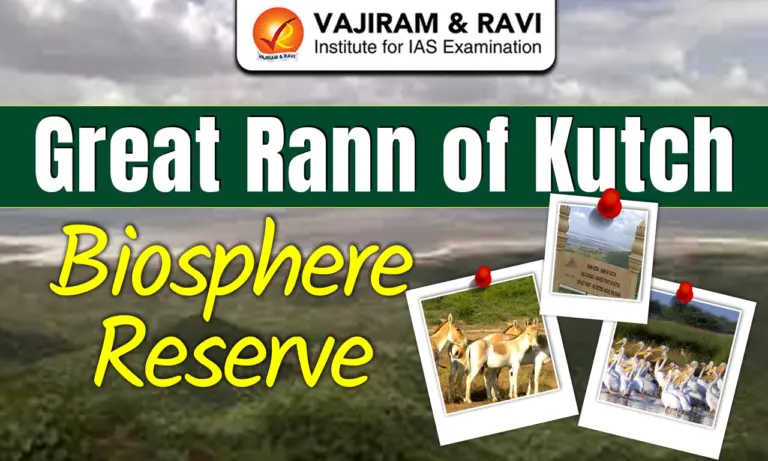
The Great Rann of Kutch Biosphere Reserve is a unique natural region located in western India, known for its vast stretches of white salt desert. It is a place where land and sea meet, creating a landscape that changes with the seasons. Despite its harsh conditions, the area supports a variety of plants, animals, and bird life. The biosphere reserve plays an important role in conserving this fragile ecosystem while also supporting local communities.
Great Rann of Kutch Biosphere Reserve Location
- The Great Rann of Kutch Biosphere Reserve lies in the westernmost part of Gujarat, mainly in the Kachchh district, and forms a natural boundary near the India-Pakistan border.
- It is a major component of the larger Rann of Kutch Biosphere Reserve, which also includes the Little Rann, but the Great Rann is more expansive and ecologically distinctive.
- The region stretches between the Gulf of Kutch and inland desert areas, acting as a transition zone between marine and terrestrial ecosystems.
- Covering a vast area within the overall 12,454 sq. km biosphere reserve, it represents one of the largest continuous salt desert landscapes in the world.
- Its remote location and difficult terrain have helped preserve its natural character and biodiversity to a large extent.
- The area is sparsely populated, with human settlements mostly located on the fringes rather than in the core saline desert zone.
Also Read : Biosphere Reserves in India
Great Rann of Kutch Biosphere Reserve Landscape Features
- The Great Rann of Kutch is a seasonal salt marsh, formed due to a combination of marine transgression, river deposition, and tectonic activity over geological time.
- During the monsoon, seawater and river water from rivers like Luni, Rupen, and Banas flood the region, turning it into a shallow inland sea.
- As temperatures rise after the monsoon, rapid evaporation leaves behind thick salt deposits, creating the iconic “White Desert” landscape.
- The terrain is made up of mudflats, salt-encrusted plains, and elevated “bets”, which remain relatively dry and support some vegetation.
- The flat topography and reflective salt surface create unique visual effects, especially under sunlight and moonlight.
- Seasonal changes make the landscape highly dynamic, shifting between wetland and desert within a year.
- Known for the mysterious “Chir Batti” lights, a natural phenomenon still not fully explained.
- The area experiences dramatic seasonal transformation, shifting from a wetland to a desert within months.
- Hosts cultural events like the Rann Utsav, showcasing local traditions and attracting tourism.


Great Rann of Kutch Biosphere Reserve Ecosystem and Climate
- The ecosystem is a rare mix of desert, wetland, and coastal influences, making it one of the most unusual ecological regions in India.
- The climate is extremely arid, with very low annual rainfall, high evaporation rates, and frequent drought-like conditions.
- Temperatures can rise above 45°C in summer and drop significantly during winter nights, creating a harsh environment for life.
- High salinity and waterlogging during monsoon create dual stress conditions for organisms – both excess and scarcity of water.
- The presence of “bets” (elevated islands) allows plants and animals to survive seasonal flooding and provides critical habitat zones.
- Strong winds and dust storms are common, influencing soil conditions and vegetation patterns.
- Despite extreme conditions, the ecosystem remains biologically productive during certain seasons, especially for birds.
Great Rann of Kutch Biosphere Reserve Flora (Vegetation)
- Vegetation is sparse but highly adapted, dominated by halophytes (salt-tolerant species) that can survive extreme salinity and drought.
- Common vegetation includes thorny shrubs, grasses, and scrub forests, particularly on slightly elevated areas.
- Species like Prosopis juliflora grow on “bets,” providing shelter and stabilizing soil, although they can also spread aggressively.
- The vegetation cover is seasonal and depends heavily on rainfall and salinity levels in a given year.
- Compared to other ecosystems, plant diversity is low, but ecological specialization is very high.
- Some patches also support savanna-type grasslands, which are important for herbivores.
- Vegetation plays a crucial role in preventing soil erosion and supporting the fragile desert food chain.
Great Rann of Kutch Biosphere Reserve Fauna (Wildlife)
- The Great Rann supports wildlife specially adapted to heat, salinity, and water scarcity, making it a unique faunal region.
- It is internationally known for flamingo breeding colonies, often called “Flamingo City,” where thousands of birds nest and breed.
- Mammals include chinkara, desert fox, Indian wolf, striped hyena, and desert cat, all adapted to survive in harsh desert conditions.
- The region also supports endangered birds like the Great Indian Bustard and Lesser Florican, especially in nearby grassland areas.
- Reptiles such as lizards and snakes are common, adapted to sandy and saline soils.
- While the Indian Wild Ass is mainly found in the Little Rann, the broader ecosystem contributes indirectly to its habitat.
- Seasonal wetlands attract large numbers of migratory birds, making it an important bird conservation area.
Great Rann of Kutch Biosphere Reserve Conservation
- The Great Rann includes the Kachchh Desert Wildlife Sanctuary, one of the largest protected areas in India, known for its desert biodiversity.
- It is part of a wider network of protected areas, including Narayan Sarovar Sanctuary and Kutch Bustard Sanctuary, which help conserve different habitats.
- The biosphere reserve follows a zonal approach, with core, buffer, and transition zones for balanced conservation and development.
- Conservation efforts focus on protecting migratory birds, endangered species, and fragile habitats from human disturbances.
- The region also faces challenges like climate change, salinity changes, and human encroachment, which require careful management.
- Government and local communities work together to promote sustainable use of resources.
- Eco-tourism initiatives are being developed carefully to ensure minimum ecological impact.
Also Read : National Parks in Gujarat
Great Rann of Kutch Biosphere Reserve Cultural Significance
- Human habitation within the Great Rann is minimal, but surrounding areas are home to communities like the Rabaris and Maldharis.
- These communities depend on livestock rearing, handicrafts, and traditional knowledge systems for survival.
- Their lifestyle is closely linked to the ecosystem, especially in terms of seasonal migration and resource use.
- Traditional practices are generally sustainable and help maintain ecological balance.
- Cultural expressions such as embroidery, music, and festivals reflect their deep connection with the region.
- Conservation strategies aim to integrate local livelihoods with biodiversity protection.
- Increasing tourism has created both economic opportunities and environmental concerns.
Major Threats to the Great Rann of Kutch Biosphere Reserve
- Climate change is altering the delicate seasonal cycle of flooding and drying, with irregular monsoons, rising temperatures, and possible sea-level rise increasing salinity and disturbing the ecological balance of the region.
- Hydrological changes and increasing salinity due to reduced freshwater inflow from rivers disturb the natural freshwater–saltwater balance, affecting vegetation, grazing grounds, and breeding habitats of migratory birds.
- Industrialization and infrastructure development in nearby areas lead to habitat fragmentation, disturbance of natural drainage systems, and increased pollution, negatively impacting fragile desert and wetland ecosystems.
- Unregulated tourism, especially during events like Rann Utsav, causes pressure on the ecosystem through waste generation, off-road driving, and construction activities that damage the salt crust and wildlife habitats.
- Overgrazing and rising resource pressure from surrounding communities can degrade sparse vegetation, reduce soil stability, and disturb the already limited food chain in this arid environment.
- Invasive species like Prosopis juliflora spread aggressively, replacing native vegetation and altering habitat structure, which negatively affects biodiversity and species dependent on natural grasslands.
- Disturbance to wildlife and bird habitats, including flamingo breeding sites, due to human interference, along with pollution and strategic activities near the border, further threaten the fragile ecosystem.
Significance of Great Rann of Kutch Biosphere Reserve
- The Great Rann of Kutch is one of the largest saline desert ecosystems in the world, making it highly important for understanding desert ecology, salinity adaptation, and extreme environments.
- It is a rare region where desert, wetland, and marine ecosystems overlap, creating a unique and highly diverse ecological landscape within a single area.
- The region is a crucial habitat for migratory birds along the Central Asian Flyway, and it supports large breeding colonies of flamingos, giving it global biodiversity importance.
- It provides habitat to several rare and threatened species such as the Great Indian Bustard, Indian wolf, and desert fox, contributing to wildlife conservation in arid India.
- The seasonal cycle of flooding and drying helps in nutrient cycling, soil formation, and maintaining ecological balance in an otherwise harsh desert region.
- It supports local livelihoods through pastoralism, salt production, tourism, and traditional handicrafts, thus having strong economic and cultural relevance.
- Due to its location near the India-Pakistan border, the region holds strategic and geopolitical importance, aiding in border management and national security.

 Last updated on Oct, 2026
→ UPSC 2027 Notification will be released on 13 January 2027 at upsconline.nic.in.
→ Check Nobel Prize 2026 Winners List here.
→ Download PIB PRiSM Monthly Magazine 2026 here.
→ Check UPSC Monthly Current Affairs Magazine The Recitals here.
→ Check out the latest UPSC Syllabus here.
→ Download UPSC Model Answers for Mains 2026
→ UPSC Mains Question Paper 2026 is out now for Essay & GS Paper 1, 2, 3 & 4.
→ UPSC Calendar 2027 has been released.
→ Enroll in Vajiram & Ravi’s UPSC Mains Test Series 2027 for structured answer writing practice, expert evaluation, and exam-oriented feedback.
→ Join Vajiram & Ravi’s UPSC Mentorship Program 2027 for personalized guidance, strategy planning, and one-to-one support from experienced mentors.
→ Go through the UPSC Mains Previous Year Papers to enhance your preparation.
→ UPSC has released UPSC Toppers List 2025 with the Civil Services final result on its official website.
→ Also check Best UPSC Coaching in India
Great Rann of Kutch Biosphere Reserve FAQs
Q1. What is the Great Rann of Kutch Biosphere Reserve?+
Q2. Where is the Great Rann of Kutch located?+
Q3. How is the Great Rann of Kutch formed?+
Q4. What type of ecosystem is found in the Great Rann of Kutch?+
Q5. Which animals are found in the Great Rann of Kutch?+
Tags: environment environment notes great rann of kutch biosphere reserve