Pallas’s Gull Latest News
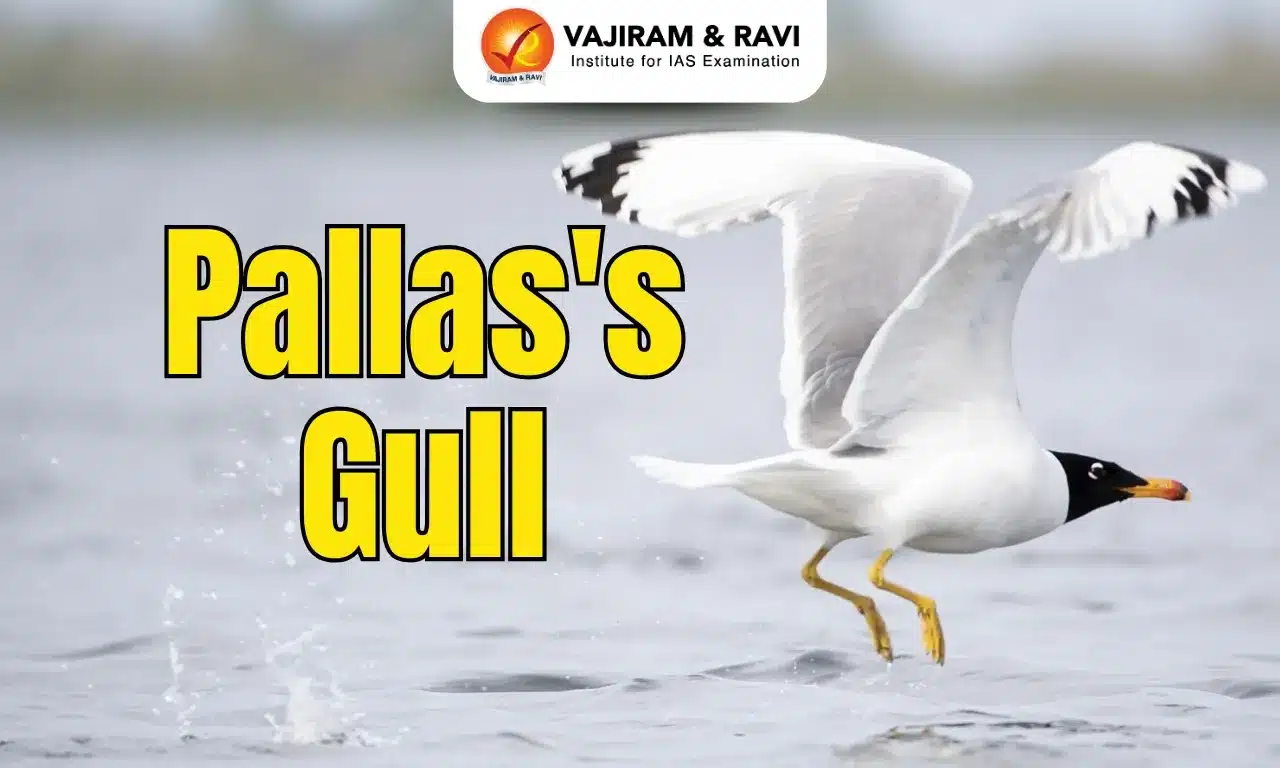
The first confirmed record of Pallas’s Gull (Ichthyaetus ichthyaetus) from the Spiti Valley was recently documented at Chandratal Lake, a Ramsar wetland, during a field visit.
About Pallas’s Gull
- Pallas’s Gull, also called the Great Black-headed Gull, is a large bird species belonging to the family Laridae.
- It is the world’s largest black-headed gull and the third-largest species of gull in the world.
- Scientific Name: Ichthyaetus ichthyaetus.


Pallas’s Gull Habitat and Distribution
- It breeds in colonies in marshes and islands from southern Russia to Mongolia.
- It is migratory, wintering in warmer places. These include the eastern Mediterranean Sea, the Arabian Peninsula, and India.
- It prefers wetlands, salt lakes, lagoons, and slow-flowing rivers.
- Sometimes, a Pallas’s gull might fly far off its usual path. When this happens, it is called a “vagrant.”
- These gulls are sometimes seen as vagrants in Western Europe. They also visit parts of the Indian Ocean and the coasts of Africa.
Pallas’s Gull Features
- It measures 55–72 cm in length with a 142 to 170 cm wingspan.
- Summer adults are unmistakable, since no other gull of this size has a black hood.
- The adults have grey wings and backs, with conspicuous white “mirrors” at the wing tips.
- The legs are yellow, and the bill is orangey-yellow with a red tip.
- In all other plumages, a dark mask through the eye indicates the vestiges of the hood.
- The call is a deep aargh cry.
- These birds are predatory, taking fish, crustaceans, insects, and even small mammals.
- Typical Lifespan: 12 to 24 years in the wild.
Pallas’s Gull Conservation Status
It is classified as ‘Least Concern‘ under the IUCN Red List
Key Facts about Chandratal Lake
- Chandra Taal (meaning the Lake of the Moon), or Chandra Tal, is a high-altitude lake situated in the Spiti Valley of Himachal Pradesh.
- This crescent-shaped lake is situated at an altitude of about 4,300 metres (14,100 ft) in the Himalayas.
- It has a circumference of about 2-3 kms and is one of the sources of the Chandra River.
- It is beautifully surrounded by snow-capped mountains on one side and cirques on the other.
- The lake is famous for its crystal-clear turquoise waters, which often change shades from blue to green depending on sunlight and weather conditions.
- It is also celebrated in Hinduism for its mention in the epic Mahabharata.
- It is a designated Ramsar site.
Source: IE

 Last updated on Oct, 2026
→ UPSC 2027 Notification will be released on 13 January 2027 at upsconline.nic.in.
→ Check Nobel Prize 2026 Winners List here.
→ Download PIB PRiSM Monthly Magazine 2026 here.
→ Check UPSC Monthly Current Affairs Magazine The Recitals here.
→ Check out the latest UPSC Syllabus here.
→ Download UPSC Model Answers for Mains 2026
→ UPSC Mains Question Paper 2026 is out now for Essay & GS Paper 1, 2, 3 & 4.
→ UPSC Calendar 2027 has been released.
→ Enroll in Vajiram & Ravi’s UPSC Mains Test Series 2027 for structured answer writing practice, expert evaluation, and exam-oriented feedback.
→ Join Vajiram & Ravi’s UPSC Mentorship Program 2027 for personalized guidance, strategy planning, and one-to-one support from experienced mentors.
→ Go through the UPSC Mains Previous Year Papers to enhance your preparation.
→ UPSC has released UPSC Toppers List 2025 with the Civil Services final result on its official website.
→ Also check Best UPSC Coaching in India
Pallas’s Gull FAQs
Q1. What is Pallas’s Gull?+
Q2. What is the scientific name of Pallas’s Gull?+
Q3. Where does Pallas’s Gull breed?+
Q4. Where does Pallas’s Gull spend the winter?+
Q5. What is the IUCN Red List status of Pallas’s Gull?+
Tags: pallas's gull prelims pointers upsc current affairs upsc prelims current affairs