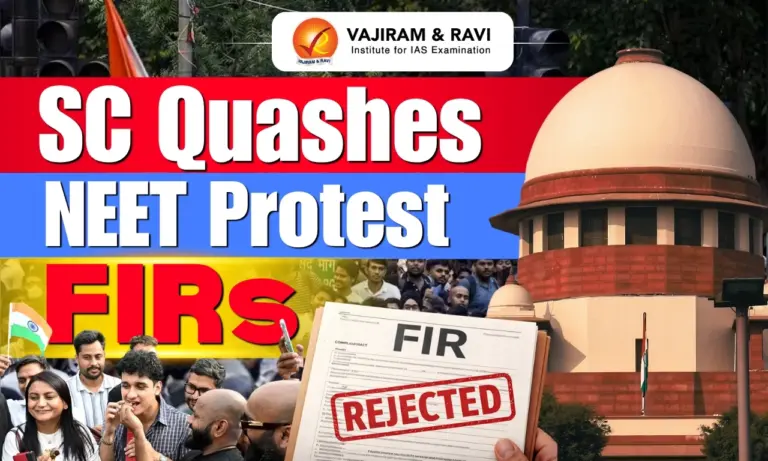
Supreme Court has ordered the closure of FIRs registered against students and young people who participated in protests related to the NEET-UG paper leak issue. The Court used its extraordinary powers under Article 142 of the Constitution to provide relief to protesters who had participated bona fide in the demonstrations.
The ruling is important from the perspective of fundamental rights, the right to protest, judicial powers and Article 142.7
Why in News?
The Supreme Court invoked Article 142 to quash FIRs registered against students and other protesters who participated in NEET-UG protests between July 20 and 25, 2026.
Article 142 of Indian Constitution
Article 142 of Indian Constitution gives the Supreme Court the power to pass orders necessary for doing “complete justice” in any case or matter pending before it.
- Complete Justice: Enables the Court to provide effective relief where ordinary legal remedies may be inadequate.
- Extraordinary Power: Gives the Supreme Court a wide discretionary power to meet the ends of justice.
- Enforcement: Orders passed under Article 142 are enforceable throughout India.
- Scope: Can be used to address situations where existing laws do not provide an adequate remedy.
- Limitations: The power cannot be used to override substantive law or violate constitutional provisions.
- Case-Specific: Its application depends on the facts and circumstances of each case.
Also Read:- Jantar Mantar


Article 19 and the Right to Peaceful Protest
Article 19 guarantees citizens important fundamental freedoms, including freedom of speech and expression and the right to assemble peacefully. These freedoms provide the constitutional basis for peaceful protests, but they are subject to reasonable restrictions.
- Article 19(1)(a): Guarantees freedom of speech and expression, allowing citizens to express opinions, criticism and dissent.
- Article 19(1)(b): Guarantees the right to assemble peacefully and without arms, which forms an important basis for peaceful demonstrations.
- Article 19(2): Nothing in Article 19(1)(a) prevents the State from making laws imposing reasonable restrictions on freedom of speech and expression in the interests of sovereignty and integrity of India, security of the State, friendly relations with foreign States, public order, decency or morality, or in relation to contempt of court, defamation or incitement to an offence.
- Article 19(3): Permits reasonable restrictions on the right to peaceful assembly in the interests of sovereignty and integrity of India and public order.
- Not an Absolute Right: The right to protest does not include a right to engage in violence, destruction of property or serious disruption of public order.
- Democratic Importance: Peaceful protests enable citizens to express dissent, raise public concerns and hold authorities accountable.
Also Read:- Right to Protest in India
Important Case Laws Related to Article 142
- Union Carbide Corporation v. Union of India (1991): The Supreme Court used Article 142 to facilitate a settlement in the Bhopal Gas Tragedy case and emphasised its power to ensure complete justice.
- Supreme Court Bar Association v. Union of India (1998): The Court held that Article 142 cannot be used to override substantive law and cannot be exercised in a manner that violates existing legal provisions.
- Laxmi Kant Pandey v. Union of India (1984): The Court used its powers to establish guidelines for inter-country adoption, protecting the interests of children.
- Vishaka v. State of Rajasthan (1997): In the absence of a specific law on workplace sexual harassment, the Supreme Court issued the Vishaka Guidelines using its constitutional powers, including Article 142.
- Shilpa Sailesh v. Varun Sreenivasan (2023): The Supreme Court held that it can use Article 142 to dissolve a marriage on the ground of irretrievable breakdown of marriage, without requiring the consent of both parties in appropriate cases.

 Last updated on Oct, 2026
→ UPSC 2027 Notification will be released on 13 January 2027 at upsconline.nic.in.
→ Check Nobel Prize 2026 Winners List here.
→ Download PIB PRiSM Monthly Magazine 2026 here.
→ Check UPSC Monthly Current Affairs Magazine The Recitals here.
→ Check out the latest UPSC Syllabus here.
→ Download UPSC Model Answers for Mains 2026
→ UPSC Mains Question Paper 2026 is out now for Essay & GS Paper 1, 2, 3 & 4.
→ UPSC Calendar 2027 has been released.
→ Enroll in Vajiram & Ravi’s UPSC Mains Test Series 2027 for structured answer writing practice, expert evaluation, and exam-oriented feedback.
→ Join Vajiram & Ravi’s UPSC Mentorship Program 2027 for personalized guidance, strategy planning, and one-to-one support from experienced mentors.
→ Go through the UPSC Mains Previous Year Papers to enhance your preparation.
→ UPSC has released UPSC Toppers List 2025 with the Civil Services final result on its official website.
→ Also check Best UPSC Coaching in India
SC Quashes NEET Protest FIRs FAQs
Q1. What did the Supreme Court decide on NEET protest FIRs?+
Q2. Why did the Supreme Court invoke Article 142?+
Q3. Can fresh FIRs be registered for the same protests?+
Q4. Will everyone involved in the protests get protection?+
Q5. What is Article 142 of the Constitution?+
Tags: neet protest firs sc quashes sc quashes neet protest firs