About Perovskite
- Perovskites are a class of materials that share a similar structure and which display a myriad of exciting properties like superconductivity, magnetoresistance, etc.
- Crystal Structure:
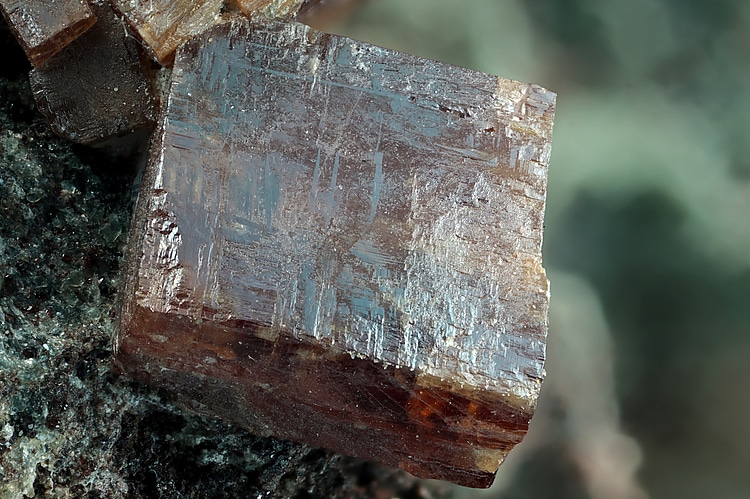
- It is a material that has the same crystal structure as the mineral calcium titanium oxide (CaTiO3), the first-discovered perovskite crystal.
- It is characterized by a three-dimensional arrangement of atoms.
- It has the general formula ABX3, where “A” and “B” represent cations (positively charged ions) and “X” represents anions (negatively charged ions).
- Discovery: The mineral was discovered in the Ural Mountains of Russia by Gustav Rose in 1839 and is named after Russian mineralogist Lev Perovski.
- Due to its compositional flexibility, scientists can design perovskite crystals to have a wide variety of physical, optical, and electrical characteristics from insulating, semiconducting, metallic, and superconducting characteristics.
- Optical Properties:
- They are known for their exceptional optical properties. They can efficiently absorb and emit light across a wide range of wavelengths, from visible to near-infrared.
- This property has made them a promising candidate for solar cells and light-emitting devices.
- Applications:
- It includes uses in sensors and catalyst electrodes, certain types of fuel cells, solar cells, lasers, memory devices and spintronics applications.
- Solar cells are currently the most prominent perovskite application, as synthetic perovskites are recognized as potential inexpensive base materials for high-efficiency commercial photovoltaics.
Q1) What is superconductivity?
Superconductivity is a phenomenon in physics in which certain materials, when cooled to extremely low temperatures, exhibit zero electrical resistance and the expulsion of magnetic fields. This remarkable behavior allows electric current to flow through these materials with no energy loss, making them highly efficient conductors of electricity.
Source: Solar panel breakthrough could supercharge ‘miracle material’ production


 Last updated on Oct, 2026
→ UPSC 2027 Notification will be released on 13 January 2027 at upsconline.nic.in.
→ Check Nobel Prize 2026 Winners List here.
→ Download PIB PRiSM Monthly Magazine 2026 here.
→ Check UPSC Monthly Current Affairs Magazine The Recitals here.
→ Check out the latest UPSC Syllabus here.
→ Download UPSC Model Answers for Mains 2026
→ UPSC Mains Question Paper 2026 is out now for Essay & GS Paper 1, 2, 3 & 4.
→ UPSC Calendar 2027 has been released.
→ Enroll in Vajiram & Ravi’s UPSC Mains Test Series 2027 for structured answer writing practice, expert evaluation, and exam-oriented feedback.
→ Join Vajiram & Ravi’s UPSC Mentorship Program 2027 for personalized guidance, strategy planning, and one-to-one support from experienced mentors.
→ Go through the UPSC Mains Previous Year Papers to enhance your preparation.
→ UPSC has released UPSC Toppers List 2025 with the Civil Services final result on its official website.
→ Also check Best UPSC Coaching in India