Plurilateral Trade Agreements Latest News
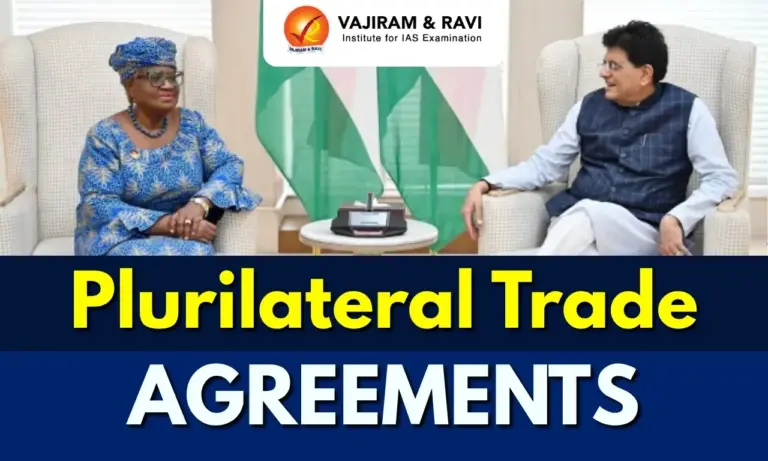
- India has consistently opposed plurilateral trade agreements at the World Trade Organisation (WTO), insisting that trade rules be negotiated by all members.
- But the 2026 BRICS New Delhi Declaration, issued under India’s chairship, says members recognise the importance of identifying “pathways” for plurilateral initiatives to enter the WTO legal framework.
- This comes just months after India blocked such pacts at the WTO’s 14th Ministerial Conference (MC14) in Cameroon in March 2026.
What Plurilateral Agreements Are
- A plurilateral agreement is a trade deal among a group of WTO members rather than the full membership.
- Key features:
- Countries that join must follow its rules; non-members are generally not bound.
- Under the Marrakesh Agreement, a plurilateral pact can be added to the WTO rulebook (Annex 4) only by consensus of all members.
- A multilateral agreement, by contrast, involves the entire WTO membership negotiating rules together.


Why India Opposes Plurilaterals
- India’s objections are systemic rather than issue-specific:
- Plurilaterals could let a group of powerful or interested countries create new rules without everyone’s participation, which is especially risky for developing countries.
- WTO members should first agree on common safeguards, or “guardrails”, for all plurilateral agreements before any single one is added to the rulebook.
- Adding one agreement first and deciding broader rules later sets a dangerous precedent.
The Investment Facilitation for Development Agreement
- The clearest test case is the China-backed Investment Facilitation for Development (IFD) agreement, launched by the WTO in 2017 to enhance FDI flows.
- At MC14, India blocked its inclusion as an Annex 4 agreement, arguing that:
- Incorporating IFD risks eroding the WTO’s foundational principles and functional limits.
- Investment is not a core trade issue.
- Members must first agree on legal safeguards for plurilaterals.
- As many as 129 members support IFD, leaving India as the primary holdout.
India’s Objection to the E-Commerce Agreement
- India has also questioned the Western-backed Agreement on Electronic Commerce (ECA).
- ECA is the world’s first baseline set of global digital trade rules, designed to streamline and secure cross-border digital transactions among participating WTO members.
- In a recent letter to the WTO, India challenged the legal basis for the Director-General acting as depositary of the ECA.
- India pointed out that consensus to add the agreement to Annex 4 was not reached on two occasions and asked on what institutional basis the “interim arrangements” were operating.
- According to the WTO Secretariat, 66 members covering about 70 per cent of global trade have adopted a pathway to bring the ECA into force through interim arrangements.
Pressure on India at the Trade Policy Review
- Several countries targeted India’s stance during its trade policy review last month:
- Canada most prominently opposed India’s position on plurilaterals.
- The EU noted that India has benefited significantly from global trade integration and urged it to see plurilaterals as an opportunity to shape the WTO agenda rather than a threat to multilateralism.
- Gambia and Costa Rica asked India to withdraw its opposition to IFD.
- Others urged India to join plurilaterals on fossil fuel subsidy reform, plastics pollution and environmentally sustainable plastics trade.
What the BRICS Declaration Says
- The New Delhi Declaration commits BRICS members to implementing MC14 outcomes, engaging constructively in WTO reform, and identifying appropriate pathways for plurilateral initiatives into the WTO legal framework, including on development-oriented issues, while exploring forward-looking rules.
- Notably, the term “guardrails” is absent from the declaration despite India holding the chair.
- Experts warn that plurilaterals cannot work for development issues: if developed countries do not join a plurilateral on food security or farm subsidy reduction, the outcome will be meaningless. Such issues must remain multilateral.
- The declaration also:
- Strongly advocates immediate restoration of a fully functioning, two-tier binding WTO dispute settlement mechanism and appointment of Appellate Body members without delay.
- Supports Ethiopia and Iran’s bid for WTO accession.
- Acknowledges China’s expansion of zero-tariff treatment to 53 African countries.
Why It Matters for India
- The direct implication could be India lifting its reservation on IFD, a significant policy shift.
- Two sectors are particularly relevant:
- Services: India has a huge IT and business services industry. If new international services rules emerge, India needs a seat at the table.
- Digital trade: With over 60 members moving ahead on e-commerce rules through interim arrangements, staying out risks India being bound later by rules it did not shape.
Conclusion
- The BRICS declaration signals a subtle softening in India’s opposition to plurilaterals, driven by mounting international pressure and the risk of isolation.
- Yet the missing “guardrails” language and the systemic concerns about IFD and e-commerce remain unresolved.
- India must balance openness to shaping new trade rules against protecting the consensus-based multilateralism that safeguards developing countries.

 Last updated on Oct, 2026
→ UPSC 2027 Notification will be released on 13 January 2027 at upsconline.nic.in.
→ Asian Games 2026 are being held in Aichi-Nagoya, Japan, from 19 September to 4 October.
→ Check Nobel Prize 2026 Winners List here.
→ Download PIB PRiSM Monthly Magazine 2026 here.
→ Check UPSC Monthly Current Affairs Magazine The Recitals here.
→ Check out the latest UPSC Syllabus here.
→ Download UPSC Model Answers for Mains 2026
→ UPSC Mains Question Paper 2026 is out now for Essay & GS Paper 1, 2, 3 & 4.
→ UPSC Calendar 2027 has been released.
→ Enroll in Vajiram & Ravi’s UPSC Mains Test Series 2027 for structured answer writing practice, expert evaluation, and exam-oriented feedback.
→ Join Vajiram & Ravi’s UPSC Mentorship Program 2027 for personalized guidance, strategy planning, and one-to-one support from experienced mentors.
→ Go through the UPSC Mains Previous Year Papers to enhance your preparation.
→ UPSC has released UPSC Toppers List 2025 with the Civil Services final result on its official website.
→ Also check Best UPSC Coaching in India
Plurilateral Trade Agreements FAQs
Q1. What are plurilateral trade agreements?+
Q2. Why has India opposed plurilateral trade agreements? +
Q3. What does the BRICS declaration say about plurilateral trade agreements?+
Q4. Why is the Investment Facilitation for Development Agreement significant?+
Q5. What could the BRICS declaration mean for India?+
Tags: mains articles Plurilateral Trade Agreements upsc current affairs upsc mains current affairs