


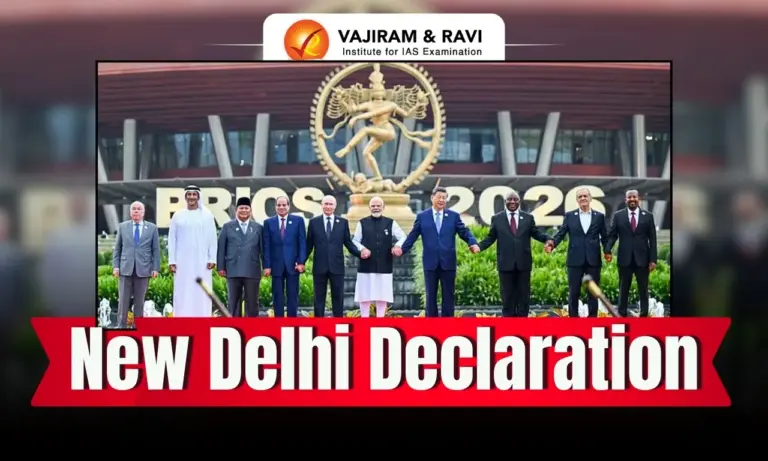
New Delhi Declaration Latest News
- BRICS members adopted the New Delhi Declaration at the 18th BRICS Summit after marathon negotiations, particularly over the language concerning the West Asia conflict.
- Consensus was significant as BRICS foreign ministers had failed to issue a joint statement in May amid differences between Iran and the UAE.
- India, as the host and chair, played a crucial diplomatic role in reconciling divergent positions and ensuring that geopolitical disagreements did not derail the summit outcome.
West Asia
- Consensus without attribution: Rather than assigning responsibility for the conflict, BRICS adopted broader language acceptable to competing positions within the grouping. The declaration calls for –
- Maximum restraint and avoidance of actions that aggravate the conflict.
- Dialogue and diplomacy for a durable peace.
- Respect for sovereignty and territorial integrity of states.
- Protection of civilians and civilian infrastructure.
- Continuity of trade, supply chains and energy flows.
- Nuclear security and safeguards: BRICS also expressed serious concern over attacks on civilian infrastructure and peaceful nuclear facilities under IAEA safeguards, and stressed the need for nuclear safety even during armed conflicts.
- Gaza and Palestine: BRICS called for –
- Maintenance of the ceasefire and unhindered humanitarian access.
- Opposition to forced displacement of Palestinians.
- Protection of civilians and civilian infrastructure.
- Opposition to starvation as a method of warfare.
- Support for UNRWA (United Nations Relief and Works Agency for Palestine Refugees in the Near East).
- A two-state solution, with a Palestinian state based on the 1967 borders and East Jerusalem as its capital.
- Palestinian self-determination, right of return and full UN membership.
- Lebanon: The declaration also called for adherence to the Lebanon ceasefire, Israeli withdrawal from remaining Lebanese territory and an inclusive political transition in Syria.


Terrorism – Significant Indian Diplomatic Gain
- BRICS strongly condemned terrorism in all its forms and manifestations and specifically condemned the April 2025 Pahalgam terrorist attack, in which 26 people were killed.
- It highlighted terror financing, safe havens, extremism and radicalisation among youth, international counter-terrorism cooperation, zero tolerance for terrorism, and rejection of double standards in countering terrorism.
- Terrorism should not be associated with any particular religion, nationality, civilisation or ethnic group. It also recognised the role of the BRICS Counter-Terrorism Working Group (CTWG).
- For India, explicit reference to cross-border terrorism is particularly important given the divergent positions among BRICS members on terrorism-related issues.
Trade – Opposition to Unilateral Protectionism
- Against the backdrop of rising tariffs and trade tensions, BRICS opposed unilateral coercive measures inconsistent with international law, the UN Charter and WTO principles.
- It called for a fair, stable and predictable trading environment conducive to sustainable development.
- The declaration also opposed unilateral carbon border adjustment mechanisms (CBAMs) where they are punitive, discriminatory or protectionist.
- This reflects a broader BRICS objective of reducing vulnerability to unilateral economic and financial measures and strengthening the voice of developing economies in global economic governance.
De-dollarisation – Practical Steps, No Common Currency
- BRICS did not announce a common BRICS currency. Instead, it adopted a gradual approach towards greater use of local currencies.
- Key priorities include:
- Interoperability of national payment systems.
- Faster, cheaper and safer cross-border payments.
- Greater use of local currencies for trade and investment.
- Technical work by the BRICS Payment Task Force.
- Expansion of local-currency financing by the New Development Bank (NDB).
- Continued work on a proposed New Investment Platform.
- Exploration of India’s proposed BRICS Risk Lab at GIFT City.
- Thus, the focus is on payment-system interoperability and financial diversification rather than an immediate common currency.
AI and Global South
- BRICS identified Artificial Intelligence (AI) as both an economic opportunity and a governance challenge for the Global South.
- It emphasised inclusive access to AI resources, safety and security, reliability and energy efficiency, trustworthy and inclusive AI, and greater participation of developing countries in global AI governance.
- The grouping also welcomed India’s hosting of the AI Impact Summit in February 2026.
Indian Imprint on the Declaration
- Digital Public Infrastructure (DPI): A proposed BRICS repository for DPI and pilot projects could facilitate sharing of India’s DPI experience with partner countries.
- Health: The declaration supports a BRICS Training Hub Network and Centres of Excellence on mental well-being, with NIMHANS, Bengaluru, serving as the coordinating centre.
- Industry 4.0: An India Centre for BRICS Industrial Competencies will support manufacturing firms and small businesses in adopting Industry 4.0 and advanced digital technologies.
- Development cooperation: Other initiatives include –
- BRICS Task Force on Growth and Development.
- BRICS–New Development Bank Knowledge Portal.
- Cooperation on infrastructure and public-private partnerships.
- Strengthening the BRICS insurance ecosystem.
Conclusion
- The New Delhi Declaration demonstrates BRICS‘ attempt to function as a platform for Global South cooperation amid geopolitical fragmentation.
- For India, the summit strengthened its image as a bridge-builder among competing geopolitical interests, while advancing priorities such as counter-terrorism, DPI, local-currency payments, and development cooperation.
- The summit highlights BRICS’ aspiration to reshape a more representative, multipolar global order. Its effectiveness will depend on converting broad political declarations into interoperable institutions, financial mechanisms and sustained cooperation.

 Last updated on Oct, 2026
→ UPSC 2027 Notification will be released on 13 January 2027 at upsconline.nic.in.
→ Check Nobel Prize 2026 Winners List here.
→ Download PIB PRiSM Monthly Magazine 2026 here.
→ Check UPSC Monthly Current Affairs Magazine The Recitals here.
→ Check out the latest UPSC Syllabus here.
→ Download UPSC Model Answers for Mains 2026
→ UPSC Mains Question Paper 2026 is out now for Essay & GS Paper 1, 2, 3 & 4.
→ UPSC Calendar 2027 has been released.
→ Enroll in Vajiram & Ravi’s UPSC Mains Test Series 2027 for structured answer writing practice, expert evaluation, and exam-oriented feedback.
→ Join Vajiram & Ravi’s UPSC Mentorship Program 2027 for personalized guidance, strategy planning, and one-to-one support from experienced mentors.
→ Go through the UPSC Mains Previous Year Papers to enhance your preparation.
→ UPSC has released UPSC Toppers List 2025 with the Civil Services final result on its official website.
→ Also check Best UPSC Coaching in India
New Delhi Declaration FAQs
Q1. What is the significance of the New Delhi Declaration for BRICS?+
Q2. How does the New Delhi Declaration advance India’s concerns regarding terrorism?+
Q3. What approach has BRICS adopted towards de-dollarisation?+
Q4. How can BRICS contribute to shaping global AI governance?+
Q5. How did India’s BRICS chairmanship contribute to the New Delhi Declaration? +
Tags: mains articles new delhi declaration upsc current affairs upsc mains current affairs








