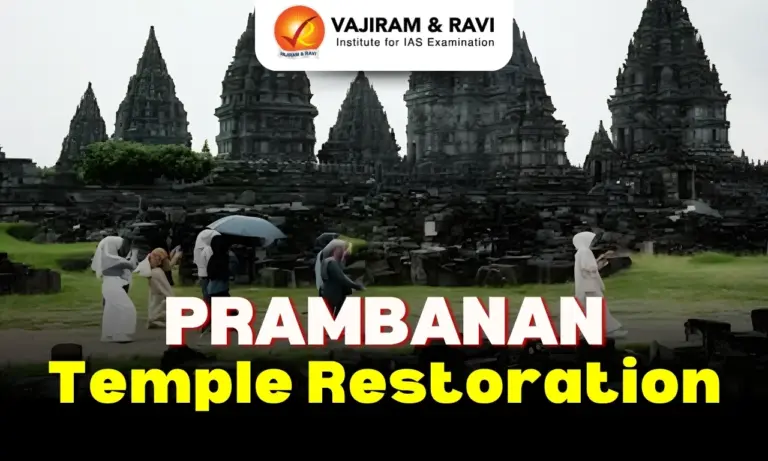
Prambanan Temple Restoration Latest News
- During his three-day visit to Indonesia, PM Modi announced that India will help restore the iconic Prambanan Temple in Yogyakarta, calling it a symbol of shared cultural heritage between the two nations.
- During his recent trip to Indonesia, PM Modi visited the temple along with Indonesian President Prabowo Subianto, and jointly launched the India-supported conservation project.
- This came amid a broader visit in which over 20 agreements were signed covering defence, maritime cooperation, critical minerals, technology, digital payments, and education.
Origins: A Hindu Temple Born from Dynastic Rivalry
- Prambanan’s history is rooted in the political and religious contest between two Javanese dynasties.
- The Sanjaya dynasty, associated with the revival of Shaivite Hinduism, ruled the Mataram Kingdom in Central Java during the 8th and 9th centuries.
- Its authority was challenged by the Sailendra dynasty, a powerful Buddhist royal house under which Javanese art and architecture flourished.
- Following the reign of Sailendra ruler Samaratungga, Rakai Pikatan of the Sanjaya dynasty married Samaratungga’s daughter and ruled between 842-856 CE.
- He is credited with commissioning Prambanan as a grand Hindu sanctuary, marking the Sanjaya dynasty’s return to power after nearly a century of Buddhist dominance.
- Inscriptions record the temple’s consecration in 856 CE.


Architecture and Design
- Prambanan, built in the 9th century, is Indonesia’s largest Hindu temple complex, located near the Buddhist Borobudur temple.
- Rather than a single structure, it is a complex built across the reigns of two kings, Rakai Pikatan and Rakai Balitung, originally comprising 240 large and small temples dedicated to Shiva, Vishnu, and Brahma.
- The complex follows a design of three concentric squares, with the innermost square housing 16 temples.
- The most significant is the 47-metre central Shiva temple, flanked by the Brahma temple to the north and the Vishnu temple to the south.
- The Shiva temple’s interior has four chambers: the main eastern chamber houses a Shiva statue, while the other three house statues of Durga (his wife, also called Loro Jonggrang locally), Agastya (his teacher), and Ganesh (his son).
- The complex’s walls are carved with scenes from the Ramayana.
Decline and Rediscovery
- Around 929-930 CE, the Mataram Kingdom’s political centre shifted to East Java, a move linked to both the eruption of Mount Merapi and political-economic factors.
- As Central Java was abandoned, Prambanan fell into disuse and was gradually buried under vegetation and volcanic debris.
- Its rediscovery by outsiders is debated. A 15th-century Javanese court poet may have described the ruins in his writings.
- Later, Dutch East India Company official C.A. Lons documented the ruins during a visit in 1733.
- Thomas Stamford Raffles, Lieutenant-Governor of Java during the British interregnum (1811-16), took a keen interest in cataloguing Central Java’s monuments in the 19th century.
- Restoration efforts, begun in 1918, were repeatedly interrupted by the Second World War and Indonesia’s independence struggle, with the main temple’s reconstruction finally completed in 1953 and inaugurated by Indonesia’s first president, Soekarno.
A Symbol of Religious Harmony
- Prambanan reflects the coexistence of Hinduism and Buddhism in ancient Java.
- The marriage between the Hindu ruler Rakai Pikatan and a Buddhist princess is seen as symbolic of this harmony, echoed architecturally in a Buddhist stupa-like element atop the temple’s superstructure.
- Several Buddhist temples, including Candi Sewu, Bubrah, and Lumbung, were built in the same era around Prambanan, reinforcing this shared religious landscape.
- In modern Indonesian usage, the word “candi” refers to any ancient Hindu or Buddhist shrine.
Heritage Recognition
- The Prambanan Temple Compounds were inscribed on the UNESCO World Heritage List in 1991, recognised for their remarkable cultural value and architecture.
- The site was further designated a National Cultural Property in 1998, with a national law in 2010 supporting its protection and conservation.
- Today, Prambanan remains both a popular tourist destination and an active place of Hindu worship, with the Ramayana ballet performed at an open-air theatre on full moon evenings from May to October.
India’s Role in Restoration
- New Delhi’s assistance for Prambanan’s conservation will be carried out by the Archaeological Survey of India (ASI).
- An ASI team surveyed the site in March 2026 and determined that restoration would use the anastylosis technique, reassembling structures using original stones found on location.
Part of a Broader Pattern: India’s Heritage Diplomacy
- The Prambanan initiative fits into India’s sustained strategy of restoring shared cultural heritage across Asia:
- Vietnam (2014): MoU to restore the UNESCO-listed Mỹ Sơn Sanctuary, a Shaivite temple complex built between the 4th and 13th centuries as the religious hub of the Champa kingdom.
- Myanmar (2017): MoU to restore monuments in the Bagan Archaeological Zone damaged by the 2016 earthquake.
- Cambodia: Major Indian role in conserving the Angkor Wat complex.
- Laos (2024): India completed restoration of the 1,000-year-old Vat Phou Temple, dedicated to Lord Shiva.
- Sri Lanka and Bangladesh: Additional conservation projects undertaken by the Indian govt.
Conclusion
- The Prambanan restoration exemplifies India’s use of shared civilisational heritage as a tool of soft power and diplomacy.
- Beyond preserving a UNESCO site, it strengthens India-Indonesia ties and reflects New Delhi’s consistent strategy of leveraging cultural connect across South and Southeast Asia to build lasting regional partnerships.

 Last updated on Oct, 2026
→ UPSC 2027 Notification will be released on 13 January 2027 at upsconline.nic.in.
→ Check Nobel Prize 2026 Winners List here.
→ Download PIB PRiSM Monthly Magazine 2026 here.
→ Check UPSC Monthly Current Affairs Magazine The Recitals here.
→ Check out the latest UPSC Syllabus here.
→ Download UPSC Model Answers for Mains 2026
→ UPSC Mains Question Paper 2026 is out now for Essay & GS Paper 1, 2, 3 & 4.
→ UPSC Calendar 2027 has been released.
→ Enroll in Vajiram & Ravi’s UPSC Mains Test Series 2027 for structured answer writing practice, expert evaluation, and exam-oriented feedback.
→ Join Vajiram & Ravi’s UPSC Mentorship Program 2027 for personalized guidance, strategy planning, and one-to-one support from experienced mentors.
→ Go through the UPSC Mains Previous Year Papers to enhance your preparation.
→ UPSC has released UPSC Toppers List 2025 with the Civil Services final result on its official website.
→ Also check Best UPSC Coaching in India
Prambanan Temple Restoration FAQs
Q1. Why is the Prambanan Temple Restoration significant for India?+
Q2. What restoration technique will be used in the Prambanan Temple Restoration project?+
Q3. How does the Prambanan Temple Restoration reflect India's soft power strategy?+
Q4. Why is the Prambanan Temple Restoration important from a heritage perspective?+
Q5. How does the Prambanan Temple Restoration fit into India's broader heritage diplomacy?+
Tags: mains articles Prambanan Temple Restoration upsc current affairs upsc mains current affairs