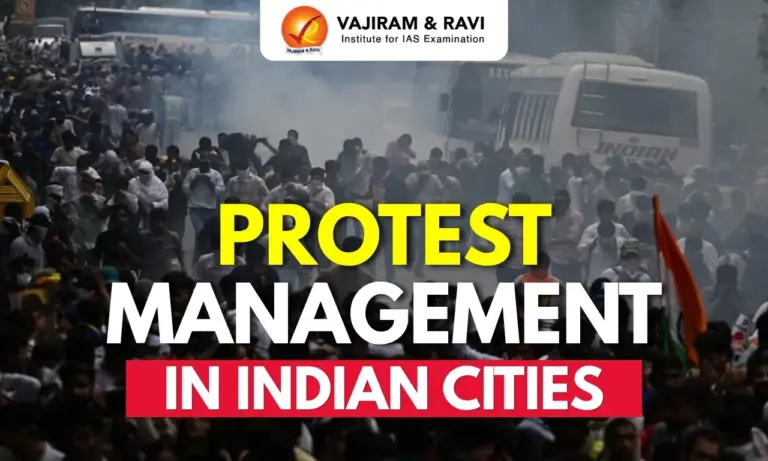
Protest management in Indian cities requires balancing the fundamental right to peaceful assembly with public order, traffic management and public safety. In Delhi, processions increased from 1,672 in January–August 2025 to 1,908 during the same period in 2026. This highlights the need for effective crowd management that facilitates democratic dissent while protecting commuters, residents and essential services.
Constitutional Provisions: The Right to Protest and Its Limits
The Constitution protects peaceful protest through fundamental rights, while allowing reasonable restrictions to maintain public order.
- Article 19(1)(a): Protects freedom of speech and expression, including criticism of government policies.
- Article 19(1)(b): Guarantees the right to assemble peaceably and without arms.
- Article 19(2): Permits reasonable restrictions on freedom of speech and expression on specified grounds, including public order.
- Article 19(3): Permits reasonable restrictions on peaceful assembly in the interests of the sovereignty and integrity of India and public order.
The State must maintain public order without arbitrarily suppressing peaceful dissent. At the same time, the right to protest does not confer an unrestricted right to occupy every public space or obstruct essential services indefinitely.
Supreme Court Judgments on Protest Management
The Supreme Court has clarified how authorities should balance peaceful assembly, public order and the rights of other citizens.
- Mazdoor Kisan Shakti Sangathan v. Union of India (2018): The Court addressed protests at Jantar Mantar and stressed balancing the right to peaceful assembly with the rights of residents and other users of public spaces. It called for regulation rather than a blanket prohibition on protests.
- Anita Thakur v. Government of Jammu and Kashmir (2016): The Court examined police action against participants in a protest march, highlighting the need for accountability in the use of force.


Legal Provisions Governing Public Protests
Authorities can regulate public gatherings to prevent disorder, but their actions must have a lawful basis and be justified by the circumstances.
- Section 163 of the Bharatiya Nagarik Suraksha Sanhita (BNSS), 2023: Empowers an Executive Magistrate to issue preventive orders in urgent cases involving apprehended danger or similar circumstances. Such orders may restrict specified activities or assemblies within a defined area and period.
- Permission for demonstrations: In Delhi, organisers seeking to hold demonstrations at Jantar Mantar must follow the applicable police permission procedure. Authorities assess expected attendance, traffic impact and security requirements before deciding on the request.
Preventive powers should address genuine risks and should not become a blanket ban on peaceful dissent.
Major Challenges in Managing Urban Protests
Managing protests in densely populated cities is difficult because public demonstrations can affect both public safety and the daily lives of people who are not participating.
- Traffic congestion and emergency access: Processions and road blockades can disrupt public transport, delay commuters and obstruct ambulances or fire services.
- Crowd safety: Unexpected increases in attendance, narrow exits and counter-protests can lead to overcrowding, stampedes and clashes.
- Excessive restrictions: Arbitrary prohibitory orders, unnecessary detentions or disproportionate force can undermine fundamental rights and public trust.
- Competing public interests: Protesters need a meaningful opportunity to express grievances, while residents and other citizens have legitimate interests in mobility, safety and access to their homes.
- Unplanned mobilisation: Rapid mobilisation through social media can make attendance difficult to estimate, complicating police deployment and traffic planning.
Way Forward: A Rights-Based Approach
Effective protest management requires advance planning, coordination among public agencies and respect for constitutional freedoms.
- Accessible protest venues: Provide adequate space and essential facilities without unnecessarily isolating demonstrations from decision-makers.
- Transparent permission procedures: Establish clear requirements and timelines, explain refusals and provide appropriate avenues for review.
- Advance traffic planning: Announce diversions, maintain emergency corridors and coordinate with transport operators and municipal authorities.
- Dialogue and de-escalation: Engage organisers to address route changes, overcrowding and emerging tensions before they escalate.
- Proportionate policing: Prioritise negotiation and use force only when necessary and proportionate to the circumstances.
- Accountability: Document police action, investigate credible complaints and provide remedies for unlawful detention or excessive force.
- Inter-agency coordination: Coordinate police, traffic authorities, municipal bodies and emergency services to ensure public safety.
The objective should be to facilitate peaceful protest while preventing violence and avoidable disruption, rather than treating every demonstration as a law-and-order threat.

 Last updated on Oct, 2026
→ UPSC 2027 Notification will be released on 13 January 2027 at upsconline.nic.in.
→ Check Nobel Prize 2026 Winners List here.
→ Download PIB PRiSM Monthly Magazine 2026 here.
→ Check UPSC Monthly Current Affairs Magazine The Recitals here.
→ Check out the latest UPSC Syllabus here.
→ Download UPSC Model Answers for Mains 2026
→ UPSC Mains Question Paper 2026 is out now for Essay & GS Paper 1, 2, 3 & 4.
→ UPSC Calendar 2027 has been released.
→ Enroll in Vajiram & Ravi’s UPSC Mains Test Series 2027 for structured answer writing practice, expert evaluation, and exam-oriented feedback.
→ Join Vajiram & Ravi’s UPSC Mentorship Program 2027 for personalized guidance, strategy planning, and one-to-one support from experienced mentors.
→ Go through the UPSC Mains Previous Year Papers to enhance your preparation.
→ UPSC has released UPSC Toppers List 2025 with the Civil Services final result on its official website.
→ Also check Best UPSC Coaching in India
Protest Management in Indian Cities FAQs
Q1. What is protest management in Indian cities?+
Q2. Which constitutional Articles protect the right to protest in India?+
Q3. How does Section 163 of the BNSS, 2023, regulate protests?+
Q4. Which Supreme Court judgment deals with protest management in India?+
Q5. How can protest management in Indian cities be improved?+
Tags: protest management in indian protest management in indian cities