


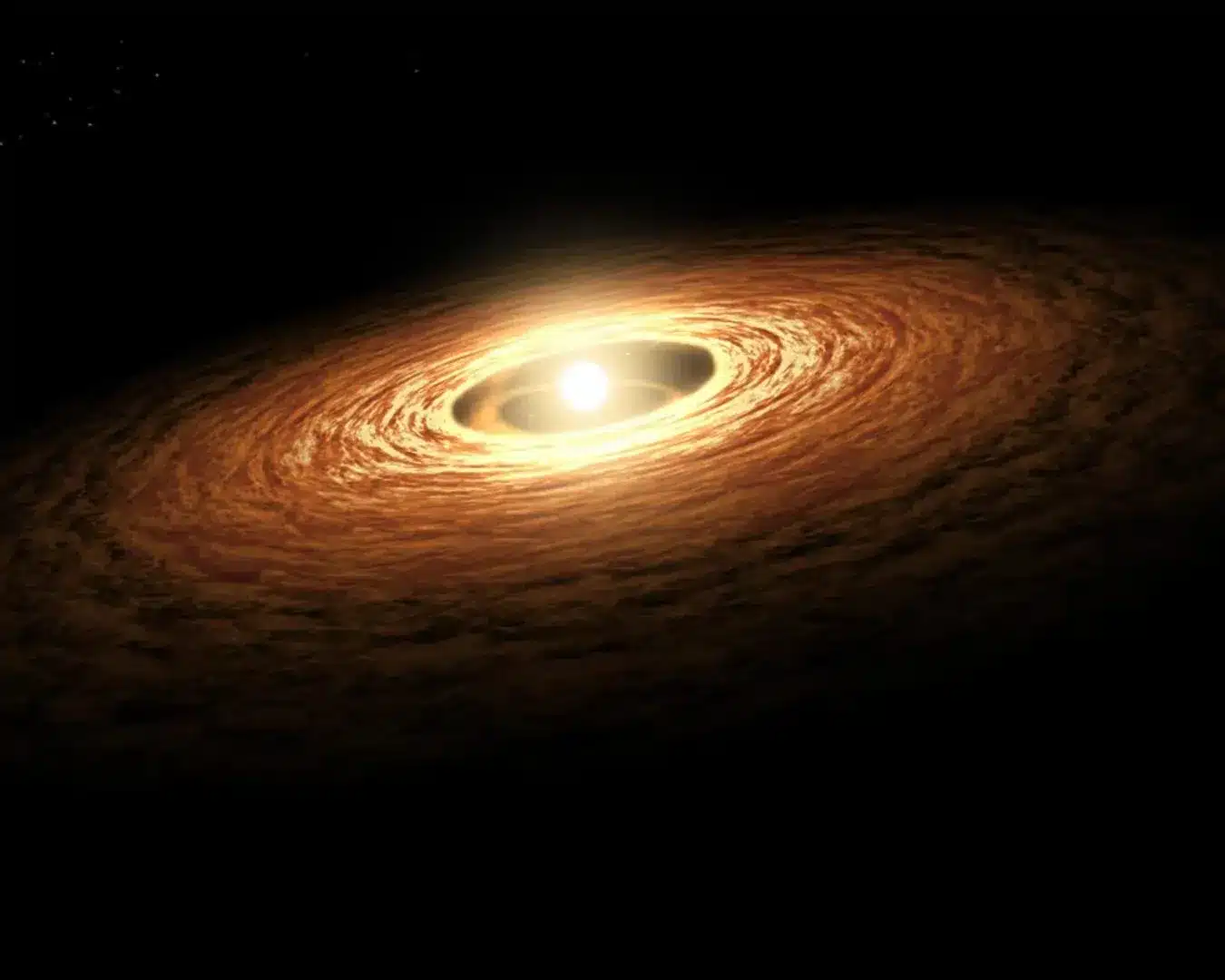
About Protoplanetary Disk
- A protoplanetary disk is a disk of gas (99% by mass) and dust (1%), orbiting a newly formed star, from which planets may eventually form or be in the process of forming.
- Disks are common by-products of star formation, and range in mass from 0.001 to 0.3 Solar masses (1027–1029 kg) and in size from several tens to almost 1,000 Astronomical Units (1012–1014 m).
- How are they formed?
- Stars form from cold interstellar molecular clouds. A molecular cloud is an interstellar cloud of gas and dust in which molecules can form, the most common of which is hydrogen (H2).
- As they collapse into protostars under the force of gravity, the remaining matter forms a spinning disk.
- Eventually, the star stops accreting matter, leaving the disk in orbit around it.
- The leftover gas and dust inside that protoplanetary disk become the ingredients for planet formation.
- Organic molecules present in the original molecular cloud become part of the protoplanetary disk and the planets that form from it.
- The chemical composition of the protoplanetary disk determines the composition of the eventual planets that form from it.
- Protoplanetary disks typically disperse after 2–3 million years through the coalescence of their matter into planets and photoevaporation by the stellar radiation.
Q1) What is the James Webb Space Telescope (JWST)?
JWST was built in collaboration between NASA, the European Space Agency (ESA), and the Canadian Space Agency. It was launched in December 2021. It is the largest and most powerful space telescope to date. It orbits around a point in space called the L2 Lagrange point (a gravitationally stable location in space). It is approximately 1.5 million km beyond Earth’s orbit and is one of the five points in the orbital plane of the Earth-Sun system. It will focus on four main areas: the first light in the universe, the assembly of galaxies in the early universe, the birth of stars and protoplanetary systems, andplanets (including the origins of life).


 Last updated on Oct, 2026
→ UPSC 2027 Notification will be released on 13 January 2027 at upsconline.nic.in.
→ Check Nobel Prize 2026 Winners List here.
→ Download PIB PRiSM Monthly Magazine 2026 here.
→ Check UPSC Monthly Current Affairs Magazine The Recitals here.
→ Check out the latest UPSC Syllabus here.
→ Download UPSC Model Answers for Mains 2026
→ UPSC Mains Question Paper 2026 is out now for Essay & GS Paper 1, 2, 3 & 4.
→ UPSC Calendar 2027 has been released.
→ Enroll in Vajiram & Ravi’s UPSC Mains Test Series 2027 for structured answer writing practice, expert evaluation, and exam-oriented feedback.
→ Join Vajiram & Ravi’s UPSC Mentorship Program 2027 for personalized guidance, strategy planning, and one-to-one support from experienced mentors.
→ Go through the UPSC Mains Previous Year Papers to enhance your preparation.
→ UPSC has released UPSC Toppers List 2025 with the Civil Services final result on its official website.
→ Also check Best UPSC Coaching in India








