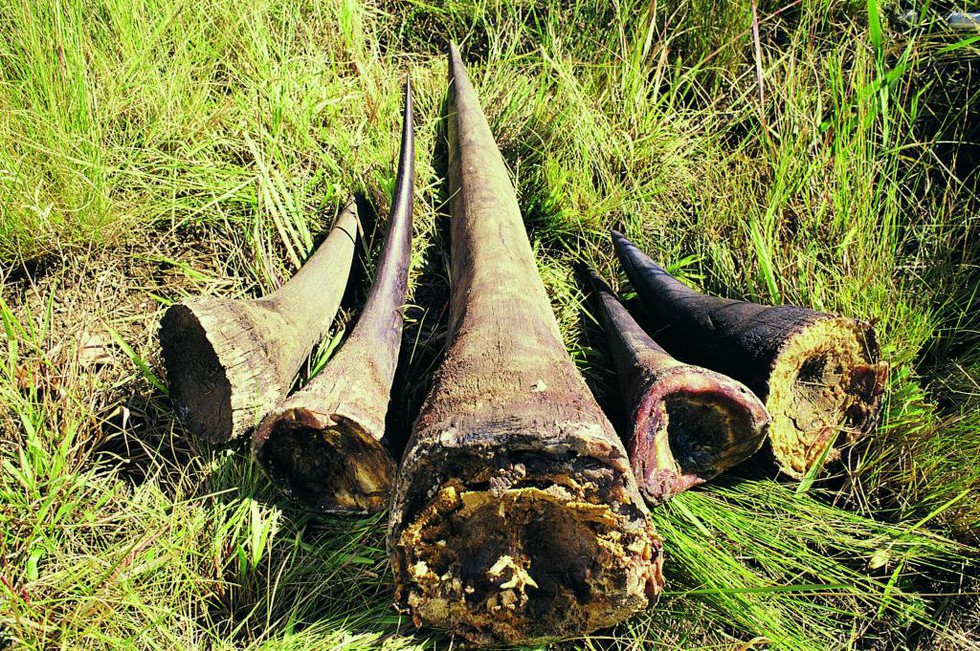
About Rhino Horns:
- A comprehensive analysis titled ‘Executive Summary of the Rhino Horn Trafficking as a Form of Transnational Organised Crime (2012-2021): 2022 Global Threat Assessment’, was presented at the meeting of the Conference of Parties organised by the Convention on International Trade in Endangered Species of Wild Fauna and Flora (CITES).
- Supported by the World Wide Fund for Nature, the Wildlife Justice Commission (WJC) prepared the document on the rhino horn trafficking during the decade from January 1, 2012, to December 31, 2021.
- The threat assessment was compiled from the analysis of 674 rhino horn seizure incidents that had occurred globally during this decade, in addition to seven years of criminal intelligence and findings from the WJC investigations into the rhino horn trafficking, conducted since 2015.
- The report said six countries and territories have dominated the rhino horn trafficking routes from the source to the destination locations although more than 50 countries and territories were implicated in the transnational crime.
- These countries were South Africa, Mozambique, Malaysia, Hong Kong Special Administrative Region, Vietnam, and China.
- Prolific Vietnamese and Chinese criminal networks are driving the racket throughout the supply chain.
- Vietnam is a highly significant transit and distribution area for products ultimately bound for China.
The Greater One-horned Rhinoceros:
- The greater one-horned rhino (or “Indian rhino”) is the largest of the rhino species
- It is identified by a single black horn and a grey-brown hide with skin folds.
- This species of rhino is commonly found in Nepal, Bhutan, Pakistan and in Assam, India.
- Protection Status:
- IUCN Red List: Vulnerable
- CITES: Appendix I
- Wildlife Protection Act, 1972: Schedule I
It is one of the five species of Rhinos. The other four species are:
- White rhino: It is native to northern and southern Africa
- Black rhino: It is native to eastern and southern Africa
- Javan rhino: It is also known as Sunda rhino or lesser one-horned rhino
- Sumatran rhino: Critically Endangered species of rhino
Source : The Hindu


 Last updated on Oct, 2026
→ UPSC 2027 Notification will be released on 13 January 2027 at upsconline.nic.in.
→ Check Nobel Prize 2026 Winners List here.
→ Download PIB PRiSM Monthly Magazine 2026 here.
→ Check UPSC Monthly Current Affairs Magazine The Recitals here.
→ Check out the latest UPSC Syllabus here.
→ Download UPSC Model Answers for Mains 2026
→ UPSC Mains Question Paper 2026 is out now for Essay & GS Paper 1, 2, 3 & 4.
→ UPSC Calendar 2027 has been released.
→ Enroll in Vajiram & Ravi’s UPSC Mains Test Series 2027 for structured answer writing practice, expert evaluation, and exam-oriented feedback.
→ Join Vajiram & Ravi’s UPSC Mentorship Program 2027 for personalized guidance, strategy planning, and one-to-one support from experienced mentors.
→ Go through the UPSC Mains Previous Year Papers to enhance your preparation.
→ UPSC has released UPSC Toppers List 2025 with the Civil Services final result on its official website.
→ Also check Best UPSC Coaching in India