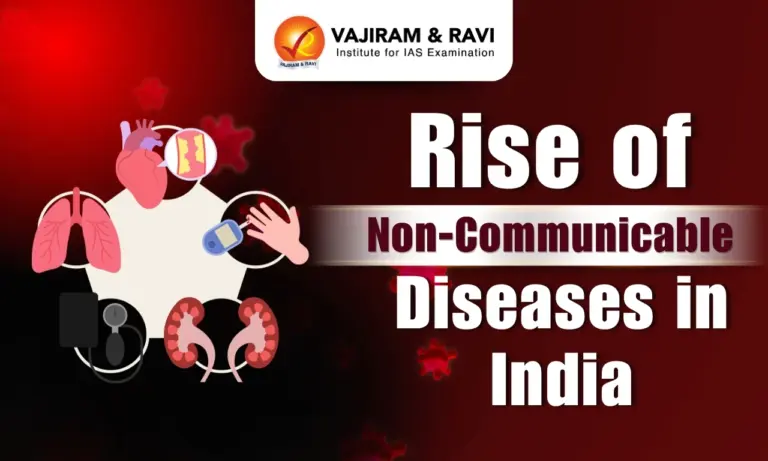
The Sample Registration System (SRS) Statistical Report 2024 highlights a major shift in India’s mortality pattern. Non-Communicable Diseases (NCDs) accounted for 60% of all deaths during 2022–2024, rising from 52.8% in 2015–2017. This sharp increase of 7.3 percentage points signals a decisive epidemiological transition where chronic diseases have overtaken infectious diseases as the leading cause of death in India.
About Non-Communicable Diseases (NCDs)
- Non-Communicable Diseases are chronic, non-infectious conditions that develop slowly and persist over long durations.
- They are not transmitted from person to person and arise due to a combination of genetic, physiological, environmental, and behavioural factors.
- The major NCDs include cardiovascular diseases, cancers, chronic respiratory diseases, and diabetes.
- These conditions are strongly associated with lifestyle risks such as unhealthy diets, physical inactivity, tobacco use, alcohol consumption, and chronic stress.
- The World Health Organization (WHO) identifies tobacco use, unhealthy diet, physical inactivity, and harmful use of alcohol as the four key behavioural drivers of the global NCD burden.
Rising Burden of NCDs in India
India is witnessing a steady rise in the burden of NCDs, which now account for 60% of total deaths. This reflects a clear structural shift in the country’s disease profile over the last decade.
- Among NCDs, cardiovascular diseases are the leading cause of death, accounting for 32.1% of total deaths in 2022–2024 compared to 27.1% earlier.
- The burden of cardiovascular diseases is higher in the 30–69 age group, where they account for 37.3% of deaths, indicating rising premature mortality among working-age individuals.
- Other important causes of death include cancers, respiratory diseases, digestive diseases, and respiratory infections, each accounting for more than 5% of total deaths in India during 2022–2024.


Other Key Findings of SRS 2024
- Double Burden of Disease: While NCDs are rising rapidly, the combined share of communicable diseases, maternal, perinatal, and nutritional conditions has declined only marginally from 22% to 19.7%, indicating that infectious diseases still persist alongside chronic illnesses.
- Youth Mortality: Among the 15–29 age group, suicide has emerged as the leading cause of death, increasing to 19% from 16.3%.
- Rural-Urban and Gender Divide: The burden of NCDs is higher in urban areas at 64.8% compared to 58.8% in rural areas, and slightly higher among men at 62.3% compared to 56.9% among women. However, the increasing trend across rural areas and women shows that NCDs are becoming widespread across all sections of society.
- Regional Disparities: In Empowered Action Group (EAG) states and Assam, NCDs account for 53.9% of deaths, while in other states the share rises to 63.5%, reflecting uneven stages of epidemiological transition across India.
Implications
The rising burden of NCDs has significant economic and demographic consequences for India.
- Rising premature mortality in the working-age population reduces productivity and economic output.
- Increased long-term treatment needs of NCDs raise healthcare costs and out-of-pocket expenditure.
- Financial stress on households increases, pushing vulnerable groups towards poverty.
- Growing NCD burden adds pressure on an already overburdened public healthcare system.
- Combined with declining fertility rates, it threatens India’s demographic dividend.
- Rising mental health issues and suicides among youth deepen socio-economic concerns.
Government Initiatives
To address the rising burden of Non-Communicable Diseases (NCDs) in India, the Government has implemented several preventive, promotive, and curative healthcare initiatives under national health programmes and flagship schemes.
- The National Programme for Prevention and Control of Non-Communicable Diseases (NP-NCD) focuses on screening, early detection, and management of major NCDs such as diabetes, hypertension, cardiovascular diseases, and cancer.
- Under Ayushman Bharat, Health and Wellness Centres (Ayushman Arogya Mandirs) strengthen primary healthcare by providing community-level screening and preventive services for NCDs.
- The Pradhan Mantri Jan Arogya Yojana (PM-JAY) offers financial protection for secondary and tertiary treatment, reducing the economic burden of high-cost NCD care.
- The National Mental Health Programme and the Mental Healthcare Act, 2017 aim to improve access to mental health services and address rising suicide cases among youth.
- Behavioural change and awareness initiatives such as the Fit India Movement and Eat Right India Campaign promote healthier lifestyles to reduce key NCD risk factors.
Challenges
Despite several government initiatives, India continues to face major structural, behavioural, and institutional challenges in tackling the rising burden of Non-Communicable Diseases (NCDs).
- India’s healthcare system remains largely curative-oriented rather than preventive and primary healthcare-focused, limiting effective long-term NCD management.
- Weak screening, early diagnosis, and surveillance mechanisms, especially in rural and EAG states, lead to delayed treatment and higher mortality.
- Rapid urbanisation, sedentary lifestyles, unhealthy diets, tobacco use, alcohol consumption, and air pollution are emerging as major lifestyle risk factors driving the NCD epidemic.
- Rising cases of mental health disorders and youth suicides highlight the inadequate reach of India’s mental healthcare infrastructure and counselling services.
- Persistent shortage of specialists, diagnostic facilities, trained healthcare workers, and health infrastructure affects accessibility and affordability of quality healthcare.
- Weak civil registration systems and cause-of-death data collection continue to hamper accurate assessment and evidence-based policy intervention.
Way Forward
India needs a comprehensive and preventive public health approach to effectively tackle the rising burden of Non-Communicable Diseases (NCDs).
- Strengthening primary healthcare systems through Ayushman Arogya Mandirs and expanding community-level screening can improve early detection and long-term disease management.
- Greater focus on preventive healthcare and behavioural change is needed through awareness campaigns promoting healthy diet, physical activity, yoga, and reduction in tobacco and alcohol consumption.
- Integrating mental healthcare services into primary healthcare, schools, colleges, and workplaces is essential to address rising stress, depression, and youth suicides.
- A multi-sectoral “Health in All Policies” approach involving education, urban planning, food regulation, environment, and employment policies is necessary to address lifestyle and social determinants of health.
- Special emphasis should be given to rural areas and EAG states by improving healthcare infrastructure, specialist availability, and diagnostic facilities.
- Strengthening health data systems, civil registration, and cause-of-death reporting will help in evidence-based policymaking and targeted interventions.

 Last updated on Oct, 2026
→ UPSC 2027 Notification will be released on 13 January 2027 at upsconline.nic.in.
→ Check Nobel Prize 2026 Winners List here.
→ Download PIB PRiSM Monthly Magazine 2026 here.
→ Check UPSC Monthly Current Affairs Magazine The Recitals here.
→ Check out the latest UPSC Syllabus here.
→ Download UPSC Model Answers for Mains 2026
→ UPSC Mains Question Paper 2026 is out now for Essay & GS Paper 1, 2, 3 & 4.
→ UPSC Calendar 2027 has been released.
→ Enroll in Vajiram & Ravi’s UPSC Mains Test Series 2027 for structured answer writing practice, expert evaluation, and exam-oriented feedback.
→ Join Vajiram & Ravi’s UPSC Mentorship Program 2027 for personalized guidance, strategy planning, and one-to-one support from experienced mentors.
→ Go through the UPSC Mains Previous Year Papers to enhance your preparation.
→ UPSC has released UPSC Toppers List 2025 with the Civil Services final result on its official website.
→ Also check Best UPSC Coaching in India
Rise of Non-Communicable Diseases in India FAQs
Q1. What are Non-Communicable Diseases (NCDs)?+
Q2. What does the SRS Statistical Report 2024 reveal about NCDs in India?+
Q3. Which is the leading cause of death among NCDs in India?+
Q4. What is meant by the “double burden of disease”?+
Q5. Why are rising NCDs a concern for India?+
Tags: rise of non communicable diseases in india