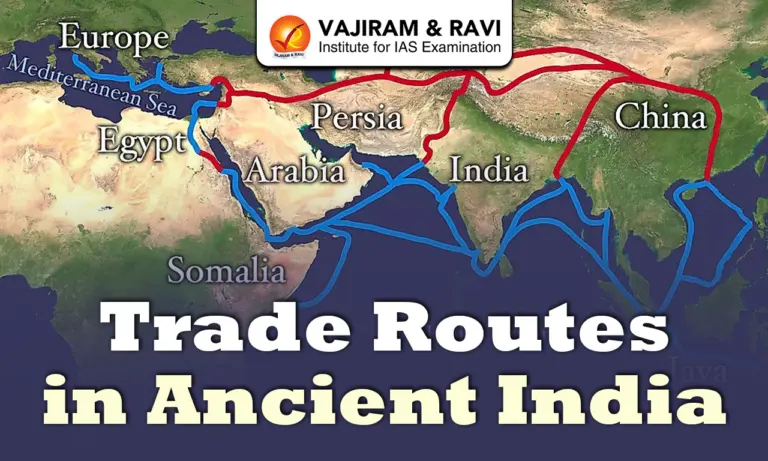
Trade Routes in Ancient India played an important role in connecting different regions of the subcontinent as well as distant parts of the world. These routes, both land and sea, helped in the exchange of goods, culture, ideas, and technology, contributing to economic growth and cultural development.
Trade Routes in Ancient India and Its Strategic Location
- Central geographical position: India was located between major regions like East Asia, Central Asia, the Middle East, and Europe. Because of this, it became a natural meeting point for traders moving between these areas, making it an important hub in early global trade networks.
- Access to both land and sea routes: India had the advantage of being connected through important land routes such as the Silk Road, as well as major sea routes across the Indian Ocean. This allowed traders to choose different paths depending on convenience, season, and type of goods.
- Long coastline and natural ports: The long coastline of India, along with the presence of natural harbours, supported the development of important ports. These ports became busy centers of trade where goods were imported, exported, and stored.
- Favorable monsoon winds: The discovery and use of monsoon winds made sea travel easier and more predictable. Traders could plan their journeys according to seasonal wind patterns, which helped in faster and safer trade across the Indian Ocean.
- Availability of valuable goods: India was rich in resources and produced highly demanded goods such as spices, cotton textiles, silk, precious stones, and metals. These products attracted traders from distant lands, increasing India’s importance in trade.
- Well-developed trade centers: Ancient India had many developed cities and market centers that supported trade activities. These places provided facilities like storage, security, and marketplaces, making trade more organized.
- Cultural openness and interaction: India was open to foreign traders, travelers, and scholars. This made it easier for people from different regions to come, trade, and exchange ideas, which further strengthened its position in trade networks.
- Link between major civilizations: India acted as a bridge connecting powerful civilizations such as China, Rome, Persia, and Southeast Asia. This connecting role made India a key part of international trade and cultural exchange.
Major Trade Routes in Ancient India
The major trade routes in ancient India can be broadly classified into inland routes, international land routes like the Silk Route, and maritime (sea) routes. Inland routes such as the Uttarapatha and Dakshinapatha connected different regions within the subcontinent, while the Silk Route linked India with Central Asia and beyond. At the same time, maritime routes connected Indian ports with distant regions like the Roman Empire, Arabia, and Southeast Asia. These routes are discussed in detail below.
Major Inland Routes
- Uttarapatha (The Northern Route)
- About: The Uttarapatha, also known as the Northern Route, was one of the most important and longest land trade routes in ancient India. It stretched for more than 2,000 km and acted as a major highway connecting different parts of the subcontinent with regions outside India.
- Route and key regions: This route began in the north-western region of Gandhara, around Purushapura (modern Peshawar) and Takshashila. From there, it passed through important cities like Delhi, Mathura, Prayag (Allahabad), Varanasi, and Pataliputra (Patna), and finally ended at the eastern port of Tamralipti in present-day West Bengal.
- Connection with other regions: A part of this route, known as the Himavatpatha (Himalayan route), connected India to the famous Silk Road. Through this, India maintained trade links with Central Asia, Turkey, and even Europe.
- Goods traded: The Uttarapatha was used for the exchange of many valuable goods. Horses from Central Asia and Arabia, silk, and lapis lazuli were brought into India. In return, Indian goods like spices, fine cotton textiles (especially muslin), pearls, ivory, and precious stones were sent to other regions.
- Economic significance: This route was very important for trade and wealth. Rulers who controlled parts of the Uttarapatha, especially during the Maurya and Kushana periods, collected taxes and tolls from traders, which increased their revenue and strengthened their kingdoms.
- Cultural and religious exchange: Apart from trade, the route also helped in the spread of ideas and culture. Buddhist monks and travelers used this route to move across regions, which played a major role in spreading Buddhism to Central Asia and beyond.
- Legacy and continuity: The importance of the Uttarapatha continued even after ancient times. Its path later became the base for the Sadak-e-Azam built by Sher Shah Suri, which is now known as the famous Grand Trunk Road.
- Dakshinapatha (The Southern Route)
- About: The Dakshinapatha, meaning “Southern Route,” was one of the major trade routes of ancient India. It served as the main north-south highway, connecting the fertile Gangetic plains in the north with the resource-rich Deccan plateau and southern regions.
- Route and key regions: This route is believed to have started from northern cities like Shravasti or Pataliputra. It passed through important places such as Varanasi, Prayag, and Chitrakoot, and then moved towards central India through Vidisha and Ujjain. Finally, it reached Pratishthana (modern Paithan) in the Deccan region.
- Connection with ports (feeder networks): From Pratishthana, several smaller routes branched out towards the western coast. These connected to major ports like Bharukachchha (Bharuch), Nala Sopara, and Dwaraka, linking inland trade with maritime trade across the Arabian Sea.
- Meeting point with northern route: The Dakshinapatha intersected with the Uttarapatha around the Prayag-Varanasi region. This made cities like Varanasi important centers of trade, culture, and interaction between northern and southern India.
- Goods traded: A wide range of goods were exchanged along this route. These included precious stones like diamonds and agate, pearls, conch shells, metals such as iron and copper, timber, ivory products, spices, and fine textiles like muslin.
- Economic importance: The Dakshinapatha played a key role in both internal and international trade. It helped in moving goods from the interior regions to coastal ports, from where they were exported to other parts of the world, including the Mediterranean and Southeast Asia.
- Cultural and religious exchange: This route was not only used for trade but also for the movement of people and ideas. Buddhist monks, Jain ascetics, and travelers used it to spread their teachings across different regions, especially into the Deccan.
- Influence on art and culture: The route also contributed to cultural exchange. It helped in spreading languages, traditions, and art forms between north and south India. Famous sites like the Ajanta and Ellora caves developed along connected routes, showing a mix of cultural influences.
Ancient India and the Silk Road
- Meaning and overall importance: Ancient India was an important part of the Silk Road network, which connected the Mediterranean world with East Asia. This was not just a route for trade but also a major pathway for the exchange of ideas, culture, and religion. India acted as a key link between different regions.
- More than just trade: Although the Silk Road is famous for goods like silk, spices, and horses, it also helped in spreading religions such as Buddhism from India to Central Asia and China. It became a bridge for cultural and intellectual exchange.
- Main routes connecting India to the Silk Road: India was connected to this network through several important land routes passing through mountains and valleys:
- One route passed through Srinagar, Gilgit, and the Karakoram Pass, linking India with Central Asia and Tibet.
- Another route went through Purushapura (Peshawar) and Bamiyan, joining the Silk Road near Balkh.
- Eastern routes connected India with Tibet and China through Sikkim, Nathula Pass, and the Chumbi Valley, ending at Tamralipti.
- Routes from Uttarakhand (like Gartang Gali) were also used for trade with Tibet.
- Connection through Uttarapatha: The Uttarapatha (Northern Route) played a key role in linking internal Indian trade with the international Silk Road. Goods from different parts of India were brought to this route and then carried further to Central Asia and beyond.
- Maritime connections (Sea routes): India’s long coastline also supported sea trade. Ports like Tamralipti and others on the western and southern coasts connected India with Southeast Asia, Persia, and even the Roman Empire. These sea routes were an extension of the Silk Road.
- Role of empires and traders: During the 1st century CE, the Kushan Empire played an important role in controlling and securing trade routes. They acted as a link between regions like Rome, Central Asia, and China. Indian merchants were key intermediaries in this trade network.
- Goods exchanged: Trade along these routes included:
- Exports from India: Spices (like pepper), cotton textiles, muslin, precious stones, pearls, and ivory.
- Imports into India: Silk, wool, gold, silver, glassware, and metals.
- Non-material exchange: Apart from goods, many ideas and knowledge systems also spread:
- Religious ideas, especially Buddhism
- Scientific and technical knowledge
- Cultural practices and art styles
- Even diseases like the plague spread along these routes
- Cultural and historical impact: These routes helped in spreading Indian culture, art, and architecture across Asia. They also brought foreign influences into India, creating a rich and diverse cultural environment.
- Long-term legacy: Many of these ancient routes are still known today and can be traced in regions like Ladakh, Sikkim, and Himachal Pradesh. They remain important for understanding India’s role in early global trade and cultural exchange.
Maritime and Oceanic Trade Routes in Ancient India
- Early beginnings of maritime trade: India’s connection with sea trade is very old. Evidence like the dockyard at Lothal (from the Harappan period) shows that Indians were already involved in overseas trade thousands of years ago. Ships were used to carry goods across long distances, and systems like seals were used to identify cargo.
- The Spice Route (western sea trade): Indian merchants played a leading role in the famous Spice Route. Ships sailed westward across the Arabian Sea to the Red Sea and the Persian Gulf, connecting India with Egypt and the Roman Empire. Spices like black pepper, cardamom, cinnamon, and sandalwood were highly demanded and widely exported.
- Use of monsoon winds: One of the most important developments in maritime trade was the use of monsoon winds. Around the 1st century CE, traders understood that:
- Southwest monsoon winds (June-September) helped ships travel from India to the west (Arabia, Africa, Red Sea).
- Northeast monsoon winds (November-January) helped them return.
- This made sea travel faster, safer, and more regular.
- Indo-Roman trade relations: Trade between India and the Roman Empire became very strong during the 1st-2nd century CE. Roman demand for Indian goods like spices, muslin, and pearls was very high. In return, India received gold, silver, wine, and glassware. This created a trade imbalance, where a large amount of Roman gold flowed into India.
- Important ports and trade centers: India had many active ports along its coastline:
- West Coast: Bharuch (Barygaza) and Muziris were major centers for trade with Rome, Egypt, and West Asia.
- East Coast: Tamralipti, Arikamedu, and Kaveripattinam were important for trade with Southeast Asia and China.
- These ports acted as hubs where goods were collected, stored, and transported.
- Trade with Southeast Asia (Eastern routes): Indian traders also sailed east across the Bay of Bengal to regions like Myanmar, Thailand, Malaysia, and Indonesia (Suvarnabhumi). They carried textiles, spices, and cultural ideas, including religion and art.
- Goods exchanged:
- Exports from India: Spices (pepper, cinnamon), cotton textiles, muslin, ivory, pearls, gemstones, and sandalwood.
- Imports into India: Gold, silver, wine, glassware, metals, and luxury items from Rome and West Asia.
- Cultural and religious exchange: Maritime routes were not only for trade but also for spreading culture. Indian religions like Buddhism and Hinduism spread to Southeast Asia. At the same time, foreign ideas and practices also reached India.
- Role of powerful kingdoms: South Indian kingdoms like the Cholas later became strong naval powers. They controlled important sea routes and ensured the safety of merchants, which further increased trade activities.
- Overall significance: Maritime trade made India a major center of global commerce. It connected India with the Mediterranean world, Africa, the Middle East, and Southeast Asia, leading to economic prosperity and rich cultural exchanges.


Major Ports and Trading Centers in Ancient India
Ancient India had a well-developed network of ports and trading centers that connected inland trade routes with maritime routes. These hubs played a key role in facilitating both internal and international trade.
- West Coast Ports
- Bharukachchha (Barygaza / Bharuch): Located in present-day Gujarat, it was one of the most important western ports. It served as a major gateway for trade with the Persian Gulf, Egypt, and the Mediterranean world. Goods like cotton textiles, spices, and ivory were exported.
- Muziris (Muchiripattanam): Situated on the Malabar Coast (Kerala), Muziris was a prominent center for Indo-Roman trade. It was famous for exporting spices, especially black pepper, and importing gold, wine, and luxury goods.
- Sopara (Maharashtra): An ancient port near present-day Mumbai, it was active in trade with Mesopotamia, Arabia, and East Africa and remained important for several centuries.
- East Coast Ports
- Tamralipti (Tamluk, West Bengal): A major eastern port that connected the Gangetic plains with Southeast Asia and Sri Lanka. It also played a role in the spread of Buddhism.
- Arikamedu (Poduca, near Puducherry): An important trading center known for its Roman trade connections, as seen from archaeological findings like Roman pottery and glassware.
- Masulipatnam (Machilipatnam): A key port on the eastern coast, known especially for its fine muslin textiles, which were in high demand internationally.
- Harappan Period Ports (3300-1300 BCE)
- Lothal (Gujarat): One of the world’s earliest known dockyards, indicating advanced maritime trade. It connected India with Mesopotamia.
- Sutkagendor, Sotkakoh, Balakot (in present-day Pakistan): Important coastal trading centers of the Harappan Civilization, facilitating trade along the Arabian Sea.
- Sangam Era Ports (300 BCE – 300 CE)
- West Coast: Muziris, Tondi, Kottayam, Kannur
- East Coast: Korkai, Puhar (Kaveripattinam), Poduka, Shaliyur
- These ports were actively involved in Indian Ocean trade, especially with the Roman Empire.
- Mauryan & Post-Mauryan Period Ports
- Bharukachchha, Barbaricum (Indus Delta), Sopara, Nelcynda (West Coast)
- Tamralipti and smaller ports on the East Coast
- These ports were described in texts like the Periplus of the Erythraean Sea and were central to long-distance trade.
- Gupta Period Ports (4th-6th Century CE)
- Tamralipti (East Coast) – continued to be a major hub
- Khambhat (Cambay) – known for textiles and spices
- Deval (near Karachi) – an important western port
Significance of Trade Routes in Ancient India
- Economic Prosperity: Trade routes like the Uttarapatha, Dakshinapatha, and maritime Spice Routes boosted commerce by enabling the export of valuable goods such as cotton textiles, spices, precious stones, and sandalwood. This brought wealth and prosperity to kingdoms.
- Urbanization and Growth of Cities: The continuous movement of traders led to the development of major urban centers like Taxila and Pataliputra, along with flourishing ports such as Bharuch, Muziris, and Tamralipti, promoting urban growth and infrastructure.
- India as a Global Trade Hub: Due to its strategic location, India became a central link connecting the Mediterranean, Central Asia, the Middle East, and Southeast Asia, making it a key player in ancient global trade.
- Cultural Exchange: Trade routes facilitated the exchange of art, language, traditions, and lifestyles between India and other civilizations, enriching cultural diversity.
- Spread of Religion: Religions like Buddhism spread to Central Asia, China, and East Asia through land routes, while Hinduism spread to Southeast Asia via maritime routes.
- Technological and Knowledge Exchange: These routes enabled the sharing of knowledge in fields like mathematics, astronomy, metallurgy, and textiles. The discovery and use of monsoon winds improved navigation and maritime trade.
- Development of Trade Centers: Inland markets and coastal ports developed as important hubs for storage, exchange, and redistribution of goods, strengthening trade networks.
- International Relations: India maintained active trade connections with regions like the Roman Empire, Mesopotamia, Arabia, and Southeast Asia, promoting diplomatic and commercial ties.
- Revenue and State Power: Empires like the Mauryas and Guptas earned significant revenue by taxing trade routes, which strengthened their economy and administration.
- Strategic and Administrative Role: Trade routes helped rulers in the movement of armies, communication of orders, and maintaining control over vast territories.
- Navigation and Maritime Advancement: Knowledge of seasonal monsoon winds revolutionized sea travel, making long-distance maritime trade more reliable and efficient.
- Cultural Influence Abroad: Indian culture, including art, architecture, and language, spread to Southeast Asia, leaving a lasting impact on regions like Cambodia and Indonesia.

 Last updated on Oct, 2026
→ UPSC 2027 Notification will be released on 13 January 2027 at upsconline.nic.in.
→ Check Nobel Prize 2026 Winners List here.
→ Download PIB PRiSM Monthly Magazine 2026 here.
→ Check UPSC Monthly Current Affairs Magazine The Recitals here.
→ Check out the latest UPSC Syllabus here.
→ Download UPSC Model Answers for Mains 2026
→ UPSC Mains Question Paper 2026 is out now for Essay & GS Paper 1, 2, 3 & 4.
→ UPSC Calendar 2027 has been released.
→ Enroll in Vajiram & Ravi’s UPSC Mains Test Series 2027 for structured answer writing practice, expert evaluation, and exam-oriented feedback.
→ Join Vajiram & Ravi’s UPSC Mentorship Program 2027 for personalized guidance, strategy planning, and one-to-one support from experienced mentors.
→ Go through the UPSC Mains Previous Year Papers to enhance your preparation.
→ UPSC has released UPSC Toppers List 2025 with the Civil Services final result on its official website.
→ Also check Best UPSC Coaching in India
Trade Routes in Ancient India FAQs
Q1. What were the main Trade Routes in Ancient India?+
Q2. Why was India a strategic location for ancient trade?+
Q3. What goods were traded through ancient Indian trade routes?+
Q4. How did trade routes contribute to the spread of culture and religion?+
Q5. What was the role of the Silk Road in Ancient India?+
Tags: history history notes trade routes in ancient india