


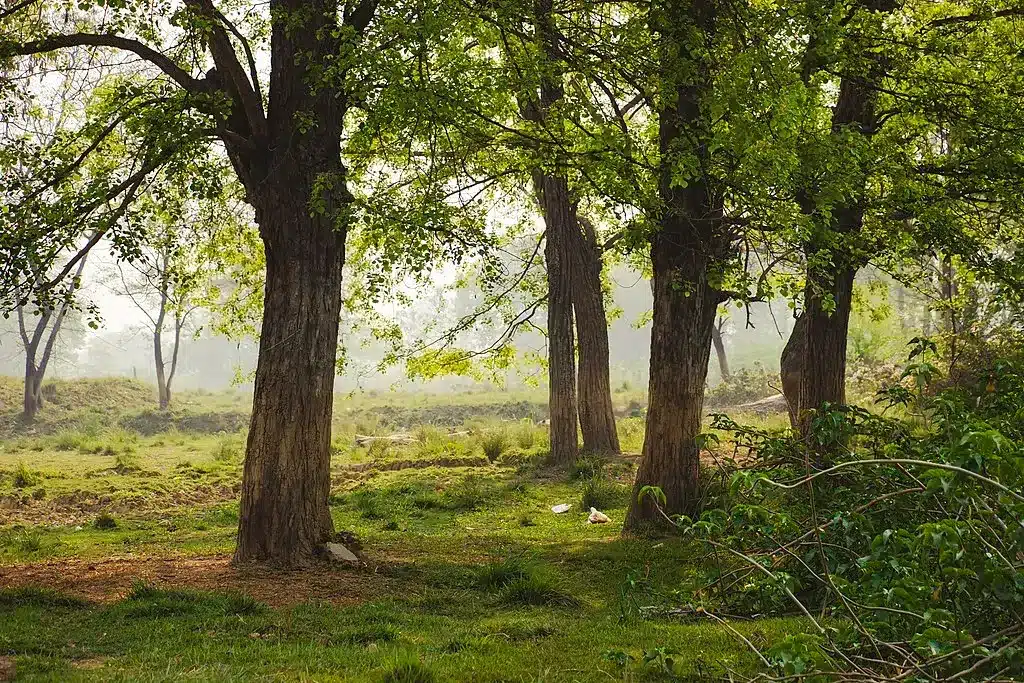
About Rosewood Tree:
- Rosewood is a commercial term encompassing a wide range of tropical hardwoods in the Fabaceae (Leguminosae) family.
- Distribution: It is native to South-East Asia, Papua New Guinea, the Solomon Islands, Sabah, Philippines, Indonesia and Malaysia.
Indian Rosewood
- Dalbergia sissoo(North Indian rosewood)
- It is a fast-growing, hardy, deciduous crooked rosewood tree is native to the foothills of the Himalayas, ranging from Afghanistan in the west to Bihar, India, in the east.
- It has long, leathery leaves and whitish or pink flowers.
- It is primarily found growing along river banks above 200 m (700 ft) elevation, but can range naturally up to 1,400 m (4,600 ft).
- Dalbergia latifolia (East Indian Rose wood)
- Common names: East Indian Rosewood, Black Rosewood, Bombay Black wood, Indonesian Rosewood, Malabar rosewood.
- Habitat: Tropical dry deciduous forests, Tropical moist deciduous forests, also in the plains.
- Distribution: India, Nepal, Andama Islands (India), Malay peninsula, Indonesia, Himalayas, China, Malaysia
- It is commonly used for furniture, musical instruments, decorative items and veneers.
- Conservation status: Currently, these species are listed in Appendix II of the CITES list.


Key facts about CITES
- It is an international agreement between governments that aims to ensure that international trade in wild animals and plants does not threaten their survival.
- CITES was adopted in 1973 and entered into force in 1975.
- Member countries: There are 184 member parties, and trade is regulated in more than 38,000 species.
- Although CITES is legally binding on the Parties – in other words, they have to implement the Convention–it does not take the place of national laws.
- Secretariat: It is administered by the United Nations Environment Programme (UNEP) and is located in Geneva, Switzerland.
Q1: What is the United Nations Environment Programme (UNEP)?
It is the leading environmental authority in the United Nations system. It uses its expertise to strengthen environmental standards and practices while helping implement environmental obligations at the country, regional, and global levels.
Source: CITES defines guidelines on trade of rosewood species

 Last updated on Oct, 2026
→ UPSC 2027 Notification will be released on 13 January 2027 at upsconline.nic.in.
→ Check Nobel Prize 2026 Winners List here.
→ Download PIB PRiSM Monthly Magazine 2026 here.
→ Check UPSC Monthly Current Affairs Magazine The Recitals here.
→ Check out the latest UPSC Syllabus here.
→ Download UPSC Model Answers for Mains 2026
→ UPSC Mains Question Paper 2026 is out now for Essay & GS Paper 1, 2, 3 & 4.
→ UPSC Calendar 2027 has been released.
→ Enroll in Vajiram & Ravi’s UPSC Mains Test Series 2027 for structured answer writing practice, expert evaluation, and exam-oriented feedback.
→ Join Vajiram & Ravi’s UPSC Mentorship Program 2027 for personalized guidance, strategy planning, and one-to-one support from experienced mentors.
→ Go through the UPSC Mains Previous Year Papers to enhance your preparation.
→ UPSC has released UPSC Toppers List 2025 with the Civil Services final result on its official website.
→ Also check Best UPSC Coaching in India








