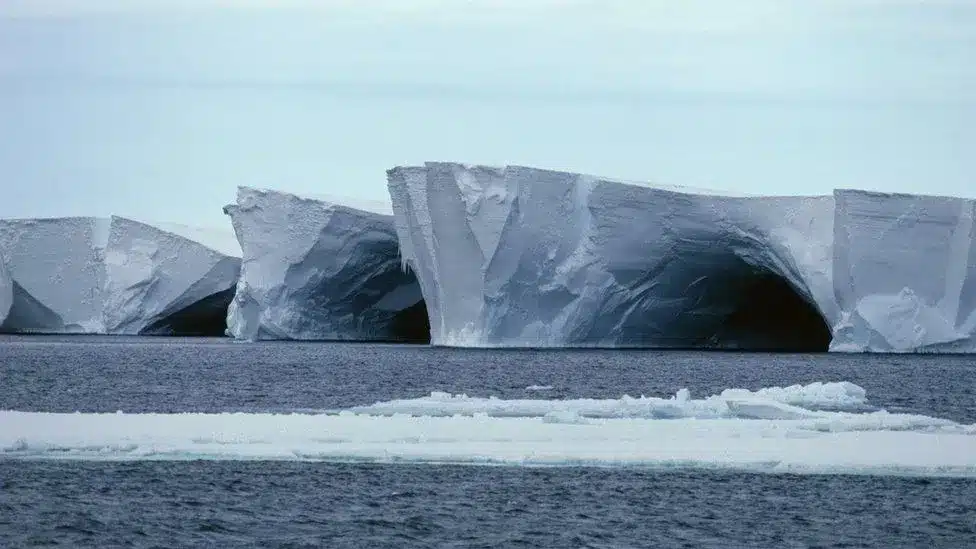
About Ross Ice Shelf:
- Location: It is the largest ice shelf of Antarctica.
- It is situated in the Ross Sea, extending off the continent’s coast into the ocean.
- It is the world’s largest floating body of ice, covering approximately 487,000 square kilometres, about the size of France.
- Only ten percent of the ice shelf is visible, with the majority hidden in several hundred metres of ice below the surface.
- Thickness: Its thickness varies significantly, ranging from about 100 meters to several hundred meters. The thickest parts are generally found where the shelf anchors against the continent.
- Formation:
- It is formed by the accumulation and compaction of snow, which, over time, turns into ice.
- It is being fed a constant flow of ice from glaciersdrainingfrom both the East and West Antarctic Ice Sheets.
- As new ice is added, existing ice is being removed through melting at the base and ice calving at the front.
- It plays an important role in stabilising the Antarctic ice sheet, buttressing the ice that is constantly moving over the land surface.
Key Facts about Ross Sea:
- It is a giant bay just 320 kms from the South Pole.
- The sea is remote and positioned south and slightly east of New Zealand.
- It is the largest polar marine ecosystem in the world.
- The Ross Sea is relatively shallow, and it accounts for an area of approximately 960,000 square km (370,000 square miles).
- A large portion of the sea is covered by the Ross Ice Shelf.
- It is strongly influenced by the coastal East-Wind Drift that sets up a vast clockwise gyre accompanied by deep water upwelling.
- It is the first protected area in Antarctica and home to most of the world’s penguins and many species of whale.
Numerous scientific research stations are located along its coasts.
Q1: What is a Glacier?
A glacier is a large, perennial accumulation of crystalline ice, snow, rock, sediment, and often liquid water that originates on land and moves down slope under the influence of its own weight and gravity.
Source: Antarctica’s France-Sized Ice Shelf Makes Daily Jumps, Raising Icequake Concern


 Last updated on Oct, 2026
→ UPSC 2027 Notification will be released on 13 January 2027 at upsconline.nic.in.
→ Check Nobel Prize 2026 Winners List here.
→ Download PIB PRiSM Monthly Magazine 2026 here.
→ Check UPSC Monthly Current Affairs Magazine The Recitals here.
→ Check out the latest UPSC Syllabus here.
→ Download UPSC Model Answers for Mains 2026
→ UPSC Mains Question Paper 2026 is out now for Essay & GS Paper 1, 2, 3 & 4.
→ UPSC Calendar 2027 has been released.
→ Enroll in Vajiram & Ravi’s UPSC Mains Test Series 2027 for structured answer writing practice, expert evaluation, and exam-oriented feedback.
→ Join Vajiram & Ravi’s UPSC Mentorship Program 2027 for personalized guidance, strategy planning, and one-to-one support from experienced mentors.
→ Go through the UPSC Mains Previous Year Papers to enhance your preparation.
→ UPSC has released UPSC Toppers List 2025 with the Civil Services final result on its official website.
→ Also check Best UPSC Coaching in India