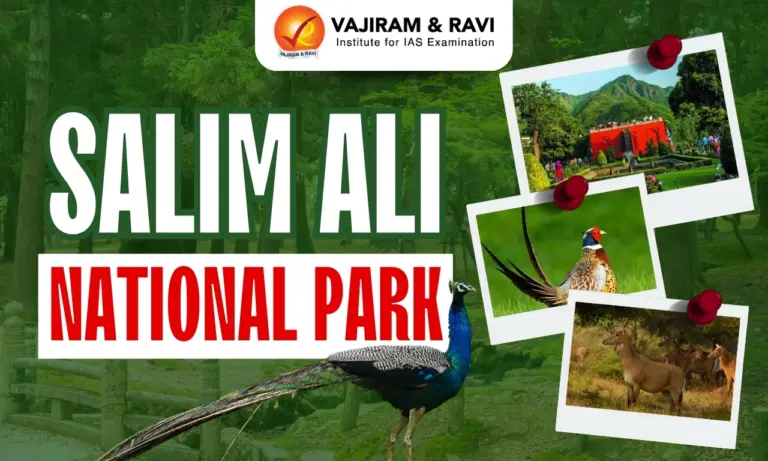
Salim Ali National Park, formerly known as the City Forest National Park, was one of India’s few urban protected areas. Located in Srinagar, Jammu and Kashmir, it was named after the eminent ornithologist Dr. Salim Ali in recognition of his outstanding contribution to bird conservation in India.
Salim Ali National Park Location and Geographical Features
- Salim Ali National Park is located in Srinagar district of Jammu and Kashmir.
- It is situated on the foothills of the Zabarwan Range, near the famous Dal Lake.
- The park forms part of the Jhelum River basin.
- It originally covered an area of about 9 square kilometres.
- The landscape comprised temperate forests, marshes, wetlands and riverine habitats, providing favourable conditions for a wide variety of wildlife.
Salim Ali National Park Floral Diversity
The vegetation of the park represents the temperate Himalayan ecosystem.
- Deodar, Blue Pine (Kail), Chinar, Willow and Poplar.
- Wetland vegetation included reeds, grasses and other marsh plants.
- Dense vegetation provided food, shelter and nesting sites for numerous bird species.
- The rich plant diversity also played an important role in maintaining the ecological balance of the Dal Lake catchment.


Salim Ali National Park Faunal Diversity
Salim Ali National Park supports a rich diversity of wildlife due to its temperate forests and wetland habitats.
- It provided habitat for the endangered Hangul (Kashmir Stag), along with the Himalayan Black Bear, Leopard, Himalayan Musk Deer, Himalayan Serow and Jungle Cat.
- The park was particularly renowned for its avifauna, with over 70 species of resident and migratory birds, including Paradise Flycatcher, Himalayan Monal, Kingfishers, Herons, Egrets, Cormorants and numerous migratory waterfowl from Central Asia.
- Several reptiles and amphibians associated with wetland ecosystems were also recorded from the park.
Salim Ali National Park Major Challenges
Salim Ali National Park faces serious conservation challenges due to rapid urbanisation and developmental pressures. A major portion of the notified National Park was converted into the Royal Springs Golf Course between 1998 and 2001, resulting in significant habitat loss and fragmentation. The shrinking forest and wetland ecosystem has adversely affected wildlife, particularly resident and migratory birds. Encroachment, increasing tourism, and infrastructure development around Dal Lake and the Zabarwan Range have further degraded the ecological integrity of the area.
About Dr. Salim Ali
Dr. Salim Ali (1896-1987), popularly known as the “Birdman of India,” was India’s most distinguished ornithologist and naturalist.
- He conducted the first systematic bird surveys across India.
- He played a pioneering role in developing ornithology as a scientific discipline in the country.
- He was closely associated with the Bombay Natural History Society (BNHS) and made significant contributions to bird conservation.
- His efforts greatly influenced the protection of several important bird habitats, including Keoladeo National Park in Rajasthan.

 Last updated on Oct, 2026
→ UPSC 2027 Notification will be released on 13 January 2027 at upsconline.nic.in.
→ Check Nobel Prize 2026 Winners List here.
→ Download PIB PRiSM Monthly Magazine 2026 here.
→ Check UPSC Monthly Current Affairs Magazine The Recitals here.
→ Check out the latest UPSC Syllabus here.
→ Download UPSC Model Answers for Mains 2026
→ UPSC Mains Question Paper 2026 is out now for Essay & GS Paper 1, 2, 3 & 4.
→ UPSC Calendar 2027 has been released.
→ Enroll in Vajiram & Ravi’s UPSC Mains Test Series 2027 for structured answer writing practice, expert evaluation, and exam-oriented feedback.
→ Join Vajiram & Ravi’s UPSC Mentorship Program 2027 for personalized guidance, strategy planning, and one-to-one support from experienced mentors.
→ Go through the UPSC Mains Previous Year Papers to enhance your preparation.
→ UPSC has released UPSC Toppers List 2025 with the Civil Services final result on its official website.
→ Also check Best UPSC Coaching in India
Salim Ali National Park FAQs
Q1. Where is Salim Ali National Park located?+
Q2. Why is Salim Ali National Park named after Dr. Salim Ali?+
Q3. Which is the flagship species associated with Salim Ali National Park?+
Q4. What is the major conservation challenge faced by Salim Ali National Park?+
Q5. Which important geographical feature lies adjacent to Salim Ali National Park?+
Tags: salim ali National park