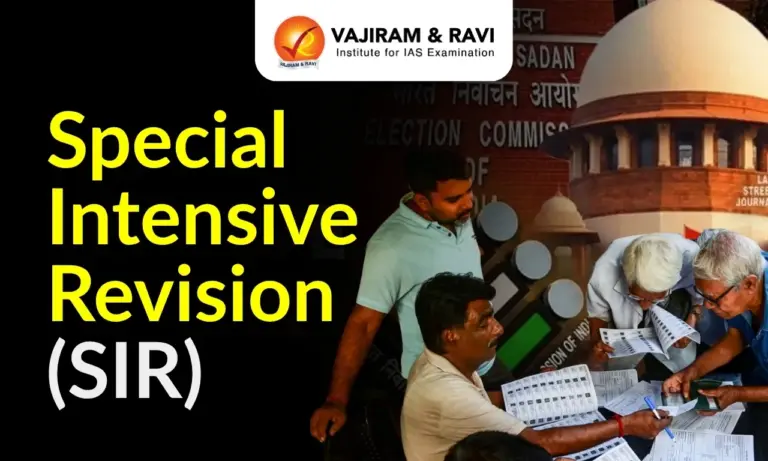
Special Intensive Revision (SIR) Latest News
- The Supreme Court upheld the constitutional validity of the Election Commission’s (EC) Special Intensive Revision (SIR) of electoral rolls in Bihar, while permitting similar exercises in other States and Union Territories.
- The judgment assumes significance as the second phase of the SIR has begun across 12 States/UTs, including West Bengal, Tamil Nadu and Assam, ahead of forthcoming elections.
- The ruling addresses the scope of the EC’s powers under Article 324, electoral integrity, and the sensitive overlap between voter eligibility and citizenship determination.
Supreme Court’s Key Observations
- EC’s power under Article 324:
- The Bench held that the SIR neither replaces the provisions of the Representation of the People Act (RPA), 1950, nor the Registration of Electors Rules, 1960.
- Instead, it operationalises the constitutional mandate under Article 324 – Superintendence, direction and control of elections vested in the EC.
- The Court described Article 324 as a “continuous wellspring of power”, enabling the EC to safeguard the sanctity of the democratic process at every stage of election management.
- Justification for the SIR:
- The Court accepted the EC’s rationale for undertaking an intensive revision after more than two decades.
- It cited rapid urbanisation, large-scale migration, non-reporting of deaths, duplicate voter entries, and frequent additions and deletions in electoral rolls.
- The Bench observed that electoral rolls are not static documents and must evolve with demographic and residential changes.


Electoral Roll Revision in Bihar
- Scale of deletions:
- The final Bihar electoral roll published on September 30 last year contained 7.42 crore electors, compared to 7.89 crore voters when the SIR was notified in June 2025.
- The Court directed that persons whose names were deleted due to absence, duplication, death, shifting, or suspected citizenship issues may challenge the EC’s decision before competent courts.
- Citizenship adjudication:
- A major feature of the ruling is the direction regarding individuals excluded on citizenship grounds.
- The Court ordered the EC to refer such cases to the competent authority under the Citizenship Act, 1955 for adjudication before the next parliamentary, Assembly, or local body elections.
- This effectively brings the Ministry of Home Affairs (MHA) and mechanisms such as Foreigners’ Tribunals into the process.
Core Constitutional Contradiction
- Electoral eligibility vs citizenship determination:
- The Court simultaneously made two observations:
- Deletion from the voter list does not amount to a declaration that a person is not an Indian citizen.
- Excluded individuals would nevertheless face adjudication regarding citizenship status.
- This creates a constitutional and administrative contradiction. While the EC’s scrutiny is termed “prima facie and contextual,” the consequences extend beyond mere electoral exclusion.
- The Court simultaneously made two observations:
- Burden of proof concerns:
- Critics argue that the ruling indirectly shifts the burden of proving citizenship onto deleted individuals.
- This is especially significant because access to documentary proof remains uneven among vulnerable populations, migrants, and economically weaker sections.
Court’s Position on Citizenship Presumption
- Petitioners relied on the SC’s earlier judgment [Lal Babu Hussein case (1995)], which recognised that inclusion in electoral rolls carries a presumption of citizenship.
- However, the present Bench clarified that the presumption is only evidentiary and rebuttable, and the inclusion in voter lists is not a permanent immunity against future scrutiny.
- Thus, prior enrolment does not create a conclusive legal guarantee of citizenship status.
Safeguards Introduced by the Court
- Procedural fairness:
- The Court acknowledged that the original SIR process raised concerns regarding documentation requirements, transparency deficits, risk of arbitrary exclusion, and limited accessibility for vulnerable groups.
- However, it held that subsequent judicial interventions introduced adequate safeguards, thereby making the process constitutionally compliant.
- Transparency measures:
- The Court specifically highlighted publication of the complete list of nearly 65 lakh excluded electors, disclosure of reasons for exclusion, and opportunity for hearing and challenge.
- These measures, according to the Bench, transformed the process into a “verifiable and contestable” exercise consistent with procedural fairness.
Constitutional and Democratic Implications
- Supporters:
- They view the judgment as reinforcing electoral purity, accuracy of voter rolls, and prevention of duplication and fraudulent entries.
- The ruling expands the functional scope of Article 324 and strengthens the EC’s supervisory authority.
- Critics:
- They fear the judgment may increase disenfranchisement risks, blur the line between electoral administration and citizenship determination, and burden marginalised populations with documentary verification.
- The decision may also revive debates similar to those surrounding the National Register of Citizens (NRC).
Conclusion
- The SC’s ruling validates the EC’s authority to undertake intensive electoral roll revisions as part of its constitutional responsibility under Article 324.
- The long-term impact of the ruling will depend on how transparently and fairly the SIR process is implemented across States before upcoming elections.

 Last updated on Oct, 2026
→ UPSC 2027 Notification will be released on 13 January 2027 at upsconline.nic.in.
→ Check Nobel Prize 2026 Winners List here.
→ Download PIB PRiSM Monthly Magazine 2026 here.
→ Check UPSC Monthly Current Affairs Magazine The Recitals here.
→ Check out the latest UPSC Syllabus here.
→ Download UPSC Model Answers for Mains 2026
→ UPSC Mains Question Paper 2026 is out now for Essay & GS Paper 1, 2, 3 & 4.
→ UPSC Calendar 2027 has been released.
→ Enroll in Vajiram & Ravi’s UPSC Mains Test Series 2027 for structured answer writing practice, expert evaluation, and exam-oriented feedback.
→ Join Vajiram & Ravi’s UPSC Mentorship Program 2027 for personalized guidance, strategy planning, and one-to-one support from experienced mentors.
→ Go through the UPSC Mains Previous Year Papers to enhance your preparation.
→ UPSC has released UPSC Toppers List 2025 with the Civil Services final result on its official website.
→ Also check Best UPSC Coaching in India
Special Intensive Revision (SIR)
Q1. What is the significance of Article 324 in empowering the Election Commission (EC) to conduct SIR of electoral rolls?+
Q2. Why did the SC uphold the constitutional validity of the SIR?+
Q3. What constitutional concern emerges from linking electoral roll deletion with citizenship adjudication?+
Q4. How did the SC interpret the presumption of citizenship arising from inclusion in electoral rolls?+
Q5. What safeguards did the SC mandate to ensure procedural fairness in the SIR process?+
Tags: special intensive revision (sir)