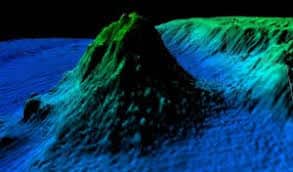
About Seamount:
- It is an underwater mountain formed through volcanic activity.
- These are recognised as hotspots for marine life. Like volcanoes on land, seamounts can be active, extinct or dormant volcanoes.
- These are formed near mid-ocean ridges, where the earth’s tectonic plates are moving apart, allowing molten rock to rise to the seafloor.
- The planet’s two most-studied mid-ocean ridges are the Mid-Atlantic Ridge and the East Pacific Rise.
- Some seamounts have also been found near intraplate hotspots – regions of heavy volcanic activity within a plate – and oceanic island chains with a volcanic and seismic activity called island arcs.
- These are formed when molten rock comes up from below the tectonic plate.
- Significance of seamounts
- They provide information about the mantle’s composition and how tectonic plates evolve.
- These are helpful in understanding their influence on how water circulates and absorbs heat and carbon dioxide.
- They are good places for life because they can cause localised ocean upwelling – the process by which nutrient-rich water from deep within the ocean moves up to the surface.
Key facts about Andaman Sea
- It is a marginal sea of the northeastern Indian Ocean.
- It is bounded
- To the north by the Irrawaddy River delta of Myanmar (Burma)
- To the east by peninsular Myanmar, Thailand, and Malaysia;
- To the south by the Indonesian island of Sumatra and by the Strait of Malacca; and to the west by the Andaman and Nicobar Islands, which constitute a union territory of India.
Q1) What is a volcano?
A volcano is a geological feature characterized by the eruption of molten rock, ash, and gases from beneath the Earth’s surface. Volcanoes can be active, dormant, or extinct, and they play a significant role in shaping the Earth’s landscape and geology.
Source: Indian scientists discover active submarine volcano in Andaman sea


 Last updated on Oct, 2026
→ UPSC 2027 Notification will be released on 13 January 2027 at upsconline.nic.in.
→ Asian Games 2026 are being held in Aichi-Nagoya, Japan, from 19 September to 4 October.
→ Check Nobel Prize 2026 Winners List here.
→ Download PIB PRiSM Monthly Magazine 2026 here.
→ Check UPSC Monthly Current Affairs Magazine The Recitals here.
→ Check out the latest UPSC Syllabus here.
→ Download UPSC Model Answers for Mains 2026
→ UPSC Mains Question Paper 2026 is out now for Essay & GS Paper 1, 2, 3 & 4.
→ UPSC Calendar 2027 has been released.
→ Enroll in Vajiram & Ravi’s UPSC Mains Test Series 2027 for structured answer writing practice, expert evaluation, and exam-oriented feedback.
→ Join Vajiram & Ravi’s UPSC Mentorship Program 2027 for personalized guidance, strategy planning, and one-to-one support from experienced mentors.
→ Go through the UPSC Mains Previous Year Papers to enhance your preparation.
→ UPSC has released UPSC Toppers List 2025 with the Civil Services final result on its official website.
→ Also check Best UPSC Coaching in India