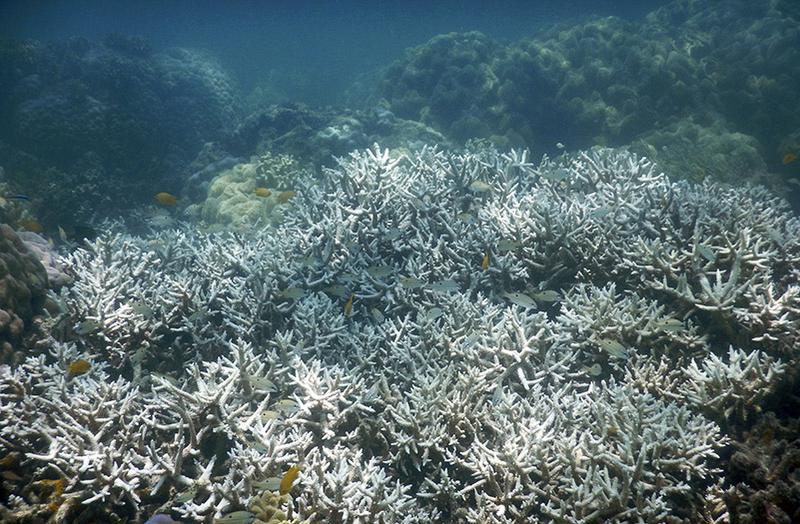
About Staghorn coral:
- It is one of the most important corals in the Caribbean.
- It, along with elkhorn coral and star corals built Caribbean coral reefs over the last 5,000 years.
- Staghorn coral can form dense groups called “thickets” in very shallow water.
- These provide important habitat for other reef animals, especially fish.
- Appearance
- Staghorn coral colonies are golden tan or pale brown with white tips and they get their color from the algae that live within their tissue.
- These corals have antler-like branches and typically stem out from a central trunk and angle upward.
- Each staghorn coral colony is made up of many individual polyps that grow together.
- These coral get food from photosynthetic algae that live inside the coral’s cells. They also feed by capturing plankton with their polyps’ tentacles.
- Distribution:
- It is found typically in clear, shallow water (15–60 feet) on coral reefs throughout the Bahamas, Florida, and the Caribbean.
- The northern extent of the range in the Atlantic Ocean is Palm Beach County, Florida, where it is relatively rare.
- They live in many coral reef habitats including spur and groove, bank reef, patch reef, and transitional reef habitats, as well as on limestone ridges, terraces, and hard bottom habitats.
- Lifespan & Reproduction
- These coral reaches reproductive maturity at about 7 inches tall.
- Staghorn coral is a simultaneous hermaphrodite, meaning each colony produces both eggs and sperm, but usually does not self-fertilize.
- This coral sexually reproduces once per year after the full moon in late summer by “broadcast spawning” eggs and sperm into the water column.
- Fertilized eggs develop into larvae that settle on hard surfaces and form new colonies.
- Threats
- Climate change
- Diseases: It is particularly susceptible to white band and white plague diseases.
- Unsustainable Fishing Pressure
What is White band disease?
- It is a common tissue loss disease.
- Studies suggest that white band disease is caused by a communicable agent, however, a specific pathogen has not yet been definitively identified.
Q1) What is Algae?
Algae are a diverse group of photosynthetic organisms that can be found in various aquatic and moist environments, including freshwater and marine ecosystems. They belong to the kingdom Protista or Plantae, depending on the classification system used.
Source: Genomic markers of disease resistance in staghorn corals


 Last updated on Oct, 2026
→ UPSC 2027 Notification will be released on 13 January 2027 at upsconline.nic.in.
→ Asian Games 2026 are being held in Aichi-Nagoya, Japan, from 19 September to 4 October.
→ Check Nobel Prize 2026 Winners List here.
→ Download PIB PRiSM Monthly Magazine 2026 here.
→ Check UPSC Monthly Current Affairs Magazine The Recitals here.
→ Check out the latest UPSC Syllabus here.
→ Download UPSC Model Answers for Mains 2026
→ UPSC Mains Question Paper 2026 is out now for Essay & GS Paper 1, 2, 3 & 4.
→ UPSC Calendar 2027 has been released.
→ Enroll in Vajiram & Ravi’s UPSC Mains Test Series 2027 for structured answer writing practice, expert evaluation, and exam-oriented feedback.
→ Join Vajiram & Ravi’s UPSC Mentorship Program 2027 for personalized guidance, strategy planning, and one-to-one support from experienced mentors.
→ Go through the UPSC Mains Previous Year Papers to enhance your preparation.
→ UPSC has released UPSC Toppers List 2025 with the Civil Services final result on its official website.
→ Also check Best UPSC Coaching in India