About Sendai Framework for Disaster Risk Reduction 2015-2030:
- It was the first major agreement of the post-2015 development agenda and provides member states with concrete actions to protect development gains from the risk of disaster.
- It was adopted by the UN member states at the Third UN World Conference on Disaster Risk Reduction in Sendai, Japan, on March 18, 2015.
- It is the successor instrument to the Hyogo Framework for Action (HFA) 2005-2015.
- The Sendai Framework advocates for:
- The substantial reduction of disaster risk and losses in lives, livelihoods, and health and in the economic, physical, social, cultural, and environmental assets of persons, businesses, communities, and countries.
- It recognizes that the State has the primary role to reduce disaster risk, but that responsibility should be shared with other stakeholders, including local government, the private sector, and other stakeholders.
- Four Priorities:
- Understanding disaster risk
- Strengthening disaster risk governance to manage disaster risk
- Investing in disaster risk reduction for resilience
- Enhancing disaster preparedness for effective response and “Building Back Better” in recovery, rehabilitation, and reconstruction.
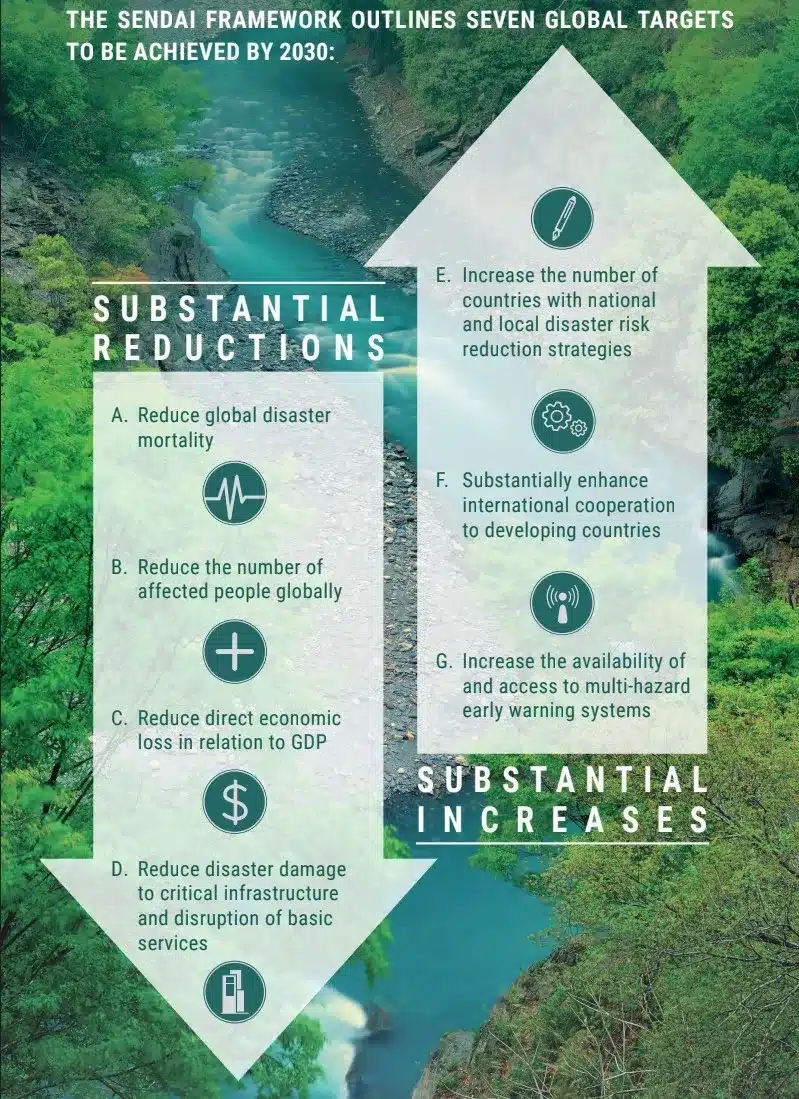
- Targets:
- Substantially reduce global disaster mortality.
- Substantially reduce the number of affected people globally.
- Reduce direct disaster economic loss in relation to global GDP.
- Substantially reduce disaster damage to critical infrastructure and disruption of basic services.
- Substantially increase the number of countrieswith national and local disaster risk reduction strategies.
- Substantially enhance international cooperation to developing countries.
- Substantially increase the availability of and access to multi-hazard early warning systems and disaster risk information and assessments to people.
- The Sendai Framework covers technological hazards in addition to natural hazards, which represent an evolution compared to its predecessor, the Hyogo Framework for Action.
- These technological hazards include chemical/industrial hazards further to radiological, nuclear, biological, and others.
- It works hand in hand with the other 2030 Agenda agreements, including the Paris Agreement on Climate Change, the Addis Ababa Action Agenda on Financing for Development, the New Urban Agenda, and ultimately the Sustainable Development Goals.
- The United Nations Office for Disaster Risk Reduction (UNDRR)is tasked tosupport the implementation, follow-up and review of the Sendai Framework.
Q1: What are the stages of a disaster risk management cycle?
The disaster risk management cycle consists of four phases: Prevention/Mitigation and Preparedness in the pre-disaster stage, and Response and Rehabilitation/Reconstruction in the post-disaster stage.
Source: India committed to Sendai Framework for disaster risk reduction: PM’s aide P.K. Mishra


 Last updated on Oct, 2026
→ UPSC 2027 Notification will be released on 13 January 2027 at upsconline.nic.in.
→ Check Nobel Prize 2026 Winners List here.
→ Download PIB PRiSM Monthly Magazine 2026 here.
→ Check UPSC Monthly Current Affairs Magazine The Recitals here.
→ Check out the latest UPSC Syllabus here.
→ Download UPSC Model Answers for Mains 2026
→ UPSC Mains Question Paper 2026 is out now for Essay & GS Paper 1, 2, 3 & 4.
→ UPSC Calendar 2027 has been released.
→ Enroll in Vajiram & Ravi’s UPSC Mains Test Series 2027 for structured answer writing practice, expert evaluation, and exam-oriented feedback.
→ Join Vajiram & Ravi’s UPSC Mentorship Program 2027 for personalized guidance, strategy planning, and one-to-one support from experienced mentors.
→ Go through the UPSC Mains Previous Year Papers to enhance your preparation.
→ UPSC has released UPSC Toppers List 2025 with the Civil Services final result on its official website.
→ Also check Best UPSC Coaching in India