Sistan sand boa Latest News
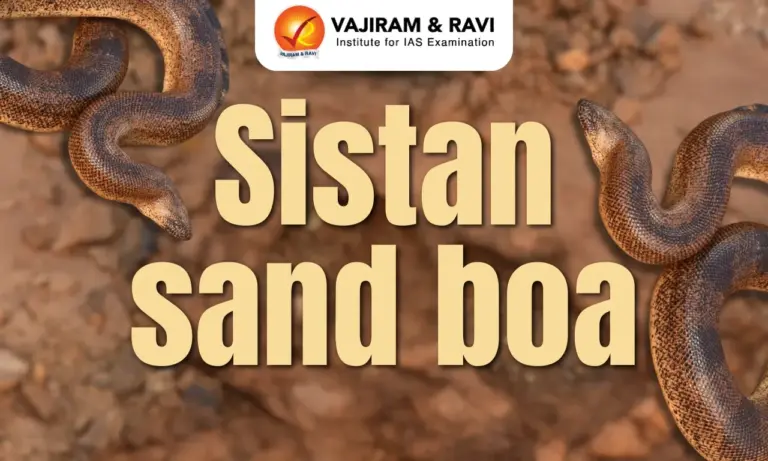
A new study reports the first confirmed record in India of the Sistan sand boa (Eryx sistanensis), a species formally described only in 2020 and previously known from Iran and Pakistan.
Why in News?
- The Sistan sand boa was documented from the northern Thar Desert in Rajasthan.
- It is the first confirmed record in India of the Sistan sand boa, formally described only in 2020 and previously known from Iran and Pakistan.
- The discovery effectively adds a fourth species of sand boa to India, alongside the red sand boa (Eryx johnii), rough-scaled sand boa (Eryx conicus), and Whitaker’s boa (Eryx whitakeri).


About Sistan sand boa
- It is a species of sand boa snake.
- Scientific Name: Eryx sistanensis
- It can be distinguished from the red sand boa by its persistent dark bands and a tail that gradually tapers towards the tip.
- While red sand boas lose their body bands as they mature, the Sistan sand boa retains its sooty bands throughout life.
- Juveniles are buff-coloured, while subadults and adults are tan to tan-brown.
- The species has not yet been evaluated by the IUCN.
Key Facts about Sand Boas
- Sand Boas are a group of non-venomous snakes belonging to the genus Eryx.
- Unlike most snakes, the tail of a sand boa snake is almost as thick as the body and gives the reptile the appearance of being “double-headed”.
- These snakes prefer dry, sandy, and loose soil environments that support their fossorial lifestyle.
- Body coloration is pale yellow to reddish to brownish, depending on the type of soil in the region.
- Most species display a mottled or blotched pattern that blends perfectly with their sandy and pebbly surroundings, an adaptation known as protective coloration.
- Sand boas spend most of their time buried just below the surface in sand or loose soil, exposing only the eyes and nostrils.
- They seize passing prey, consisting of mostly mice and lizards, which they kill by constriction.
News: MONG

 Last updated on Oct, 2026
→ UPSC 2027 Notification will be released on 13 January 2027 at upsconline.nic.in.
→ Check Nobel Prize 2026 Winners List here.
→ Download PIB PRiSM Monthly Magazine 2026 here.
→ Check UPSC Monthly Current Affairs Magazine The Recitals here.
→ Check out the latest UPSC Syllabus here.
→ Download UPSC Model Answers for Mains 2026
→ UPSC Mains Question Paper 2026 is out now for Essay & GS Paper 1, 2, 3 & 4.
→ UPSC Calendar 2027 has been released.
→ Enroll in Vajiram & Ravi’s UPSC Mains Test Series 2027 for structured answer writing practice, expert evaluation, and exam-oriented feedback.
→ Join Vajiram & Ravi’s UPSC Mentorship Program 2027 for personalized guidance, strategy planning, and one-to-one support from experienced mentors.
→ Go through the UPSC Mains Previous Year Papers to enhance your preparation.
→ UPSC has released UPSC Toppers List 2025 with the Civil Services final result on its official website.
→ Also check Best UPSC Coaching in India
Sistan sand boa FAQs
Q1. From which region in India was the Sistan sand boa recently recorded?+
Q2. What is the scientific name of the Sistan sand boa?+
Q3. Are sand boas venomous or non-venomous?+
Q4. How can the Sistan sand boa be distinguished from the red sand boa?+
Tags: prelims pointers sistan sand boa upsc current affairs upsc prelims current affairs