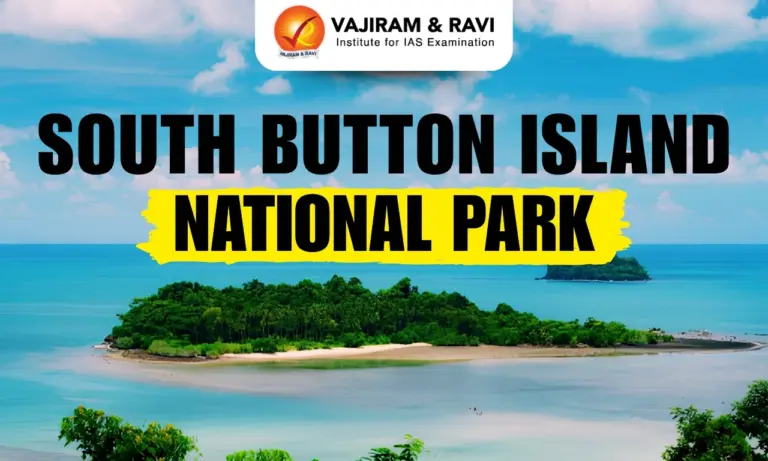
South Button Island National Park is a small but beautiful protected area located in the Andaman and Nicobar Islands of India. Surrounded by clear blue waters, it is known for its peaceful environment and rich marine life. The park is especially famous for its coral reefs, colorful fish, and diverse underwater ecosystem. Though small in size, it plays an important role in marine biodiversity conservation and maintaining the ecological balance of the region.
South Button Island National Park Highlights
- South Button Island National Park is a beautiful marine park known for its crystal-clear turquoise waters, colorful coral reefs, and rich marine life, making it a perfect spot for nature lovers and adventure seekers.
- It was established in 1987 and is a part of the Rani Jhansi Marine National Park, located in the Andaman and Nicobar Islands near Swaraj Dweep (Havelock Island).
- Despite covering a very small area (around 5 sq km), it is one of the smallest national parks in India, yet it holds great ecological importance due to its vibrant biodiversity.
- The park is famous for its white sandy beaches, gentle waves, and peaceful environment.
South Button Island National Park Flora (Plant Life)
- The island has dense tropical vegetation with a mix of trees, shrubs, and coastal plants, giving it a rich green cover despite its small size.
- Important plant species include Rattan palm (Calamus palustris), Dinochloa andamanica (climbing bamboo), and trees like Dipterocarpus, Artocarpus, and Canarium.
- Other notable species such as Hopea odorata, Caryota mitis, and Sideroxylon add to the island’s biodiversity.
- The most significant feature is the presence of shallow-water coral reefs, which act as the main “underwater vegetation” supporting marine life.
- These coral reefs are visible even at shallow depths, making the ecosystem unique and visually stunning.


South Button Island National Park Fauna (Animal Life)
- Since the island is very small, large terrestrial mammals are absent, but it is extremely rich in marine biodiversity.
- The surrounding waters are home to animals like Dugongs, Dolphins, Sea turtles, and even Blue whales, making it ecologically important.
- A wide variety of colorful fishes such as Snappers, Butterflyfish, Lionfish, Angelfish, and Barracuda can be easily spotted.
- Marine creatures like Octopuses, Nudibranchs, Shrimps, and Manta rays thrive in the coral reef ecosystem.
- The island is also a breeding ground for Sea turtles, which adds to its conservation value.
- In terms of birdlife, species like the White-bellied sea eagle and the Edible-nest swiftlet (endemic subspecies) are commonly found.
South Button Island National Park Climate
- The park experiences a tropical oceanic climate, which keeps the weather pleasant for most of the year.
- The average temperature ranges between 20°C to 30°C, making it comfortable for visitors.
- The region receives heavy rainfall during the monsoon season (June to October), which may affect travel plans.
Significance of South Button Island National Park
- South Button Island National Park holds great importance as a marine biodiversity hotspot, where rich coral reefs support a wide variety of fish, sea turtles, and other marine species.
- It plays a key role in conservation of coral ecosystems, which are very sensitive and important for maintaining the ecological balance of ocean life.
- The park is a part of the Rani Jhansi Marine National Park, making it an important component of a larger protected marine area in the Andaman and Nicobar Islands.
- It is especially significant as a breeding and nesting ground for sea turtles and a habitat for rare species like the Dugong (sea cow) and White-bellied sea eagle.
- Being one of the smallest national parks in India, it shows how even a small area can have high ecological and environmental value.
- The park also promotes eco-tourism activities like snorkeling and scuba diving, helping people learn about and appreciate marine conservation.
- Its clear waters and healthy coral reefs act as a natural indicator of a clean and well-preserved marine environment.

 Last updated on Oct, 2026
→ UPSC 2027 Notification will be released on 13 January 2027 at upsconline.nic.in.
→ Check Nobel Prize 2026 Winners List here.
→ Download PIB PRiSM Monthly Magazine 2026 here.
→ Check UPSC Monthly Current Affairs Magazine The Recitals here.
→ Check out the latest UPSC Syllabus here.
→ Download UPSC Model Answers for Mains 2026
→ UPSC Mains Question Paper 2026 is out now for Essay & GS Paper 1, 2, 3 & 4.
→ UPSC Calendar 2027 has been released.
→ Enroll in Vajiram & Ravi’s UPSC Mains Test Series 2027 for structured answer writing practice, expert evaluation, and exam-oriented feedback.
→ Join Vajiram & Ravi’s UPSC Mentorship Program 2027 for personalized guidance, strategy planning, and one-to-one support from experienced mentors.
→ Go through the UPSC Mains Previous Year Papers to enhance your preparation.
→ UPSC has released UPSC Toppers List 2025 with the Civil Services final result on its official website.
→ Also check Best UPSC Coaching in India
South Button Island National Park FAQs
Q1. What is South Button Island National Park famous for?+
Q2. Where is South Button Island National Park located?+
Q3. Why is South Button Island National Park important?+
Q4. What type of climate does the park have?+
Q5. What kind of animals can be seen in South Button Island National Park?+
Tags: environment environment notes south button island national park