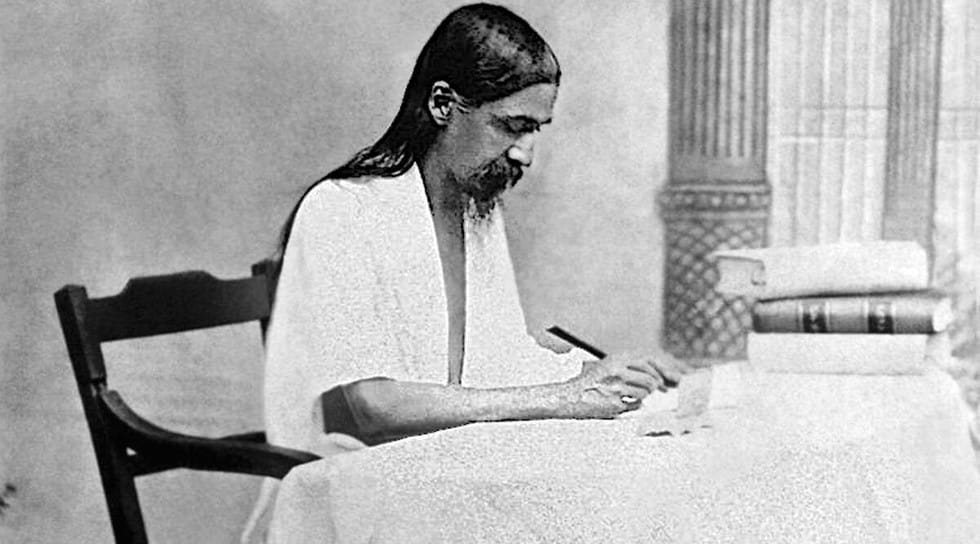
About Sri Aurobindo Ghosh:
Early Life & Career:
- Born to surgeon Krishna Dhan Ghose and Swarnalata Devi in Calcutta on August 15, 1872.
- He passed the Indian Civil Service Examination in 1890 but failed in the horsemanship test due to which he could not enter the service.
- In 1893, he accepted an appointment in the Baroda state service.
- He worked for 13 years and rose to the post of principal of the Baroda State College.
- Later, he left his job at Baroda to join the Bengal National College.
Revolutionary Streak:
- He became a leading figure in the freedom movement and used to write fearless articles for the English newspaper Bande Mataram.
- He also contributed articles to the Bengali weekly Yugantar.
- Later, he started the weekly English journal titled Dharma, in which he tried to convey the message of Swaraj or freedom from British rule.
- He was one of the founders of the youth club Anushilan Samiti which protested against the atrocities of the British government.
- He was one of the leading protesters against the 1905 Partition of Bengal and called on the citizens to boycott British institutions and goods.
- He took part in the 1906 session of the Indian National Congress and was a member of the team which set four objectives-Swadeshi, Swaraj, education and boycott.
Alipore Bomb Case
- Aurobindo, a revolutionary and a militant nationalist, was charged in the Alipore Bomb Case (1906-1910) and was sentenced to jail.
- He spent one year in solitary confinement at the Alipore Central Jail in Calcutta.
- Deshbandhu Chittaranjan Das fought his case and Ghosh was released.
Spiritualism at Puducherry:
- He decided to give up active politics after his stint in jail and devoted himself to spiritualism.
- In 1910, he left British India and found refuge in the French colony of Pondichéry (now called ‘Puducherry’) in southeastern India.
- He founded a community of spiritual seekers, which took shape as the Sri Aurobindo Ashram in 1926.
- He devoted himself for the rest of his life to the development of his “integral” yoga.
- The main objective of his teachings was to increase the level of consciousness of people and to aware people of their true selves.
Work:
- Aurobindo’s voluminous literary work comprises philosophical speculation, many treatises on yoga and integral yoga, poetry, plays, and other writings.
His major works include:
- Essays on the Gita (1922),
- The Life Divine (1939)
- Collected Poems and Plays (1942),
- The Synthesis of Yoga (1948),
- The Human Cycle (1949),
- The Ideal of Human Unity (1949),
- Savitri: A Legend and a Symbol (1950),
- On the Veda (1956).
Q1) What is Integral Yoga?
Integral Yoga is a flexible combination of specific methods designed to develop every aspect of the individual: physical, emotional, intellectual, and spiritual. It is a scientific system that integrates the various branches of Yoga to bring about a complete and harmonious development of the individual.
Source: All India Radio


 Last updated on Oct, 2026
→ UPSC 2027 Notification will be released on 13 January 2027 at upsconline.nic.in.
→ Asian Games 2026 are being held in Aichi-Nagoya, Japan, from 19 September to 4 October.
→ Check Nobel Prize 2026 Winners List here.
→ Download PIB PRiSM Monthly Magazine 2026 here.
→ Check UPSC Monthly Current Affairs Magazine The Recitals here.
→ Check out the latest UPSC Syllabus here.
→ Download UPSC Model Answers for Mains 2026
→ UPSC Mains Question Paper 2026 is out now for Essay & GS Paper 1, 2, 3 & 4.
→ UPSC Calendar 2027 has been released.
→ Enroll in Vajiram & Ravi’s UPSC Mains Test Series 2027 for structured answer writing practice, expert evaluation, and exam-oriented feedback.
→ Join Vajiram & Ravi’s UPSC Mentorship Program 2027 for personalized guidance, strategy planning, and one-to-one support from experienced mentors.
→ Go through the UPSC Mains Previous Year Papers to enhance your preparation.
→ UPSC has released UPSC Toppers List 2025 with the Civil Services final result on its official website.
→ Also check Best UPSC Coaching in India