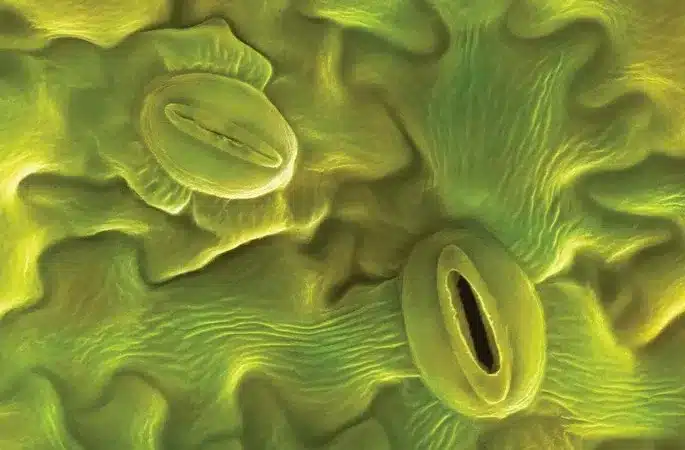
About Stomata
- Stomata are tiny openings or pores in plant tissue that allow for gas exchange.
- They are typically found in plant leaves but can also be found in some stems.
- Stomata allow a plant to take in carbon dioxide, which is needed for photosynthesis.
- They also help to reduce water loss by closing when conditions are hot or dry.
- Stomata look like tiny mouths which open and close as they assist in transpiration.
- Plants that reside on land typically have thousands of stomata on the surfaces of their leaves.
- The majority of stomata are located on the underside of plant leaves, reducing their exposure to heat and air current.
- In aquatic plants, stomata are located on the upper surface of the leaves.
- A stoma (singular for stomata) is surrounded by two types of specialized plant cells that differ from other plant epidermal cells. These cells are called guard cells and subsidiary cells.
- Guard cells are large, crescent-shaped cells, two of which surround a stoma and are connected to at both ends.
- A stomate opens and closes in response to the internal pressure of guard cells.
- These cells enlarge and contract to open and close stomatal pores.
- Guard cells work to control excessive water loss, closing on hot, dry, or windy days and opening when conditions are more favourable for gas exchange.
- Guard cells also contain chloroplasts, the light-capturing organelles in plants.
- Subsidiary cells, also called accessory cells, surround and support guard cells.
- They act as a buffer between guard cells and epidermal cells, protecting epidermal cells against guard cell expansion.
- For most plants, dawn triggers a sudden increase in stomatal opening, reaching a maximum near noon, which is followed by a decline because of water loss.
Q1) What is Photosynthesis?
Photosynthesis is the process used by plants, algae and some bacteria to turn sunlight into energy. The process chemically converts carbon dioxide (CO2) and water into food (sugars) and oxygen. The chemical reaction often relies on a pigment called chlorophyll, which gives plants their green color.
Source: Discovery of amino acid unveils how light makes stomata open in plants


 Last updated on Oct, 2026
→ UPSC 2027 Notification will be released on 13 January 2027 at upsconline.nic.in.
→ Asian Games 2026 are being held in Aichi-Nagoya, Japan, from 19 September to 4 October.
→ Check out the latest UPSC Syllabus here.
→ Download UPSC Model Answers for Mains 2026
→ UPSC Mains Question Paper 2026 is out now for Essay & GS Paper 1, 2, 3 & 4.
→ UPSC Calendar 2027 has been released.
→ Enroll in Vajiram & Ravi’s UPSC Mains Test Series 2027 for structured answer writing practice, expert evaluation, and exam-oriented feedback.
→ Join Vajiram & Ravi’s UPSC Mentorship Program 2027 for personalized guidance, strategy planning, and one-to-one support from experienced mentors.
→ Go through the UPSC Mains Previous Year Papers to enhance your preparation.
→ UPSC has released UPSC Toppers List 2025 with the Civil Services final result on its official website.
→ Download PIB PRiSM Monthly Magazine 2026 here.
→ Also check Best UPSC Coaching in India