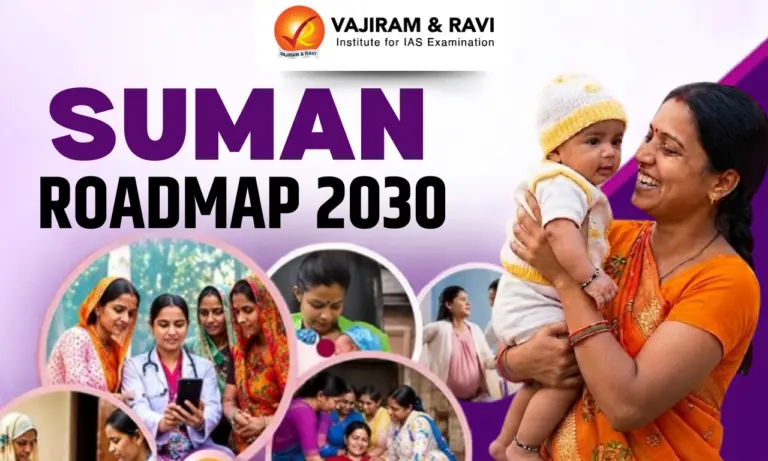
Why in News: The Union Ministry of Health and Family Welfare launched the SUMAN Roadmap 2030 during the 16th Conference of the Central Council of Health and Family Welfare (CCHFW) to strengthen maternal and newborn healthcare and accelerate India’s progress towards the Sustainable Development Goals (SDGs) by 2030.
About SUMAN Roadmap 2030
The SUMAN (Surakshit Matritva Aashwasan) Roadmap 2030 is a comprehensive, evidence-based national strategy launched by the Ministry of Health and Family Welfare to strengthen maternal and newborn healthcare and accelerate India’s progress towards SDG-3 (Good Health and Well-being) by 2030.
Key Features
- Evidence-based strategy: Combines scientific evidence with field experiences to improve maternal and newborn health outcomes.
- RMNCHA+N Framework: Anchored in the Reproductive, Maternal, Newborn, Child, Adolescent Health and Nutrition (RMNCHA+N) framework.
- Life-cycle Approach: Covers the entire continuum from pre-pregnancy, pregnancy, childbirth and postnatal care, while integrating child health, adolescent health, family planning and nutrition.
- Person-centric Healthcare: Aims to deliver equitable, accessible and high-quality maternal and newborn healthcare across the country.
- Focus on High-Burden Areas: Introduces targeted interventions in 130 districts across 13 high-focus States, while providing strategies for all States and UTs.
- Health System Strengthening: Emphasises better referral systems, emergency obstetric care, digital health, community participation and improved healthcare infrastructure.
- Ultimate Goal: Achieve universal coverage of quality maternal and newborn healthcare and zero preventable maternal and newborn deaths by 2030.
Major Interventions under the SUMAN Roadmap 2030
The Roadmap proposes differentiated, evidence-based interventions for high-burden regions while strengthening maternal and newborn healthcare systems across all States and Union Territories.
For High-Focus States
- SUMAN Package for Pregnant Women: Early registration, complete antenatal care, quality clinical assessment and adequate post-partum institutional stay.
- ASHA Home Visits: Bi-weekly visits during the eighth and ninth months for danger sign identification, nutrition counselling and birth preparedness.
- Referral Support: Financial incentives for emergency obstetric transport.
- Caregiver Support: Financial assistance for designated caregivers during the postnatal period.
- Infrastructure Strengthening: Establishment of Birth Waiting Homes, Maternal & Child Health Wings, Obstetric HDUs and ICUs.
For All States and UTs
- Pre-Pregnancy Care: Folic acid supplementation for women planning pregnancy.
- Nutrition Interventions: Address maternal anaemia and undernutrition.
- Maternal Death Reviews: Strengthen Maternal Death Surveillance & Response (MDSR) and Maternal Near Miss (MNM) reviews.
- Emergency Care: Wider use of Non-Pneumatic Anti-Shock Garments (NASG) for obstetric haemorrhage.
- Digital Monitoring: Real-time monitoring through the JANANI Portal.
- Climate-Responsive Care: Special planning for pregnant women and newborns during climate emergencies.
- Optimised Caesarean Sections: Promote appropriate clinical use.
- Child Health Integration: Integrate Samagra Shishu Bal Swasthya Karyakram (SSBSK) for home-based care from birth to 36 months.
- Institutional Strengthening: Develop Centres of Excellence, establish a SUMAN Call Centre and strengthen referral linkages.


Significance of the SUMAN Roadmap 2030
The SUMAN Roadmap 2030 provides a comprehensive strategy to improve maternal and newborn healthcare through targeted interventions, stronger health systems and community participation.
- Supports SDG Targets: Aims to reduce Maternal Mortality Ratio (MMR) to below 70 per 100,000 live births by 2030, while further reducing Neonatal Mortality Rate (NMR) and Infant Mortality Rate (IMR).
- Focuses on High-Burden Areas: Targets 130 districts in 13 high-focus States, helping reduce regional disparities in maternal and newborn health.
- Ensures Continuum of Care: Provides seamless care from pre-pregnancy to postnatal stages by integrating maternal, newborn, child, adolescent health, family planning and nutrition services.
- Promotes Early Risk Detection: Improves identification and management of high-risk pregnancies for timely treatment and better health outcomes.
- Strengthens Healthcare Infrastructure: Expands emergency obstetric care, referral services, Birth Waiting Homes, Maternal & Child Health Wings and specialised care units.
- Uses Digital Innovation: Improves monitoring and service delivery through the JANANI Portal, AI-enabled labour rooms and digital reporting systems.
- Encourages Community Participation: Involves communities through SUMAN Panchayats, Mothers’ Picnic initiatives and active participation of ASHA workers.
- Addresses Emerging Challenges: Includes climate-responsive planning and stronger maternal death reviews to improve healthcare quality.
- Moves Towards Universal Safe Motherhood: Seeks to provide equitable, quality maternal and newborn healthcare across all States and Union Territories, with the goal of zero preventable maternal and newborn deaths.
- Advances Viksit Bharat: Builds healthier mothers and children, strengthening India’s human capital.
Challenges
- Regional disparities in maternal and newborn healthcare.
- Shortage of skilled healthcare personnel in rural and remote areas.
- Weak referral and emergency transport systems.
- High burden of maternal anaemia and undernutrition.
- Limited access in tribal and difficult terrains.
- Variations in quality of antenatal and postnatal care.
- Digital infrastructure and implementation gaps.
- Need for stronger community awareness and behavioural change.
- Climate-related disruptions affecting healthcare delivery.
Way Forward
- Ensure effective implementation through Centre-State coordination.
- Strengthen primary healthcare and referral systems.
- Expand digital health solutions and real-time monitoring.
- Improve nutrition interventions for women before and during pregnancy.
- Build capacity of frontline health workers and specialists.
- Promote community participation through SUMAN Panchayats.
- Strengthen maternal death audits for evidence-based policy.
- Focus on high-burden districts with targeted resource allocation.
- Enhance climate-resilient maternal and newborn healthcare services.
- Ensure universal access to quality maternal and newborn healthcare to achieve zero preventable maternal and newborn deaths by 2030.

 Last updated on Oct, 2026
→ UPSC 2027 Notification will be released on 13 January 2027 at upsconline.nic.in.
→ Check Nobel Prize 2026 Winners List here.
→ Download PIB PRiSM Monthly Magazine 2026 here.
→ Check UPSC Monthly Current Affairs Magazine The Recitals here.
→ Check out the latest UPSC Syllabus here.
→ Download UPSC Model Answers for Mains 2026
→ UPSC Mains Question Paper 2026 is out now for Essay & GS Paper 1, 2, 3 & 4.
→ UPSC Calendar 2027 has been released.
→ Enroll in Vajiram & Ravi’s UPSC Mains Test Series 2027 for structured answer writing practice, expert evaluation, and exam-oriented feedback.
→ Join Vajiram & Ravi’s UPSC Mentorship Program 2027 for personalized guidance, strategy planning, and one-to-one support from experienced mentors.
→ Go through the UPSC Mains Previous Year Papers to enhance your preparation.
→ UPSC has released UPSC Toppers List 2025 with the Civil Services final result on its official website.
→ Also check Best UPSC Coaching in India
SUMAN Roadmap 2030 FAQs
Q1. What is the SUMAN Roadmap 2030?+
Q2. What are the main objectives of the SUMAN Roadmap 2030?+
Q3. Which areas receive special focus under the SUMAN Roadmap 2030?+
Q4. What are the key interventions under the SUMAN Roadmap 2030?+
Q5. How will the SUMAN Roadmap 2030 benefit India?+
Tags: suman roadmap 2030