The Arabian Desert and Green Arabia Hypothesis Latest News
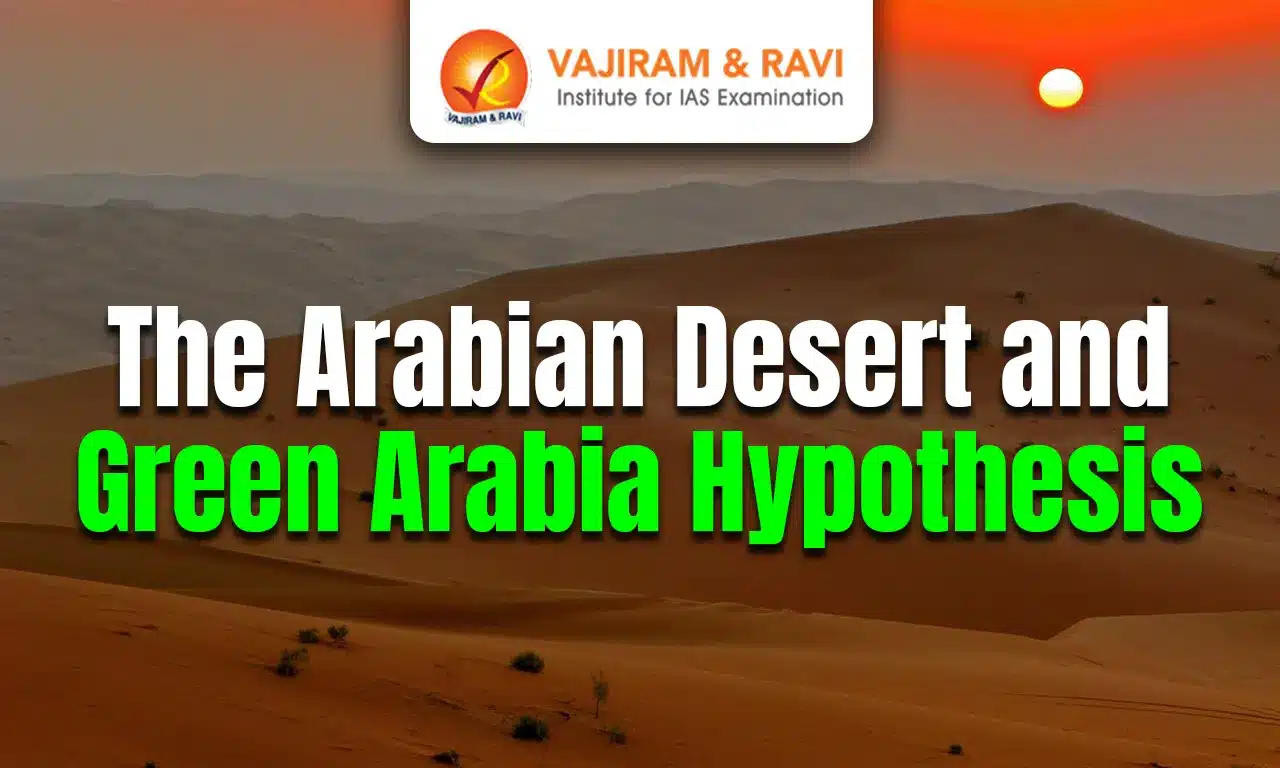
A recent study published in Nature presents evidence of recurring humid periods in the Arabian Desert, currently the largest expanse of dunes on Earth.
Geography of the Arabian Desert
- Spans around 900,000 square miles, making it the second-largest desert in the world (after the Sahara).
- Located across Saudi Arabia, UAE, Yemen, and Oman, and stretches into Iraq, Jordan, Qatar, and Kuwait.
- Composed of three main deserts:
- Rub’al-Khali (Empty Quarter) – the largest dune desert.
- Ad-Dhana Desert – central corridor.
- An-Nafud Desert – northern zone.
Climatic Features
- The region is hyper-arid, with less than 33 mm of annual rainfall.
- Extreme temperature variations: above 50°C during the day, dropping sharply at night.
- Frequent sandstorms, including seasonal Shamals and whirlwinds called Dust Devils, reduce visibility and affect human movement.
Flora and Fauna
- Plant life is scarce but includes Date palms, adenium (desert rose), acacia, ghaf trees, salt-bush, and juniper.
- Animal species:
- Large mammals like the Arabian oryx, camels, and gazelles.
- Predators like striped hyenas, Arabian wolves, and caracals (now rare).
- Reptiles like dhub lizards, horned vipers, and cobras.
- Birds like falcons, vultures, and doves.
- Insects including scarab beetles, ants, and wasps.


Green Arabia Key Discoveries
- Speleothems (Stalagmites & Stalactites): Found deep within caves in the Arabian Peninsula, these mineral deposits form only with consistent rainfall, vegetation, and soil.
- Their existence points to multiple “green phases” in the region over the last 8 million years.
- Uranium dating: Used to accurately determine the age of speleothem formations, providing one of the oldest continuous climate records for Arabia.
- Oxygen isotope analysis: Helped estimate past rainfall levels and periods of humidity, confirming that Arabia was not always a desert.
- Archaeological evidence: In the Baynunah Formation (UAE), fossils dating back 7 million years show the presence of: Hippos, Elephants, Giraffes & Primates.
- These fossils indicate that Green Arabia served as a migratory route for animals and hominids.
Source: SCN

 Last updated on Oct, 2026
→ UPSC 2027 Notification will be released on 13 January 2027 at upsconline.nic.in.
→ Check Nobel Prize 2026 Winners List here.
→ Download PIB PRiSM Monthly Magazine 2026 here.
→ Check UPSC Monthly Current Affairs Magazine The Recitals here.
→ Check out the latest UPSC Syllabus here.
→ Download UPSC Model Answers for Mains 2026
→ UPSC Mains Question Paper 2026 is out now for Essay & GS Paper 1, 2, 3 & 4.
→ UPSC Calendar 2027 has been released.
→ Enroll in Vajiram & Ravi’s UPSC Mains Test Series 2027 for structured answer writing practice, expert evaluation, and exam-oriented feedback.
→ Join Vajiram & Ravi’s UPSC Mentorship Program 2027 for personalized guidance, strategy planning, and one-to-one support from experienced mentors.
→ Go through the UPSC Mains Previous Year Papers to enhance your preparation.
→ UPSC has released UPSC Toppers List 2025 with the Civil Services final result on its official website.
→ Also check Best UPSC Coaching in India
The Arabian Desert and Green Arabia Hypothesis FAQs
Q1. What is the Green Arabia Hypothesis?+
Q2. What evidence supports the Green Arabia theory?+
Q3. How is the Arabian Desert relevant to human evolution?+
Tags: Arabian Desert green arabia hypothesis prelims pointers upsc prelims current affairs