The Mountbatten Plan at 79 Latest News
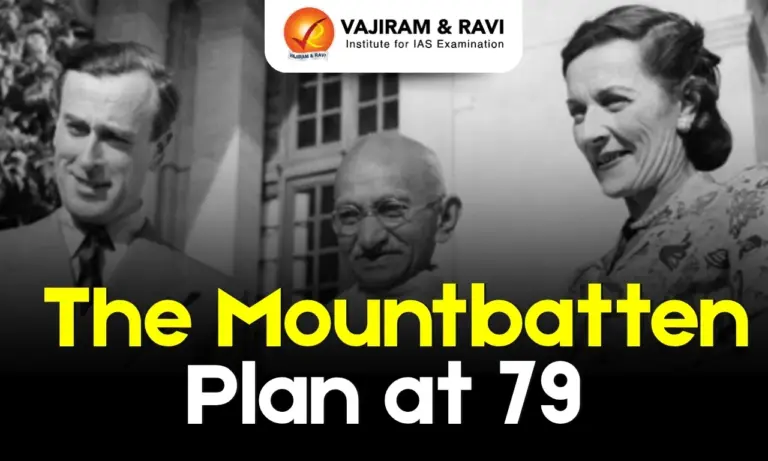
- June 3, 2026 marks the 79th anniversary of the June 3 Declaration — the announcement that sealed the partition of British India into two independent nations, India and Pakistan.
- The article revisits what the plan proposed, why both major political parties accepted it, and what followed.
The Moment of Announcement
- On the evening of June 3, 1947, all of India waited. Shops put up loudspeakers. People gathered in streets and marketplaces.
- As historians described it, India had become “an enormous collective ear, waiting for the broadcasts breathlessly, helplessly and hopelessly.”
- In a Delhi radio studio, four men announced the fate of the subcontinent: Lord Mountbatten (British Viceroy), Jawaharlal Nehru (Congress), Muhammad Ali Jinnah (Muslim League), and Baldev Singh (representing the Sikhs).


The Context: A Country Already on Fire
- When Mountbatten arrived in India on March 22, 1947, he carried a clear mandate from British Prime Minister Clement Attlee — transfer power to Indian hands by June 30, 1948.
- But India was not at peace. Communal violence had already spread widely:
- The Calcutta killings of August 1946
- Riots in Noakhali and Bihar
- Violence spreading to Bombay
- Escalating conflict in Punjab — Amritsar, Taxila, and Rawalpindi
- Mountbatten quickly concluded that a united transfer of power was no longer realistic. After consultations in India and a visit to London in mid-May, he returned to announce the Partition Plan.
What the Plan Proposed
- The June 3 Plan accepted the division of British India as a fait accompli. Its key provisions were:
- Punjab and Bengal — Their Legislative Assemblies would vote on whether to partition these provinces.
- Sindh — Its Assembly would decide whether to join India or Pakistan.
- North-West Frontier Province (NWFP) and Sylhet district — Referendums would be held to determine which country they joined.
- Boundary Commission — If partition occurred, a Commission would draw the borders, particularly in Punjab and Bengal.
- Two dominions — India and Pakistan would each become independent dominions with their own Constituent Assemblies.
- Princely states — They were required to accede to one of the two dominions.
- The transfer of power was advanced to August 15, 1947 — nearly a year ahead of the original deadline.
Why Did the Parties Accept It
- The Indian National Congress
- Congress did not accept partition with enthusiasm. It accepted it reluctantly, driven by practical compulsions.
- The most urgent concern was stopping the violence. Congress leaders believed that only a swift transfer of power could restore order. A prolonged negotiation would only mean more bloodshed.
- There was also a strategic calculation. Congress leaders — particularly Sardar Patel — had concluded that a smaller but cohesive India with a strong central government was preferable to a united India in which the Muslim League could permanently obstruct governance.
- Congress was also alarmed by Mountbatten’s earlier “Plan Balkan”, which would have allowed each province to stand apart from both India and Pakistan — potentially fragmenting the country into dozens of units. Accepting the June 3 Plan was, in a sense, the lesser evil.
- Maulana Azad, who opposed partition to the end, recorded in his memoir India Wins Freedom that Patel had told him bluntly: “whether we liked it or not, there were two nations in India.”
- Nehru accepted it with reluctance. Gandhi eventually reconciled himself after discussions with Mountbatten.
- The Muslim League
- For the Muslim League, the calculus was simpler. Accepting the plan meant Pakistan was guaranteed. That was the League’s central political objective.
- Jinnah and the League feared that in a united, Hindu-majority India, Muslims would be politically marginalised. Partition offered what they saw as a clear path to self-determination.
- Yet even Jinnah had reservations. In a private letter, he wrote that partitioning Punjab and Bengal was “a mistake” — but added that having accepted the plan, he was confident they would “make a good job of it.”
The Aftermath: A Tragedy Unforeseen
- The announcement did not resolve the hard questions. Where exactly would the borders be? Would people need to move? Which districts would fall in which country?
- When journalists asked Mountbatten whether the plan would trigger mass migration, he replied: “Personally I don’t see it.”
- He was spectacularly wrong. In the weeks that followed, violence engulfed large parts of the subcontinent — triggering one of the greatest mass migrations in human history, with millions displaced and hundreds of thousands killed.
- As historians observed, there was “no firm line between winners and losers.” The announcement had sliced through all communities, leaving behind endemic confusion and disorientation.
Source: IE

 Last updated on Oct, 2026
→ UPSC 2027 Notification will be released on 13 January 2027 at upsconline.nic.in.
→ Asian Games 2026 are being held in Aichi-Nagoya, Japan, from 19 September to 4 October.
→ Check Nobel Prize 2026 Winners List here.
→ Download PIB PRiSM Monthly Magazine 2026 here.
→ Check UPSC Monthly Current Affairs Magazine The Recitals here.
→ Check out the latest UPSC Syllabus here.
→ Download UPSC Model Answers for Mains 2026
→ UPSC Mains Question Paper 2026 is out now for Essay & GS Paper 1, 2, 3 & 4.
→ UPSC Calendar 2027 has been released.
→ Enroll in Vajiram & Ravi’s UPSC Mains Test Series 2027 for structured answer writing practice, expert evaluation, and exam-oriented feedback.
→ Join Vajiram & Ravi’s UPSC Mentorship Program 2027 for personalized guidance, strategy planning, and one-to-one support from experienced mentors.
→ Go through the UPSC Mains Previous Year Papers to enhance your preparation.
→ UPSC has released UPSC Toppers List 2025 with the Civil Services final result on its official website.
→ Also check Best UPSC Coaching in India
The Mountbatten Plan at 79 FAQs
Q1. What is The Mountbatten Plan at 79?+
Q2. What were the main provisions of The Mountbatten Plan at 79?+
Q3. Why did Congress accept The Mountbatten Plan at 79?+
Q4. Why did the Muslim League support The Mountbatten Plan at 79?+
Q5. What was the outcome of The Mountbatten Plan at 79?+
Tags: mains articles The Mountbatten Plan at 79 upsc current affairs upsc mains current affairs