What’s in today’s article?
- Why in News?
- What is the UP Madarsa Education Act 2004?
- Status of Madarsas in UP
- On What Grounds Allahabad HC Declared Madarsa Act Unconstitutional
- Key Arguments on the Constitutionality of the Madarsa Education Act Before the SC
- Wider Implications of the SC’s Decision on the Madarsa Education Act
- Conclusion
Why in News?
- The Supreme Court of India (SC) has reserved its judgement in a case concerning the constitutionality of the Uttar Pradesh (UP) Board of Madarsa Education Act, 2004.
- This verdict holds significant implications for the future of religious education in India, as it addresses key issues related to secularism, the right to education, and the intersection of religious and modern education.


What is the UP Madarsa Education Act 2004?
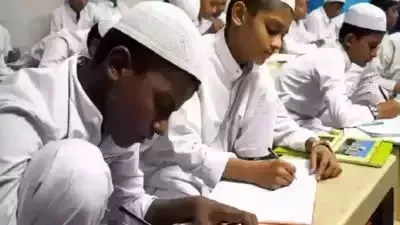
- Governs madarsas: The Act governs the education provided in madarsas – institutions which offer education that integrates religious teachings with some elements of modern, secular subjects, though religious instruction takes precedence.
- Established the UP Board of Madarsa Education:
- This board, predominantly composed of members from the Muslim community, is responsible for preparing curriculum and conducting examinations for various madarsa courses, ranging
- From ‘Maulvi’ (equivalent to Class 10)
- To ‘Fazil’ (equivalent to a Master’s degree).
- This board, predominantly composed of members from the Muslim community, is responsible for preparing curriculum and conducting examinations for various madarsa courses, ranging
Status of Madarsas in UP:
- The state has the highest number of madarsas in India: In 2023, about 1.69 lakh students from over 14,000 recognised institutions took the UP Madarsa board exams, which correspond to the Class 10 and Class 12 levels.
- The Madarsa Education Act was declared unconstitutional: In March 2024, the Allahabad HC struck down the Act of 2004, deeming it unconstitutional and instructing the state government to integrate madarsa students into the formal education system.
- What followed the HC decision?
- The SC temporarily stayed the ruling in April 2024 and began hearing the case in October.
- The SC also stayed two notifications issued by the National Commission for the Protection of Child Rights (NCPCR), which called for inspections of madarsas and the enrollment of non-Muslim students into these institutions.
On What Grounds Allahabad HC Declared Madarsa Act Unconstitutional:
- Violation of secularism:
- The HC referred to previous SC judgments to highlight that secularism means equal treatment of all religions by the state.
- The court noted that the madarsa curriculum made religious education on Islam compulsory while offering modern subjects as optional, which it argued conflicted with the state’s duty to provide secular education.
- The court emphasised that the government should not favour any particular religion or religious sect through education policies.
- Violation of the right to education:
- The HC held that the Madarsa Act violated Article 21A of the Indian Constitution, which guarantees free and compulsory education to all children between the ages of six and fourteen.
- It argued that the curriculum offered in madarsas did not meet the standard of quality education as defined by the Right to Education (RTE) Act, 2009.
- The court criticised the state for failing to ensure that madarsa students receive a comprehensive education in modern subjects.
- Conflict with the UGC Act:
- The Allahabad HC also found that the provisions of the Madarsa Act conflicted with the University Grants Commission (UGC) Act, 1956.
- The UGC Act grants only recognised universities or deemed universities the authority to confer degrees.
- The madarsa board’s ability to grant degrees, therefore, was deemed unconstitutional, as it overstepped the boundaries set by the UGC Act.
Key Arguments on the Constitutionality of the Madarsa Education Act Before the SC:
- Religious education vs. religious instruction:
- A major point of contention was whether madarsas provide “religious education” or “religious instruction.”
- The distinction is crucial, as Article 28 of the Indian Constitution prohibits religious instruction in state-funded educational institutions.
- However, religious education, which provides knowledge about different religions, is permitted for fostering communal harmony.
- Senior Advocate, representing the madarsa board, argued that the Allahabad HC wrongly combined “religious education” with “religious instruction,” leading to the conclusion that the Act violated secularism.
- Striking down the entire Act:
- Another key debate revolved around whether the HC should have struck down the entire Act or only specific provisions that were found to be unconstitutional.
- Chief Justice D.Y. Chandrachud noted that the state government has the authority to regulate madarsa education in a way that aligns with secular principles, without completely abolishing the Act.
Wider Implications of the SC’s Decision on the Madarsa Education Act:
- The decision will likely have national ramifications in addition to directly affecting how madarsas function in UP.
- The case touches on broader issues concerning –
- The balance between religious education and secularism,
- As well as the role of the state in ensuring that all children, regardless of their religious background, receive a modern, secular education.
- The SC’s ruling could impact not only madarsas but also other religious educational institutions, such as gurukuls and convent schools, which incorporate religious teachings into their curricula.
- Therefore, CJI issued a warning that when regulating religious instruction, secularism principles need to be properly taken into account.
Conclusion:
- The SC’s forthcoming judgement in the madarsa education case could set a significant precedent for religious education in India.
- This case has the potential to reshape how religious and secular education coexist in India’s diverse educational landscape.
Q.1. What is secularism as per the Constitution of India?
‘Secularism’ was introduced in India in 1976 by the 42nd Amendment to the Constitution. Secularism entails keeping religion and politics apart, which essentially means that the government should not support or adhere to any one religion but should instead give equal weight to all of them.
Q.2. What is the significance of Article 28 of the Indian Constitution?
Article 28 of the Indian Constitution protects the freedom of religion in educational institutions and ensures a secular educational environment.
News: Madarsa Education Act: SC reserves order on appeals against Allahabad HC’s ‘unconstitutional’ verdict | IE | IE

 Last updated on Oct, 2026
→ UPSC 2027 Notification will be released on 13 January 2027 at upsconline.nic.in.
→ Check Nobel Prize 2026 Winners List here.
→ Download PIB PRiSM Monthly Magazine 2026 here.
→ Check UPSC Monthly Current Affairs Magazine The Recitals here.
→ Check out the latest UPSC Syllabus here.
→ Download UPSC Model Answers for Mains 2026
→ UPSC Mains Question Paper 2026 is out now for Essay & GS Paper 1, 2, 3 & 4.
→ UPSC Calendar 2027 has been released.
→ Enroll in Vajiram & Ravi’s UPSC Mains Test Series 2027 for structured answer writing practice, expert evaluation, and exam-oriented feedback.
→ Join Vajiram & Ravi’s UPSC Mentorship Program 2027 for personalized guidance, strategy planning, and one-to-one support from experienced mentors.
→ Go through the UPSC Mains Previous Year Papers to enhance your preparation.
→ UPSC has released UPSC Toppers List 2025 with the Civil Services final result on its official website.
→ Also check Best UPSC Coaching in India