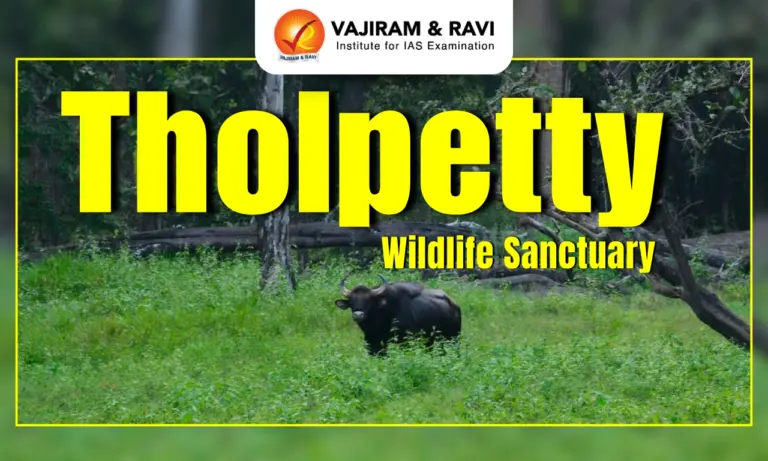
Tholpetty Wildlife Sanctuary Latest News
A wild gaur that had strayed into densely populated areas of Kannur District, Kerala, was captured by a Forest department expert team and later released into the forest area of the Tholpetty Wildlife Sanctuary recently.
About Tholpetty Wildlife Sanctuary
- It is located in the Wayanad district in Kerala.
- It is part of the larger Wayanad Wildlife Sanctuary and the Nilgiri Biosphere Reserve.
- Tholpetty in the north is one of the two discontinuous pockets of Wayanad Sanctuary, the other being Muthanga in the south.
- Flora:
- The forests consist of both tropical moist dry deciduous and semi-evergreen forests.
- Plantations of teak, eucalyptus, silver oak, and rosewood cover about one-third of the sanctuary.
- Fauna:
- Elephants, tigers, panthers, jungle cats, civet cats, monkeys, wild dogs, bison, deer, bears, and snakes can be spotted in the sanctuary.
- The sanctuary is also a bird watcher’s paradise, hosting over 300 species of birds.
- Some notable avian residents include the Malabar grey hornbill, crested serpent eagle, peafowl, and various species of woodpeckers and kingfishers.


Key Facts about Gaur
- Gaur, also known as Indian bison, is the largest species among the wild cattle and the Bovidae.
- Scientific Name: Bos gaurus
- Habitat and Distribution:
- Gaurs are indigenous to the South and Southeast parts of Asia.
- They are found in Vietnam, Cambodia, Laos, Thailand, Peninsular Malaysia, Myanmar, India, Bangladesh, Bhutan, China, and Nepal.
- They are primarily found in evergreen and semi-evergreen forests along with moist deciduous forests with open grasslands.
- They prefer hilly-terrains below an altitude of 1,500-1,800 m with large and undisturbed forest tracts and abundant water.
- Features:
- Gaur is a large animal with a sturdy build.
- It has a short and deep neck, a massive head, and frequently a large dewlap on the throat and chest.
- The color of their body varies from reddish or brown to black, while the limbs are pale colored.
- Both males and females have upwardly curved horns, growing from the sides of their heads. Their horns have a yellow base and black tip.
- These animals have a hump on their shoulders, which is especially prominent in adult males.
- Conservation Status:
- IUCN Red List: Vulnerable
Source: TH

 Last updated on Oct, 2026
→ UPSC 2027 Notification will be released on 13 January 2027 at upsconline.nic.in.
→ Check Nobel Prize 2026 Winners List here.
→ Download PIB PRiSM Monthly Magazine 2026 here.
→ Check UPSC Monthly Current Affairs Magazine The Recitals here.
→ Check out the latest UPSC Syllabus here.
→ Download UPSC Model Answers for Mains 2026
→ UPSC Mains Question Paper 2026 is out now for Essay & GS Paper 1, 2, 3 & 4.
→ UPSC Calendar 2027 has been released.
→ Enroll in Vajiram & Ravi’s UPSC Mains Test Series 2027 for structured answer writing practice, expert evaluation, and exam-oriented feedback.
→ Join Vajiram & Ravi’s UPSC Mentorship Program 2027 for personalized guidance, strategy planning, and one-to-one support from experienced mentors.
→ Go through the UPSC Mains Previous Year Papers to enhance your preparation.
→ UPSC has released UPSC Toppers List 2025 with the Civil Services final result on its official website.
→ Also check Best UPSC Coaching in India
Tholpetty Wildlife Sanctuary FAQs
Q1. Where is Tholpetty Wildlife Sanctuary located?+
Q2. Tholpetty Wildlife Sanctuary is part of which larger wildlife sanctuary?+
Q3. What type of forests are found in Tholpetty Wildlife Sanctuary?+
Tags: prelims pointers tholpetty wildlife sanctuary upsc current affairs upsc prelims current affairs