Tigidia singhal Latest News
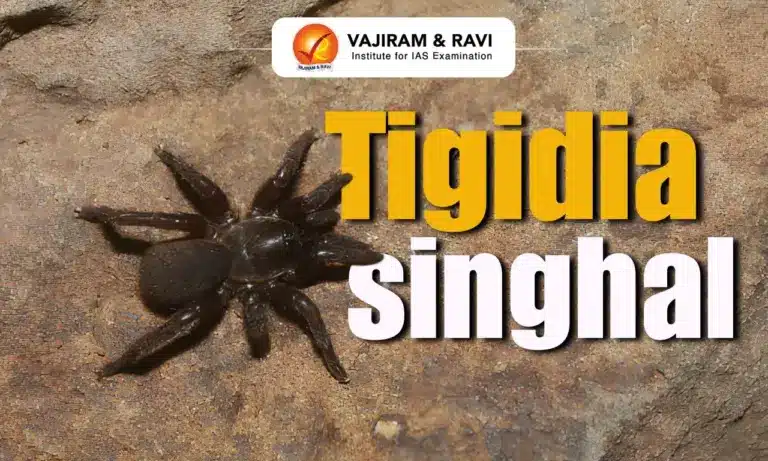
Researchers recently described a new trapdoor spider species, Tigidia singhal, from the semi-arid grasslands of the Deccan Plateau.
About Tigidia singhalt
- It is a new species of trapdoor spider.
- It was discovered from the semi-arid grasslands of the Deccan Plateau in Maharashtra.
- The collected specimen was a 15-millimetre-long female with black legs covered in greyish bristle-like hairs and a lighter abdomen with chevron-shaped markings.
- The discovery brings the number of Tigidia species in India to eight. Spiders of the genus Tigidia occur only in Madagascar, Mauritius, and India.
- Until now, species of this genus were known from peninsular India’s tropical evergreen and deciduous forests, particularly the Western and Eastern Ghats.
- T. singhal is the first record of this genus from a semi-arid open natural ecosystem.


What are Trapdoor Spiders?
- Trapdoor spiders are long-living, sedentary spiders that spend most of their lives in burrows, rarely leaving except to search for a mate.
- The doors of silk, soil, moss, and leaves that many species construct to camouflage their burrows give this group its name.
- This adaptation has great advantages for the spider, providing protection against desiccation and predators and enabling efficient prey capture.
- They feed by quickly opening the trap door and grabbing an insect or other arthropod that is passing close by.
- Trapdoor spider burrows aerate soil, maintain soil structure, and provide microhabitats for other organisms.
- Highly sensitive to habitat disturbances, these spiders also serve as ecological indicators, with their presence suggesting a healthy ecosystem and rich soil biodiversity.
- They belong to the infraorder Mygalomorphae, which also includes tarantulas and funnel-web spiders.
- The genus Tigidia falls within the family Barychelidae (brush-footed spiders) — one of India’s nine mygalomorph families.
News: MONG

 Last updated on Oct, 2026
→ UPSC 2027 Notification will be released on 13 January 2027 at upsconline.nic.in.
→ Check Nobel Prize 2026 Winners List here.
→ Download PIB PRiSM Monthly Magazine 2026 here.
→ Check UPSC Monthly Current Affairs Magazine The Recitals here.
→ Check out the latest UPSC Syllabus here.
→ Download UPSC Model Answers for Mains 2026
→ UPSC Mains Question Paper 2026 is out now for Essay & GS Paper 1, 2, 3 & 4.
→ UPSC Calendar 2027 has been released.
→ Enroll in Vajiram & Ravi’s UPSC Mains Test Series 2027 for structured answer writing practice, expert evaluation, and exam-oriented feedback.
→ Join Vajiram & Ravi’s UPSC Mentorship Program 2027 for personalized guidance, strategy planning, and one-to-one support from experienced mentors.
→ Go through the UPSC Mains Previous Year Papers to enhance your preparation.
→ UPSC has released UPSC Toppers List 2025 with the Civil Services final result on its official website.
→ Also check Best UPSC Coaching in India
Tigidia singhal FAQs
Q1. What is Tigidia singhal?+
Q2. Where was Tigidia singhal discovered?+
Q3. To which group of spiders does Tigidia singhal belong?+
Q4. In which three regions of the world does the genus Tigidia occur?+
Q5. What type of ecosystem does Tigidia singhal inhabit?+
Tags: prelims pointers tigidia singhal upsc current affairs upsc prelims current affairs