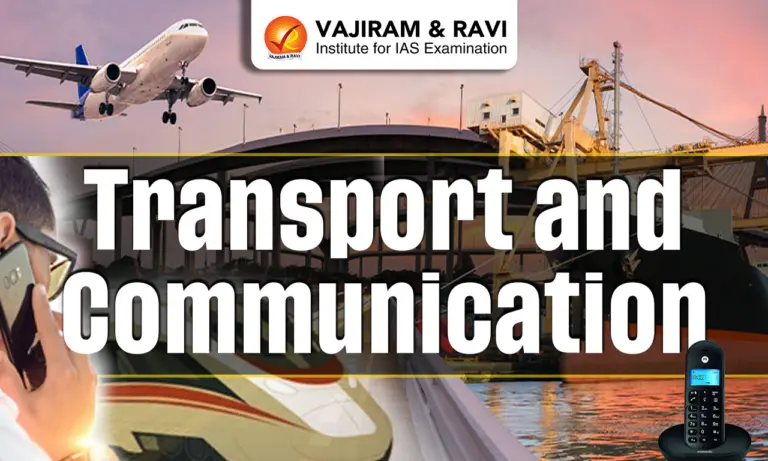
Transport and Communication are the foundation of economic development, national integration, and modernization. They connect people, goods, services, and information across regions. In today’s digital and globalized world, their importance has increased even more due to rapid technological advancements and infrastructure expansion.
Modes of Transport
Modes of transport refer to the different ways through which people, goods, and services are moved from one place to another. Each mode has its own importance, advantages, limitations, and suitability depending on distance, cost, speed, and type of goods.
1. Road Transport
- India has a vast road network of over 6.4 million km, making it one of the largest road systems in the world
- National Highways (NHs) form the main arteries, covering about 1.45 lakh km and carrying nearly 40% of total traffic
- State Highways and District Roads connect state capitals, towns, and rural areas, acting as feeder routes to NHs
- Rural Roads ensure last-mile connectivity, linking villages to markets, schools, and healthcare facilities
- Roads handle around 85-90% passenger traffic and 60-65% freight movement, showing their dominant role
- Development of expressways and economic corridors has improved speed, logistics efficiency, and connectivity
- Road transport provides door-to-door service, making it ideal for short and medium distances and perishable goods
- Use of FASTag, GPS, and Intelligent Transport Systems (ITS) has enhanced efficiency and transparency
- Major challenges include traffic congestion, road accidents, pollution, and high maintenance cost
2. Rail Transport
- Indian Railways is one of the largest rail networks in the world, with over 68,000 route km, ensuring wide connectivity
- Railways carry more than 7 billion passengers annually and over 1.6 billion tonnes of freight, showing their mass transport capacity
- Ideal for transporting bulk goods like coal, iron ore, cement, and food grains over long distances at low cost
- Dedicated Freight Corridors (DFCs) are being developed to improve speed, efficiency, and freight capacity
- Rapid electrification of railway lines (over 85%+) reduces fuel dependence and pollution
- Introduction of semi-high-speed trains like Vande Bharat Express improves travel time and passenger comfort
- Rail transport is more energy-efficient and cost-effective compared to road transport for long-distance travel
- Supports industrial development and regional connectivity by linking production centers with markets
- Major challenges include high capital cost, track congestion, delays, and maintenance requirements
3. Water Transport
- Water transport is the cheapest and most energy-efficient mode, especially suitable for bulk and heavy cargo
- Includes Inland Waterways (rivers, canals, lakes) and Ocean Transport for international trade
- India has 111 declared National Waterways, with National Waterway 1 being the most important for cargo movement
- Around 95% of India’s trade by volume and 70% by value is carried through maritime transport via ports
- Major ports like Jawaharlal Nehru Port Authority handle a large share of container traffic
- Highly suitable for transporting coal, petroleum, iron ore, fertilizers, and food grains over long distances
- Considered environment-friendly, as it produces lower carbon emissions compared to road and rail transport
- Helps in reducing logistics cost and decongesting roads and railways
- Major limitations include slow speed, dependence on water availability, seasonal rivers, and port infrastructure constraints
4. Air Transport
- Air transport is the fastest mode of transport, ideal for long-distance and international travel
- India has a rapidly growing aviation network with over 140+ operational airports, improving regional connectivity
- Airports Authority of India manages and develops a large number of airports across the country
- Handles high-value, low-volume, and perishable goods such as electronics, medicines, and fresh produce
- Crucial for tourism, business travel, emergency services, and disaster relief operations
- Regional connectivity has improved under schemes like UDAN Scheme, linking smaller towns and remote areas
- Provides access to remote and difficult terrains such as hilly, desert, and island regions
- Offers high speed and time-saving advantages, but involves high operational and travel costs
- Major challenges include expensive infrastructure, weather disruptions, limited cargo capacity, and environmental concerns
Modern Means of Communication
Modern means of communication refer to advanced systems that enable the fast, efficient, and real-time exchange of information across the world. With the growth of digital technology, communication has become instant, affordable, and widely accessible, transforming daily life, governance, and business.
- Telecommunication systems such as mobile networks and landlines enable instant voice and data communication across long distances
- Rapid expansion of internet services (broadband, fiber optics) has improved high-speed connectivity in urban and rural areas
- Mobile communication with smartphones supports calls, messaging, video conferencing, and internet access on a single device
- Deployment of 5G technology is enhancing speed, low latency, and advanced applications like IoT and smart cities
- Digital communication platforms such as email, messaging apps, and social media allow real-time information sharing and global interaction
- Satellite communication plays a key role in weather forecasting, GPS navigation, disaster management, and broadcasting
- Mass media systems like television and radio continue to provide information, education, and entertainment to large populations
- Growth of cloud computing and data centers supports storage, processing, and secure transmission of large volumes of data
- E-governance services use digital communication to deliver public services, online applications, and digital payments efficiently
- Increasing focus on cybersecurity and data protection to ensure safe and reliable communication networks


Role of Transport and Communication in Economic Development
Transport and Communication are key drivers of economic development as they connect producers, consumers, markets, and resources.
- Enable efficient movement of goods and services, reducing logistics time; India’s logistics cost is ~13-14% of GDP, with efforts to bring it closer to the global average of 8-9%
- Promote trade and commerce, with about 95% of trade by volume and 70% by value carried through maritime transport
- Support industrial development, as railways transport over 1.6 billion tonnes of freight annually, ensuring bulk movement of raw materials
- Boost agriculture by connecting rural areas; over 6.4 million km road network ensures farm-to-market connectivity and reduces wastage of perishable goods
- Encourage regional development, with expansion of National Highways beyond 1.45 lakh km, improving connectivity in backward and remote areas
- Generate employment opportunities, as transport and logistics sector contributes around 13-14% to GDP and employs millions directly and indirectly
- Strengthen the digital economy, with over 1.2 billion telecom connections and affordable data enabling growth of e-commerce and digital payments
- Improve access to education and healthcare, especially through internet penetration and rural connectivity programs
- Promote tourism, with rapid growth in air transport and improved road infrastructure increasing domestic and international travel
- Enhance national integration and governance, with 5G coverage reaching over 80-85% of population, enabling faster communication and digital services
Government Initiatives on Transport and Communication
The initiatives taken by the Government of India to strengthen and improve Transport and Communication systems have been discussed below in brief.
- Bharatmala Pariyojana focuses on developing economic corridors, border roads, coastal roads, and expressways to improve freight movement and reduce logistics cost
- Sagarmala Programme aims at modernizing ports, enhancing port connectivity, and promoting coastal shipping for efficient trade
- Pradhan Mantri Gram Sadak Yojana ensures all-weather road connectivity to unconnected rural habitations, boosting rural development
- Development of Dedicated Freight Corridors (DFCs) by Indian Railways to enable faster and efficient transport of goods and reduce congestion on passenger routes
- Introduction of semi-high-speed trains like Vande Bharat Express to improve speed, safety, and passenger experience
- Expansion of inland waterways under Jal Marg Vikas Project to promote low-cost and eco-friendly cargo transport
- UDAN Scheme enhances regional air connectivity by making air travel affordable and linking smaller towns
- Digital India Programme promotes broadband connectivity, digital services, and e-governance across the country
- BharatNet Project aims to provide high-speed internet connectivity to all gram panchayats, reducing the digital divide
- Implementation of 5G network rollout to enable high-speed internet, smart infrastructure, and advanced communication technologies
- Development of multimodal logistics parks to integrate road, rail, air, and water transport, improving overall efficiency
- Promotion of electric mobility and green transport policies to reduce carbon emissions and pollution
- Strengthening of cybersecurity frameworks and digital infrastructure to ensure safe and reliable communication systems
Challenges in Transport and Communication
Transport and communication systems face multiple structural and technological challenges that affect efficiency, accessibility, and sustainability. These issues increase costs, create regional imbalances, and limit the overall growth potential of the economy.
- High transportation cost (around 13-14% of GDP) compared to global average (8-9%), reducing competitiveness
- Traffic congestion in urban areas causing delays, fuel wastage, and productivity loss
- Inadequate infrastructure in rural and remote regions leading to poor connectivity
- Environmental concerns such as air pollution and high carbon emissions from transport systems
- Road safety issues with high accident rates due to poor enforcement and infrastructure gaps
- Overburdened rail networks affecting speed, punctuality, and freight efficiency
- Digital divide limiting internet access and communication services in rural areas
- Cybersecurity and data privacy risks affecting the safety of modern communication systems

 Last updated on Oct, 2026
→ UPSC 2027 Notification will be released on 13 January 2027 at upsconline.nic.in.
→ Check Nobel Prize 2026 Winners List here.
→ Download PIB PRiSM Monthly Magazine 2026 here.
→ Check UPSC Monthly Current Affairs Magazine The Recitals here.
→ Check out the latest UPSC Syllabus here.
→ Download UPSC Model Answers for Mains 2026
→ UPSC Mains Question Paper 2026 is out now for Essay & GS Paper 1, 2, 3 & 4.
→ UPSC Calendar 2027 has been released.
→ Enroll in Vajiram & Ravi’s UPSC Mains Test Series 2027 for structured answer writing practice, expert evaluation, and exam-oriented feedback.
→ Join Vajiram & Ravi’s UPSC Mentorship Program 2027 for personalized guidance, strategy planning, and one-to-one support from experienced mentors.
→ Go through the UPSC Mains Previous Year Papers to enhance your preparation.
→ UPSC has released UPSC Toppers List 2025 with the Civil Services final result on its official website.
→ Also check Best UPSC Coaching in India
Transport and Communication FAQs
Q1. What is transport?+
Q2. What is communication?+
Q3. What are the main modes of transport?+
Q4. hich is the cheapest mode of transport?+
Q5. Which is the fastest mode of transport?+
Q6. Why is road transport important?+
Tags: economic geography geography notes transport and communication