
MSCI Rebalancing and India’s Declining Weight: Impact on FPI Flows and Stock Markets

MSCI Rebalancing

MSCI Rebalancing Latest News

  • MSCI's quarterly rebalancing of its global benchmark indices came into effect recently, triggering a sharp sell-off in Indian stock markets — with benchmark indices ending 1.5% down. 
  • Foreign Portfolio Investors (FPIs) accounted for around 69% of the total NSE turnover of ₹2.87 lakh crore on the day of rebalancing — highlighting just how powerfully MSCI's decisions move Indian markets.

What is MSCI and Why Does It Matter

  • MSCI (Morgan Stanley Capital International) is a New York-based financial firm that creates and maintains global benchmark stock indices — essentially lists of companies from across the world, grouped by country and region, with specific weights assigned to each. 
  • These indices are keenly watched by investors worldwide because they directly dictate the flow of capital — particularly from passive funds (funds that simply mirror an index rather than actively picking stocks). 
  • When MSCI increases a country's weight, funds automatically buy more of that country's stocks. 
  • When the weight falls, they sell. This mechanical buying and selling can trigger massive market movements — as seen in India recently.

MSCI Rebalancing

  • Every quarter, MSCI reviews and adjusts its indices — adding or removing companies, and changing the weights assigned to countries based on factors like market capitalisation, share price performance, and liquidity. 
  • This is called rebalancing.

What Changed in the Latest Rebalancing

  • The number of Indian companies in the MSCI Global Standard index remained unchanged at 165 — but there were compositional changes (few companies removed and few others added).
  • India's weight in MSCI Global Standard index — edged down from 12.4% to 12.3%.
  • India's weight in MSCI Emerging Markets (EM) index — has been on a downward trend since peaking at around 21% in September 2024 and now stands at 11.94%.

India vs Asian Peers — The AI Gap

  • India's declining weight in the MSCI EM index tells a larger story about the structural shift in global equity markets driven by Artificial Intelligence (AI).
    • Taiwan - 24.84%
    • China - 23.05%
    • South Korea - 18.69%
    • India - 11.94%

The Taiwan Story — AI and Semiconductors

  • Taiwan has surged ahead driven entirely by AI-driven demand for semiconductors. Taiwan Semiconductor Manufacturing Company (TSMC) — the world's largest chipmaker — has seen its share price more than double in the last year. 
  • TSMC is one of only two non-US entities in the world's top-10 most valuable companies — the other being Saudi Aramco.
  • Taiwan recently overtook India to become the fifth most valuable stock market in the world by market capitalisation. 
  • MSCI described the catalyst bluntly — "AI. Specifically, the scale of AI-driven demand for semiconductors."

India's Structural Weakness — No AI Play

  • The absence of a significant AI or semiconductor play in India's stock market — earlier viewed as a contrarian strategy — has now become a glaring structural weakness. 
  • India's top two companies by MSCI weight — HDFC Bank and Reliance Industries — each have a weight of only 0.79% in the EM index, compared to TSMC's 14.21% alone. 
  • As MSCI noted, "broad EM exposure today is structurally different than a year ago — with more technology, more semiconductors, and a more direct stake in the global AI build-out." 
  • India, with its IT sector dominated by services rather than semiconductor manufacturing, is structurally absent from this global AI wealth creation wave.

FPI Exodus from India — The Capital Flight Story

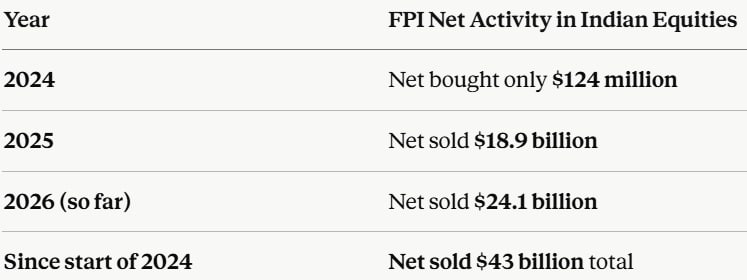
  • The MSCI weight decline and India's AI gap are directly reflected in how Foreign Portfolio Investors have been treating Indian equities — with sustained and accelerating selling:
FPI Activity

  • This sustained FPI outflow — compounded by the rupee's depreciation making Indian assets less attractive in dollar terms — is creating a negative feedback loop: FPI selling weakens the rupee, a weaker rupee reduces India's dollar-denominated market cap, which reduces India's MSCI weight, which triggers more passive fund selling.

Source: IE | IE

MSCI Rebalancing FAQs

Q1: What is MSCI Rebalancing and India's Declining Weight?

Ans: MSCI Rebalancing and India's Declining Weight refer to the reduction in India's share within MSCI indices, influencing foreign investment flows and market performance.

Q2: Why does MSCI rebalancing matter for India?

Ans: MSCI Rebalancing and India's Declining Weight affect passive fund investments because many global funds automatically adjust holdings according to MSCI index weights.

Q3: Why has India's MSCI weight been declining?

Ans: MSCI Rebalancing and India's Declining Weight are linked to AI-driven gains in semiconductor-heavy markets such as Taiwan and continued foreign investor outflows.

Q4: How does Taiwan's rise affect India's MSCI weight?

Ans: MSCI Rebalancing and India's Declining Weight reflect Taiwan's strong semiconductor sector, especially TSMC, which has benefited from global AI demand.

Q5: What are the implications of India's declining MSCI weight?

Ans: MSCI Rebalancing and India's Declining Weight may lead to reduced passive fund inflows, increased market volatility, and pressure on foreign portfolio investment trends.

India’s Push for Coal Gasification: Reducing Import Dependence and Strengthening Energy Security

India's Push for Coal Gasification

India's Push for Coal Gasification Latest News

  • Union Coal and Mines Minister promoted surface coal gasification at a roadshow, stating the technology has the potential to substitute imports worth up to ₹3 lakh crore. 
  • The Union Cabinet approved a ₹37,500-crore incentive package to encourage coal gasification — a significant policy push to utilise India's vast coal reserves while reducing import dependence on key industrial chemicals.

What is Coal Gasification

  • Imagine taking coal — a solid fuel — and converting it into a useful gas. That is essentially what coal gasification does. 
  • It converts coal into synthetic gas (syngas) — a mixture of hydrogen and carbon monoxide — which can then be used as a raw material to produce a wide range of valuable downstream products.

What Can Syngas Produce

  • Urea — critical for fertilisers
  • Ammonia — used in fertilisers and chemicals
  • Methanol — used as fuel and in chemical manufacturing
  • Synthetic Natural Gas (SNG) — substitute for natural gas
  • Hydrogen — clean energy fuel
  • Ammonium nitrate, ether, dimethyl ether — various industrial uses

Why Does India Need Coal Gasification

  • India is currently heavily import-dependent for several key industrial chemicals that can be produced domestically through coal gasification:
    • Urea — India imports one-fifth of its requirement.
    • Ammonia — India imports almost its entire requirement.
    • Methanol — India imports approximately 80-90% of its requirement.
  • Meanwhile, India sits on vast coal reserves — approximately 401 billion tonnes of coal and about 47 billion tonnes of lignite — making it one of the most coal-rich countries in the world. 
  • Coal gasification offers a way to leverage these domestic resources to produce chemicals that India currently spends enormous foreign exchange importing — directly improving energy security, reducing the current account deficit, and creating domestic industrial capacity.

India's Targets and Financial Support

  • The Ministry of Coal has set a target of gasifying 100 million tonnes of coal by 2030. 
  • The recently announced scheme aims to support gasification of about 75 million tonnes of coal and/or lignite to reach this target.

Financial Incentives

  • ₹8,500 crore package — approved in January 2024; of this, ₹6,233 crore disbursed to eight projects.
  • ₹37,500 crore package — recently approved, providing incentives amounting to one-fifth of plant and machinery costs — recognising that capital costs are the single largest cost component in gasification projects.

Key Projects and Their Timelines

  • Talcher Coal-based Ammonia-Urea Complex — Expected commissioning: FY2027-28.
  • Projects converting coal to syngas, ammonium nitrate, direct reduced iron, ethanol, and hydrogen — Expected commissioning: FY2029-30.

Key Players

  • Public Sector — Coal India (joint ventures with BHEL and GAIL), Coal India's own project in Western Coalfields.
  • Private Sector — Jindal Steel and Power, Greta Energy and Metal.

The Technical Challenge — India's High-Ash Coal

  • This is the most critical and distinctive challenge in India's coal gasification programme — one that sets India apart from all other major coal-gasifying nations.
  • Indian coal has very high ash content — along with variability in gross calorific value (GCV) and the presence of complex mineral matter. 
  • These characteristics make standard gasification technologies used in countries like China, Australia, and the US — where coal quality is significantly better — unsuitable for Indian coal.

What Technology Suits Indian Coal

  • Fluidised-bed gasification is considered particularly suitable for high-ash Indian coal. 
  • This technology uses a gas stream that lifts the coal out of ash and then gasifies it with heat — allowing it to handle the variability and high ash content that would clog or damage conventional gasifiers.
  • BHEL has specifically developed a pressurised fluidised-bed gasifier technology tailored to handle the high ash content and variability of Indian coal — an important step toward indigenous technological capability.

The Indigenisation Challenge and Opportunity

  • Coal gasification projects are by their very nature highly capital-intensive with long gestation periods. 
  • According to a research, capital costs constitute nearly 30% of total syngas production costs — making financial viability the central challenge.
  • BHEL — has developed indigenous pressurised fluidised-bed gasifier technology; its 16 facilities are capable of producing all critical components for gasification.
  • Jindal Steel and Greta Energy — have indigenised approximately 80-90% of their production requirements.
  • At its maturing stages, coal gasification may still require technology imports — particularly from China, which is the world leader in gasification technology. 
    • Industry has sought government consideration of exemptions from DPIIT regulations for acquiring necessary technologies from China.

Conclusion

  • India's coal gasification push sits at the intersection of several critical policy priorities — energy security (reducing import dependence), industrial policy (creating domestic chemical manufacturing capacity), agricultural security (domestic urea and fertiliser production), Aatmanirbhar Bharat (indigenising technology), and sustainable mining (better utilisation of coal resources). 
  • However, the programme faces significant challenges including technical adaptation for high-ash coal, capital intensity, long project gestation periods, and dependence on Chinese technology at scale.

Source: TH

India's Push for Coal Gasification FAQs

Q1: What is India's Push for Coal Gasification?

Ans: India's Push for Coal Gasification seeks to convert domestic coal into syngas for producing fertilisers, chemicals, hydrogen, and synthetic fuels while reducing import dependence.

Q2: Why is coal gasification important for India?

Ans: India's Push for Coal Gasification can lower imports of urea, ammonia, and methanol, improve energy security, and create domestic industrial capacity.

Q3: What products can be produced through coal gasification?

Ans: Coal gasification produces syngas, which can be converted into urea, ammonia, methanol, hydrogen, synthetic natural gas, and industrial chemicals.

Q4: What challenges does India's Push for Coal Gasification face?

Ans: India's Push for Coal Gasification faces challenges such as high-ash coal, capital-intensive projects, long gestation periods, and technology dependence.

Q5: What support has the government provided for coal gasification?

Ans: India's Push for Coal Gasification is backed by incentive packages worth ₹37,500 crore and ambitious targets to gasify 100 million tonnes of coal by 2030.

Cotton Import Duty Waiver – Government Boosts Textile Sector Competitiveness

Cotton Import Duty

Cotton Import Duty Latest News

  • The government has temporarily exempted all customs duties on cotton imports for five months, from June 1 to October 30, 2026, to improve cotton availability and reduce input costs for the domestic textile industry.

Cotton Production in India

  • Cotton, often referred to as "White Gold", is one of the most important commercial crops in India. 
  • It plays a central role in the country's agricultural economy and is the primary raw material for the textile and apparel industry, which is India's second-largest employer after agriculture.
  • India is the world's largest cotton producer, accounting for approximately 25% of global cotton production. 
  • It is also the only country that cultivates all four species of cotton:
    • G. Arboreum and G. Herbaceum (Asian cotton)
    • G. Barbadense (Egyptian cotton)
    • G. Hirsutum (American Upland cotton)
    • G. Hirsutum accounts for 90% of hybrid cotton production in India and forms the basis of all current Bt cotton hybrids.

Area and Production

  • India has the largest area under cotton cultivation globally, covering approximately 114.47 lakh hectares, which is roughly 37% of the global total.
  • However, India's productivity remains low at about 437 kg per hectare, ranking around 40th globally, compared to higher yields in countries like China, the US, and Australia.
  • About 67% of India's cotton is grown on rain-fed areas, with only 33% on irrigated land, making production vulnerable to monsoon variability.

Major Cotton-Producing States

  • Cotton production in India is concentrated in nine major states, grouped into three agro-ecological zones:
    • Northern Zone: Punjab, Haryana, and Rajasthan
    • Central Zone: Gujarat, Maharashtra, and Madhya Pradesh
    • Southern Zone: Telangana, Andhra Pradesh, and Karnataka
    • As per the Economic Survey 2025-26, the top three cotton-producing states are Maharashtra, Gujarat, and Telangana. Cotton is also grown in Odisha and Tamil Nadu.
  • Economic Significance
    • Cotton production supports approximately 6 million farmers and 40-50 million people in trade and processing activities.
    • The Cotton Corporation of India (CCI) operates 508 procurement centres across 152 cotton-growing districts in 11 major cotton-growing states.
    • The Minimum Support Price (MSP) mechanism ensures price stability for cotton farmers.

Background: Import Duty on Cotton

  • India's cotton import duty policy has fluctuated over the years, reflecting the government's attempt to balance the interests of domestic cotton farmers and the textile manufacturing industry.
  • Need for Cotton Imports
    • Quality and specification requirements: Certain segments of the textile industry, particularly those catering to export orders, require specific cotton varieties, such as extra-long staple (ELS) cotton, that are not sufficiently available domestically.
    • Seasonal supply gaps: Domestic cotton availability can be inconsistent due to monsoon dependence, pest attacks, and post-harvest losses.
    • Rising domestic prices: When domestic cotton prices rise sharply, imports help moderate price levels and ensure raw material availability for manufacturers.
  • Import Duty History
    • India had traditionally imposed an 11% customs duty (including basic customs duty and social welfare surcharge) on cotton imports.
    • In August 2025, the government temporarily removed the import duty on cotton to provide relief to the textile sector, which was facing rising input costs and global competition.
    • The duty-free window lasted from August to December 2025.
    • On January 1, 2026, the 11% import duty was reinstated, drawing criticism from the textile industry, which argued that the duty was hindering competitiveness and raising production costs.
    • Industry bodies like the Confederation of Indian Textile Industry (CITI) and the Apparel Export Promotion Council (AEPC) had been consistently advocating for duty relief.
    • They cited the need for Indian manufacturers to compete with Asian peers, such as Bangladesh, Vietnam, and China, that have free access to international cotton without import duties.
  • Industry vs. Farmer Interests
    • The cotton import duty debate involves a delicate balancing act:
    • Textile manufacturers argue that the duty raises input costs, reduces competitiveness, and hampers export growth.
    • Cotton farmers and farmer organisations contend that duty-free imports could depress domestic cotton prices, undermining farmer incomes and the MSP mechanism.
    • The government has attempted to address both concerns through temporary and targeted duty waivers rather than permanent removal.

News Summary: Government Waives Cotton Import Duty

  • The Ministry of Finance has issued a notification exempting all customs duties on cotton imports for a five-month period from June 1 to October 30, 2026. 
  • This effectively removes the 11% import duty that was reinstated on January 1, 2026.
  • The government stated that the measure is intended to increase cotton availability for the Indian textile sector and reduce input costs for manufacturers, while keeping the interests of domestic cotton farmers in mind.

Industry Response and Impact

  • Industry experts welcomed the duty exemption, noting that it is expected to reduce input costs across the textile value chain, improve cotton availability, enhance export competitiveness, and provide significant relief to MSMEs facing rising cotton and yarn prices. 
  • Experts also urged spinning mills to pass on the benefits through lower cotton costs to help stabilise the sector.
  • Industry bodies highlighted that the import duty had become a constraint on growth, while cotton imports are largely demand-driven and cater to specialised export requirements without affecting domestic cotton consumption. 

Sectoral Context

  • The textile and apparel sector is India’s second-largest employer and a major contributor to GDP and exports. 
  • Textile and apparel exports declined by 2.2% year-on-year to $35.79 billion in FY26. 
  • The MSME-dominated sector has been facing competitiveness challenges due to supply-chain disruptions and rising input costs. 

Expected Impact

  • The duty waiver is expected to:
    • Moderate domestic cotton prices during lean supply periods. 
    • Reduce production costs for textile and apparel manufacturers. 
    • Improve export competitiveness and order acquisition. 
    • Provide substantial relief to MSMEs, which are most vulnerable to input-cost pressures. 

Source: TOI | BS

Cotton Import Duty FAQs

Q1: Why has the government waived cotton import duty?

Ans: To improve cotton availability, reduce input costs for the textile industry, and enhance export competitiveness.

Q2: For how long is the cotton import duty waiver applicable?

Ans: The waiver is effective from June 1 to October 30, 2026, for a period of five months.

Q3: What was the import duty on cotton before the waiver?

Ans: An 11% customs duty was levied on cotton imports, which was reinstated on January 1, 2026, after a brief removal from August to December 2025.

Q4: Which sector benefits the most from this duty waiver?

Ans: The textile and apparel sector, particularly Small and Medium Enterprises (SMEs), which face the greatest pressure from rising cotton and yarn prices.

Q5: What is India's position in global cotton production?

Ans: India is the world's largest cotton producer, accounting for approximately 25% of global production, with the largest area under cotton cultivation globally.

Enquire Now

