From WPI to PPI – India’s Next Step in Inflation Measurement

From WPI to PPI

From WPI to PPI Latest News

  • In a significant statistical reform, the Government of India (DPIIT) will launch a revised Wholesale Price Index (WPI) series on 15 June 2026 with FY 2022-23 as the base year, replacing the current FY 2011-12 series. 
  • Simultaneously, it will introduce a comprehensive Producer Price Index (PPI) framework, marking the beginning of a five-year transition after which the WPI is expected to be discontinued by 2031.
  • This reform is part of the broader modernization of India’s official statistics, following recent revisions in GDP, Consumer Price Index (CPI), and Index of Industrial Production (IIP) series.

Key Features of the Revised WPI
  • Updated base year and expanded basket:
    • Base year for the WPI revised from 2011-12 to 2022-23. The commodity basket expanded from 697 items to 957 items.
    • New additions include: solar energy, wind energy, nuclear electricity, and other emerging sectors of the economy.
    • The revised series will be released with data from May 2026 along with a back series from April 2023.
  • Introduction of PPI: The Commerce Ministry will simultaneously release:
    • Output PPI: 
      • Measures prices received by producers at the farm gate or factory gate. Excludes indirect taxes and trade/transport margins. 
      • Initially covers 125 items, which may expand to around 1,500 items after WPI is phased out.
    • Input PPI (trial basis): Measures prices paid by producers for inputs. Includes trade and transport margins. Initially introduced for the manufacturing sector on an experimental basis.
  • Services PPI:
    • Covers seven major services like banking, securities transactions, insurance, pension fund management, railways, air passenger transport, and telecommunications.
    • To be released quarterly, beginning with data for January–March 2026.

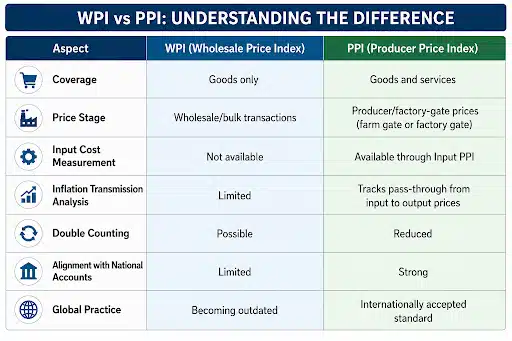
Why is India Shifting to PPI?

  • Better reflection of production costs:
    • PPI captures both: prices producers receive (output PPI), and prices producers pay (input PPI).
    • This helps analyse how rising input costs are transmitted into final producer prices.
  • Inclusion of the services sector: India’s economy is increasingly service-driven. Since WPI excludes services, it provides only a partial picture of inflation. PPI addresses this gap.
  • Consistency with national accounts: PPI is considered more suitable for measuring sectoral inflation, deflating nominal GDP to obtain real GDP, and improving accuracy of national income estimates.
  • Alignment with global best practices: Most advanced economies use PPI as the principal measure of producer-level inflation. The shift enhances international comparability of Indian statistics.

Five-Year Transition Plan (2026-2031)

  • WPI remains widely used in long-term procurement contracts, infrastructure projects, construction agreements, and price escalation clauses for raw materials and machinery.
  • To avoid disruption:
    • WPI and PPI will be released simultaneously for five years.
    • Government departments will gradually shift contractual indexing from WPI to PPI.
    • New long-term contracts extending beyond 2031 are expected to adopt PPI-based escalation mechanisms.
  • After the transition period, WPI is likely to be discontinued.

Significance for GDP Measurement

  • Economists and institutions such as the International Monetary Fund (IMF) have long advocated a dedicated PPI system.
  • Currently, India uses a combination of CPI and WPI to convert nominal GDP into real GDP. 
  • Once the new PPI series becomes stable and reliable:
    • Output PPI can serve as a more accurate deflator.
    • Real GDP estimates may become more robust.
    • National accounts methodology will become more internationally comparable.

Challenges Ahead

  • Data collection and reliability: Building reliable producer-level price databases across sectors is complex. Input PPI is still experimental and requires validation.
  • Stakeholder adaptation: Industries, government departments, and businesses must modify existing contracts and pricing frameworks.
  • Service sector measurement: Measuring service prices accurately remains more challenging than measuring goods prices.

Conclusion

  • The five-year coexistence of WPI and PPI aims to ensure a smooth transition while modernising India’s economic measurement system.
  • To ensure the success of this transition, India must strengthen producer-level data collection systems, improve service-sector price measurement, and facilitate smooth adaptation by industries and government agencies.

Source: THIE

From WPI to PPI FAQs

Q1: Why is India transitioning from the WPI to the PPI?

Ans: Because it captures both goods and services, measures producer-level inflation more accurately, etc.

Q2: How does the PPI improve inflation analysis compared to the WPI?

Ans: PPI tracks both input and output prices of producers, enabling assessment of cost pass-through.

Q3: What is the significance of introducing a Services PPI in India?

Ans: It incorporates inflation in key service sectors, providing a more comprehensive measure of producer-level price changes.

Q4: How can the PPI contribute to more accurate GDP estimation in India?

Ans: PPI serves as a better deflator for converting nominal GDP into real GDP.

Q5: Why will the WPI continue alongside the PPI until 2031?

Ans: Because it remains widely used in long-term contracts and price escalation clauses across sectors.

Future of India’s Chip Industry – Explained

Chip Industry

Chip Industry Latest News

  • NITI Aayog's Frontier Tech Hub has released a report titled "Future of India's Semiconductor Industry", highlighting the challenges and strategic imperatives for building a globally competitive chip manufacturing ecosystem in India.

About Semiconductors

  • Semiconductors, commonly known as chips, are materials that conduct electricity better than insulators but not as well as conductors. 
  • They form the foundation of modern electronics and are found in virtually every electronic device, including:
    • Consumer electronics: Smartphones, laptops, televisions, and home appliances.
    • Automobiles: Modern cars contain hundreds of chips for engine control, infotainment, and safety systems.
    • Defence equipment: Missiles, radars, satellites, and communication systems.
    • Industrial machinery: Robots, automation systems, and IoT devices.
    • Healthcare devices: Medical imaging, diagnostic equipment, and wearables.

Stages of Semiconductor Manufacturing

  • The semiconductor value chain comprises several stages:
    • Design: Creating chip architecture and circuits.
    • Fabrication (Fabs): Manufacturing the actual chip on silicon wafers in highly specialised facilities.
    • Assembly, Testing, Marking, and Packaging (ATMP): Final stages where chips are packaged and tested before shipment.
  • Fabrication is the most capital-intensive and technologically complex stage, requiring ultra-clean environments and specialised equipment costing billions of dollars.

India's Semiconductor Push

  • The Union government launched the India Semiconductor Mission (ISM) with a corpus of Rs. 76,000 crore to develop a robust semiconductor ecosystem. The mission supports:
    • Semiconductor fabrication units with capital subsidies of over 50%.
    • Display fabs for manufacturing display panels.
    • Compound semiconductors and packaging facilities.
    • Design-linked incentives for chip design startups.
    • Bulk subscriptions to industry-grade semiconductor design applications for students and academia.
  • Current Status
    • India does not yet have a single operational fabrication unit.
    • The first fabrication unit is expected to begin operations in Dholera, Gujarat by 2028.
    • A total of ten semiconductor projects are in various stages of development.
    • Multiple semiconductor packaging and testing facilities have been approved with significant subsidies.

Key Findings of the NITI Aayog Report

  • India's Current Ecosystem Is Not Self-Sufficient
    • The report explicitly states: "India's local ecosystem is not ready to fully meet domestic demand for semiconductors." 
    • Even chips used in domestic electronics assembly are largely sourced from outside the country.
  • National Security Imperative
    • Many semiconductor parts used in defence systems are produced outside India.
    • This creates threats to national security as India deploys foreign chips in aerospace and defence programmes.
    • Geopolitical disruptions, such as a potential disaster in Taiwan, which dominates global chip manufacturing, could massively disrupt the global electronics supply chain.
  • Long Gestation Period
    • Fabrication units typically require 4-5 years before commencing production.
    • Investment in 50+ specialised equipment from global players is required during the gestation phase.
    • Yield optimization and reliability testing take several quarters even after production begins.
    • Talent development for semiconductor fabs is similarly time-consuming.
    • The sector requires "sustained, mission-mode commitment over a decade or more," the report states.

Strategic Recommendations

  • Building Sovereign Capabilities
    • Sovereign design and research capabilities to reduce dependence on foreign IP.
    • R&D excellence in materials sciences and silicon design.
    • Harnessing agentic AI for semiconductor engineering.
    • Moving from a services-led design base to becoming a creator of differentiated IP, architectures, and integration technologies.
  • Capital Investment Requirements
    • The report estimates the necessary capital expenditure from the state at $45-60 billion over a decade for the second phase of the India Semiconductor Mission (ISM 2.0).
  • Strategic Focus Areas
    • Away from frontier chips (3-7 nanometre transistors) where risks are very high.
    • Towards mature and advanced nodes aligned with strategic relevance.
    • Focus on compound semiconductors for defence and industrial applications.
    • Emphasise "selective depth, capital efficiency, and system-level differentiation" rather than attempting to replicate the full global manufacturing spectrum.
  • Packaging as a Core Pillar
    • The report identifies chip packaging, traditionally seen as a downstream activity, as a "core production pillar":
    • Less expensive and complex than fabrication.
    • Can enable rapid import substitution in high-volume domestic segments.
    • Provides a strategic entry point into the global semiconductor value chain.
  • Trusted Partners Strategy
    • The report outlines a strategic partnership framework for India's semiconductor ambitions:
  • Priority Partners
    • The report highlights the following nations as trusted partners: the United States, Japan, the European Union and South Korea
  • Areas of Collaboration
    • Cooperation with these partners would provide:
    • Access to critical tools, equipment servicing, and lifecycle support.
    • Leveraging India's market scale, talent base, and packaging capacity.
    • Joint research and development opportunities.
    • Technology transfer arrangements.
  • China as an Adversary
    • The report implies that China remains an adversary in chipmaking despite recent diplomatic thaws between the two nations. 
    • This reflects the broader geopolitical realignment in the semiconductor industry, where Western nations and their allies are seeking to reduce dependence on Chinese supply chains.

Challenges Facing India's Semiconductor Industry

  • Capital Intensity
    • Setting up a single fab requires billions of dollars in investment.
    • High operational costs and long payback periods deter private investment.
    • Need for sustained government support over decades.
  • Technology Gap
    • India lags significantly behind established semiconductor manufacturers like Taiwan (TSMC), South Korea (Samsung), and the US.
    • Lack of indigenous process technology and IP.
    • Heavy reliance on foreign equipment and expertise.
  • Talent Shortage
    • Shortage of specialised engineers with semiconductor manufacturing experience.
    • Need for comprehensive training programmes and educational reforms.
    • Competition for talent with established global semiconductor hubs.
  • Supply Chain Dependencies
    • Dependence on imported raw materials, chemicals, and gases.
    • Need to develop a domestic ecosystem of suppliers.
    • Vulnerability to geopolitical disruptions.
  • Infrastructure Requirements
    • Need for reliable power supply, ultra-pure water, and specialised gases.
    • Requirement for clean room facilities with stringent environmental controls.
    • Long lead times for setting up support infrastructure.

Source: TH | NITI Aayog

Chip Industry FAQs

Q1: What is the India Semiconductor Mission (ISM)?

Ans: ISM is a ₹76,000 crore initiative by the Union government to develop a robust semiconductor manufacturing ecosystem in India through capital subsidies and production-linked incentives.

Q2: When is India's first semiconductor fabrication unit expected to begin operations?

Ans: The first fabrication unit is expected to begin operations in Dholera, Gujarat by 2028.

Q3: What capital investment does the NITI Aayog report estimate for ISM 2.0?

Ans: The report estimates capital expenditure of $45-60 billion over a period of ten years.

Q4: Why is semiconductor manufacturing strategically important for India?

Ans: It ensures national security through indigenous chips for defence, reduces vulnerability to geopolitical disruptions, and strengthens India's technological sovereignty.

Q5: Which countries does the report identify as trusted partners for India?

Ans: The report identifies the United States, Japan, European Union, and South Korea as priority partners for collaboration in the semiconductor sector.

Strengthening India’s EV Supply Chains: Reducing Battery Import Dependence

Strengthening India's EV Supply Chains

Strengthening India's EV Supply Chains Latest News

  • India's EV sector is growing fast — around 2.5 million vehicles were sold in FY26, up significantly from FY25. Government policies like purchase subsidies, road tax exemptions, and registration waivers have successfully created market demand. 
  • But as EV sales rise, a new and serious concern has emerged: India is replacing its dependence on imported fossil fuels with dependence on imported batteries — mostly from China.

The Core Problem: Trading One Dependency for Another

  • For years, India's energy security concern was about oil imports. EVs were seen as a way out. But the shift to EVs has not eliminated import dependence — it has merely changed its form.
  • The heart of the problem is the lithium-ion battery. It is the most critical and expensive component of any EV. And India does not make enough of them domestically.

How Deep Is the Dependence

  • India has awarded 40 GWh of battery manufacturing capacity under the ACC (Advanced Chemistry Cell) Production Linked Incentive scheme — but only about 1 GWh has actually been installed so far.
  • In 2025, passenger EVs in India sourced batteries from 14 global manufacturers, importing 7,987 MWh worth of cells.
  • A significant share of these imports came from Chinese manufacturers.
  • This means: more EVs sold in India = more batteries imported from China. The two are tightly linked right now.

Why China Dependence Is a Strategic Risk

  • China is not just a supplier — it is a competitor with its own industrial and geopolitical priorities. 
  • Several developments in China are already affecting India's battery supply:
    • Tighter technology export restrictions
    • Prioritisation of domestic Chinese demand over exports
    • Withdrawal of VAT exemptions on battery exports
    • Rising manufacturing and transport costs
  • Add to this the West Asia conflict, which has pushed up global raw material costs and shipping risk premiums. 
  • The combined effect is battery inflation — batteries are getting more expensive.
  • This matters enormously in a price-sensitive market like India. If battery costs rise and manufacturers pass them on to consumers, EVs could become unaffordable for the mass market. India's EV adoption targets would then be at serious risk.

What Needs to Be Done

  • Short Term: Diversify Suppliers ("China + 1")
    • Many EV manufacturers already talk about a "China + 1" strategy — sourcing from at least one non-Chinese supplier. 
    • But in practice, this is uneven. Premium EVs are increasingly using non-Chinese NMC (Nickel Manganese Cobalt) batteries, while affordable mass-market models still rely on cheaper Chinese LFP (Lithium Iron Phosphate) cells.
    • True diversification means spreading across suppliers, battery chemistries, and geographies. 
    • Yes, it may raise costs initially — but it significantly reduces the risk of a single disruption stalling the entire sector.
  • Medium Term: Smarter Product Design
    • Rising battery costs should push Indian manufacturers to design more efficient vehicles — lighter architectures, smarter drivetrains, better software, and batteries sized for actual Indian usage rather than oversized imported designs.
    • India's market may ultimately reward lean, purpose-built EVs over vehicles designed around expensive imported battery economics.
  • Emerging Technology: Sodium-Ion Batteries
    • Indian manufacturers should start testing vehicles with sodium-ion batteries. 
    • Sodium is abundantly available and not dependent on lithium supply chains. 
    • Sodium-ion is not yet a full replacement for lithium-ion, but it can serve as a meaningful hedge — especially as domestic production scales up. 
    • It broadens India's technology base and reduces dependence on any single chemistry.
  • Long Term: A Global EV Supply Chain Alliance
    • India needs to build a structured alliance with trusted partner countries — covering minerals, manufacturing, technology, and standards. 
    • This would distribute risk across geographies and ensure that no single external shock can derail India's electrification plans.

Conclusion

  • India has already proven it can create demand for EVs. The next and harder test is whether it can build the industrial depth to sustain that demand on its own terms.
  • The goal should not be to electrify faster. It should be to electrify intelligently, securely, and strategically.

Source: TH

Strengthening India's EV Supply Chains FAQs

Q1: Why is Strengthening India's EV Supply Chains important?

Ans: Strengthening India's EV Supply Chains is essential to reduce dependence on imported batteries and ensure long-term growth of the electric vehicle sector.

Q2: What is the biggest challenge in Strengthening India's EV Supply Chains?

Ans: The biggest challenge in Strengthening India's EV Supply Chains is the heavy reliance on imported lithium-ion batteries, particularly from China.

Q3: Why does battery dependence create strategic risks?

Ans: Strengthening India's EV Supply Chains is necessary because supply disruptions, export restrictions, and geopolitical tensions can affect battery availability and prices.

Q4: How can India reduce battery import dependence?

Ans: Strengthening India's EV Supply Chains requires domestic battery manufacturing, supplier diversification, improved vehicle design, and investment in alternative technologies.

Q5: What role can sodium-ion batteries play in Strengthening India's EV Supply Chains?

Ans: Strengthening India's EV Supply Chains can benefit from sodium-ion batteries, which reduce reliance on lithium-based imports and diversify technology options.

DNA Test in Paternity Cases: Supreme Court on Privacy, Identity and Inheritance Rights

DNA Test in Paternity Cases

DNA Test in Paternity Cases Latest News

  • The Supreme Court recently dismissed a challenge against orders directing a man (referred to as CP) to undergo a DNA test. 
  • The case was filed by a person claiming to be CP's biological son, who sought both a declaration of paternity and a share in CP's property. 
  • CP had been denying the claim since 1999 — over two decades. The Court upheld the DNA test order, balancing CP's right to privacy against the alleged son's right to establish his identity and inheritance.

Background: The Legal Framework

  • Section 116 of the Bharatiya Sakshya Adhiniyam 2023 (Earlier it was Section 112 of the Indian Evidence Act)
    • When a child is born during a valid marriage — or within 280 days of its dissolution — the law presumes that child to be the legitimate child of the husband. 
    • This presumption can only be overturned by proving that the husband and wife had no access to each other at the time of conception. 
    • Mere suspicion or assertion is not enough. The intent is clear: protect the child's legitimacy and dignity.
  • The Problem: No Law Explicitly Allows DNA Testing
    • There is no statute in India that expressly authorises courts to order DNA tests. 
    • The entire framework has evolved through judge-made law — that is, through Supreme Court judgments over the years.

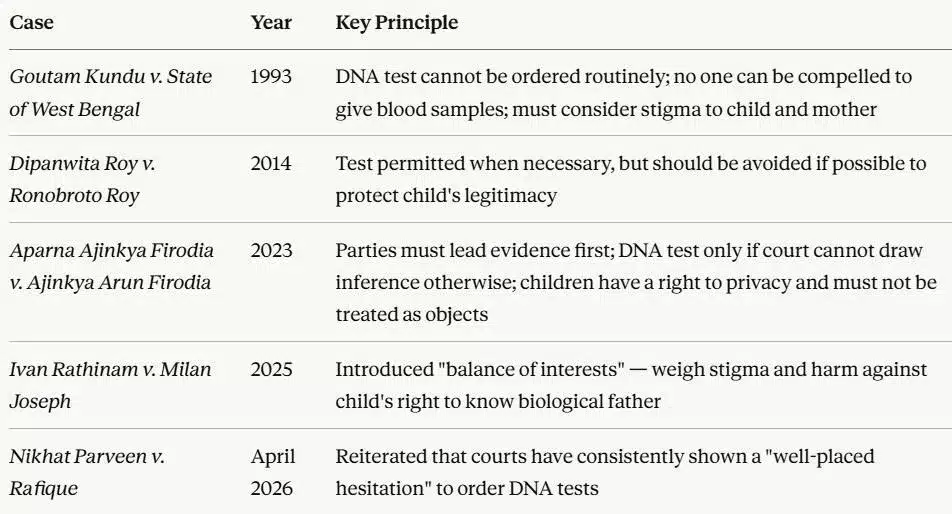
Evolution Through Case Law

  • The Supreme Court's position on DNA testing in paternity disputes has developed gradually, with each case adding a new layer of nuance.

  • The common thread across all these judgments: courts are reluctant to order DNA tests and will do so only as a last resort.

The Three-Part Test: When Can a Court Order a DNA Test

  • The Supreme Court laid down three conditions that must be satisfied:
    • Paternity must be directly in issue — it must be the central question in the case, not a peripheral one.
    • No other evidence should be available — if paternity can be established through other means, a DNA test should not be ordered.
    • It must be in the best interest of the parties or justice — the court must weigh the harm of ordering the test against the harm of not ordering it.

The Present Case: How the Court Decided

  • In this case, all three conditions were met. CP had denied paternity for over 20 years. 
  • There was no other evidence on record. The alleged son had no other way to establish his identity or claim his inheritance.
  • The Court framed the issue honestly: CP's right to privacy was real, but so was the alleged son's right to closure on a question that had defined his entire life. 
  • Denying the test would mean denying him rights he might legitimately be entitled to — forever.
  • The Court therefore upheld the DNA test order.

Ethical Dimensions Touched by This Judgement

  • Right to Privacy (Article 21) — The Puttaswamy judgment (2017) recognised privacy as a fundamental right. This case shows that even fundamental rights are not absolute — they must be balanced against competing rights and interests.
  • Judicial Activism vs. Judicial Restraint — Courts have built an entire framework on DNA testing without any legislative backing. This raises questions about the role of the judiciary in filling legislative gaps.
  • Rights of the Child — The tension between a child's right to legitimacy and a child's right to know their biological identity is a recurring theme in family law.

Source: IE | ToI

DNA Test in Paternity Cases FAQs

Q1: What is the significance of DNA Test in Paternity Cases?

Ans: DNA Test in Paternity Cases helps courts determine biological parentage when paternity is disputed and no reliable alternative evidence is available.

Q2: When can courts order a DNA Test in Paternity Cases?

Ans: DNA Test in Paternity Cases can be ordered when paternity is the central issue, no other evidence exists, and justice requires scientific verification.

Q3: How does privacy relate to DNA Test in Paternity Cases?

Ans: DNA Test in Paternity Cases involves balancing an individual's right to privacy with another person's right to identity, inheritance, and legal recognition.

Q4: What does Section 116 of the Bharatiya Sakshya Adhiniyam provide?

Ans: In DNA Test in Paternity Cases, Section 116 creates a presumption of legitimacy for children born during a valid marriage unless specific conditions prove otherwise.

Q5: Why are courts cautious about DNA Test in Paternity Cases?

Ans: DNA Test in Paternity Cases may affect personal dignity, family relationships, and legitimacy, so courts treat such tests as a measure of last resort.

Enquire Now