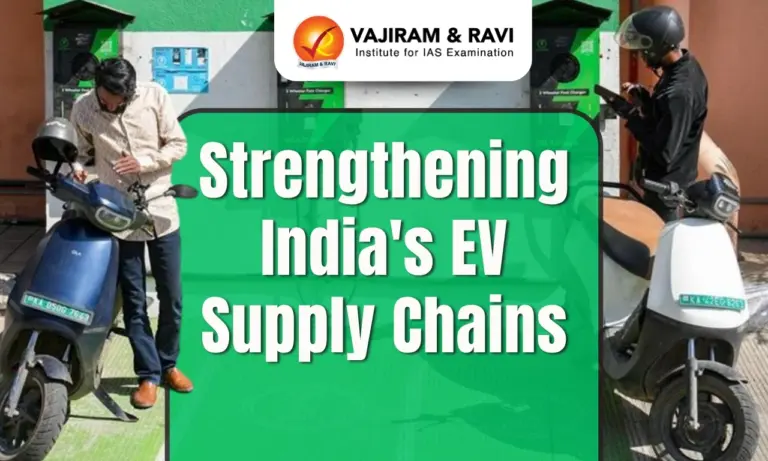
Strengthening India’s EV Supply Chains Latest News
- India’s EV sector is growing fast — around 2.5 million vehicles were sold in FY26, up significantly from FY25. Government policies like purchase subsidies, road tax exemptions, and registration waivers have successfully created market demand.
- But as EV sales rise, a new and serious concern has emerged: India is replacing its dependence on imported fossil fuels with dependence on imported batteries — mostly from China.
The Core Problem: Trading One Dependency for Another
- For years, India’s energy security concern was about oil imports. EVs were seen as a way out. But the shift to EVs has not eliminated import dependence — it has merely changed its form.
- The heart of the problem is the lithium-ion battery. It is the most critical and expensive component of any EV. And India does not make enough of them domestically.
How Deep Is the Dependence
- India has awarded 40 GWh of battery manufacturing capacity under the ACC (Advanced Chemistry Cell) Production Linked Incentive scheme — but only about 1 GWh has actually been installed so far.
- In 2025, passenger EVs in India sourced batteries from 14 global manufacturers, importing 7,987 MWh worth of cells.
- A significant share of these imports came from Chinese manufacturers.
- This means: more EVs sold in India = more batteries imported from China. The two are tightly linked right now.


Why China Dependence Is a Strategic Risk
- China is not just a supplier — it is a competitor with its own industrial and geopolitical priorities.
- Several developments in China are already affecting India’s battery supply:
- Tighter technology export restrictions
- Prioritisation of domestic Chinese demand over exports
- Withdrawal of VAT exemptions on battery exports
- Rising manufacturing and transport costs
- Add to this the West Asia conflict, which has pushed up global raw material costs and shipping risk premiums.
- The combined effect is battery inflation — batteries are getting more expensive.
- This matters enormously in a price-sensitive market like India. If battery costs rise and manufacturers pass them on to consumers, EVs could become unaffordable for the mass market. India’s EV adoption targets would then be at serious risk.
What Needs to Be Done
- Short Term: Diversify Suppliers (“China + 1”)
- Many EV manufacturers already talk about a “China + 1” strategy — sourcing from at least one non-Chinese supplier.
- But in practice, this is uneven. Premium EVs are increasingly using non-Chinese NMC (Nickel Manganese Cobalt) batteries, while affordable mass-market models still rely on cheaper Chinese LFP (Lithium Iron Phosphate) cells.
- True diversification means spreading across suppliers, battery chemistries, and geographies.
- Yes, it may raise costs initially — but it significantly reduces the risk of a single disruption stalling the entire sector.
- Medium Term: Smarter Product Design
- Rising battery costs should push Indian manufacturers to design more efficient vehicles — lighter architectures, smarter drivetrains, better software, and batteries sized for actual Indian usage rather than oversized imported designs.
- India’s market may ultimately reward lean, purpose-built EVs over vehicles designed around expensive imported battery economics.
- Emerging Technology: Sodium-Ion Batteries
- Indian manufacturers should start testing vehicles with sodium-ion batteries.
- Sodium is abundantly available and not dependent on lithium supply chains.
- Sodium-ion is not yet a full replacement for lithium-ion, but it can serve as a meaningful hedge — especially as domestic production scales up.
- It broadens India’s technology base and reduces dependence on any single chemistry.
- Long Term: A Global EV Supply Chain Alliance
- India needs to build a structured alliance with trusted partner countries — covering minerals, manufacturing, technology, and standards.
- This would distribute risk across geographies and ensure that no single external shock can derail India’s electrification plans.
Conclusion
- India has already proven it can create demand for EVs. The next and harder test is whether it can build the industrial depth to sustain that demand on its own terms.
- The goal should not be to electrify faster. It should be to electrify intelligently, securely, and strategically.
Source: TH

 Last updated on Oct, 2026
→ UPSC 2027 Notification will be released on 13 January 2027 at upsconline.nic.in.
→ Asian Games 2026 are being held in Aichi-Nagoya, Japan, from 19 September to 4 October.
→ Check Nobel Prize 2026 Winners List here.
→ Download PIB PRiSM Monthly Magazine 2026 here.
→ Check UPSC Monthly Current Affairs Magazine The Recitals here.
→ Check out the latest UPSC Syllabus here.
→ Download UPSC Model Answers for Mains 2026
→ UPSC Mains Question Paper 2026 is out now for Essay & GS Paper 1, 2, 3 & 4.
→ UPSC Calendar 2027 has been released.
→ Enroll in Vajiram & Ravi’s UPSC Mains Test Series 2027 for structured answer writing practice, expert evaluation, and exam-oriented feedback.
→ Join Vajiram & Ravi’s UPSC Mentorship Program 2027 for personalized guidance, strategy planning, and one-to-one support from experienced mentors.
→ Go through the UPSC Mains Previous Year Papers to enhance your preparation.
→ UPSC has released UPSC Toppers List 2025 with the Civil Services final result on its official website.
→ Also check Best UPSC Coaching in India
Strengthening India's EV Supply Chains FAQs
Q1. Why is Strengthening India's EV Supply Chains important?+
Q2. What is the biggest challenge in Strengthening India's EV Supply Chains?+
Q3. Why does battery dependence create strategic risks?+
Q4. How can India reduce battery import dependence?+
Q5. What role can sodium-ion batteries play in Strengthening India's EV Supply Chains?+
Tags: mains articles Strengthening India's EV Supply Chains upsc current affairs upsc mains current affairs