Passport is not Proof of Citizenship – Understanding India’s Legal Position

Passport is not Proof of Citizenship

Passport is not Proof of Citizenship Latest News

  • On Passport Seva Divas (June 24), the Ministry of External Affairs (MEA) clarified that an Indian passport is primarily a travel document and not conclusive proof of citizenship. 
  • The statement sparked public debate because passports are widely regarded as the most authoritative identity documents. 
  • However, the clarification reflects the long-established legal distinction between citizenship as a legal status and documents that merely provide evidence of that status.

Citizenship 

  • A legal status, not a document:
    • Articles 5–11 (Part II) of the Constitution and the Citizenship Act, 1955 govern acquisition and determination of Indian citizenship.
    • Citizenship is based on birth, descent, registration, naturalisation or incorporation of territory, not on possession of any particular document.
    • No law identifies a single universal document as definitive proof of Indian citizenship.
    • Government-issued documents only serve as evidence supporting the legal claim of citizenship.
  • MHA’s Parliamentary clarification (2020):
    • In response to a Parliament question, the Ministry of Home Affairs (MHA) clarified that Aadhaar, Passport, Voter ID, PAN Card and Birth Certificate are not legally designated as proof of citizenship.
    • Instead, citizenship is determined strictly according to the Citizenship Act, 1955 and related rules.

Why a Passport is Strong Evidence but Not Conclusive Proof

  • Legal position:
    • A passport is issued only after the government is satisfied that the applicant is an Indian citizen.
    • However, it does not create citizenship and cannot conclusively establish citizenship if challenged before a court.
  • Section 20 of the Passports Act:
    • It empowers the Central Government to issue a passport or travel document even to a non-citizen in exceptional cases where public interest so requires.
    • This provision has been used for stateless persons, certain Tibetan refugees, and Sri Lankan Tamil refugees requiring international travel.
  • Thus, the law itself recognises that a passport is fundamentally a travel document, not an exclusive citizenship certificate.

International Practice and Judicial Interpretation

  • Many democracies follow the same principle:
    • The United Kingdom and United States issue passports only after citizenship has been established.
    • However, they also maintain formal citizenship certificates and stronger civil registration systems, making citizenship verification more straightforward.
  • SC observations:
    • During hearings on Bihar's Special Intensive Revision (SIR) of electoral rolls, the Supreme Court of India observed that passports and birth certificates possess stronger evidentiary value.
    • Nevertheless, the Court stopped short of declaring them conclusive proof of citizenship.
  • Judicial precedents:
    • Sarbananda Sonowal v. Union of India (2005): The SC held that the burden of proving citizenship rests on the individual claiming it.
    • State of Andhra Pradesh v. Abdul Khader (1962): The Court treated a passport as relevant evidence but ultimately examined constitutional criteria such as birth, domicile and migration history before determining citizenship.
    • Bombay High Court (2013): The Court held that documentary possession alone was insufficient without establishing parental citizenship.

India’s Structural Gap

  • No universal citizenship document: A key issue highlighted by the controversy is that India has no universal citizenship certificate.
  • Current position:
    • Citizens by registration or naturalisation receive formal citizenship certificates under Sections 5 and 6 of the Citizenship Act.
    • Citizens by birth, who constitute the overwhelming majority, receive no equivalent document.
    • As a result, citizenship is generally established through a combination of birth certificates, electoral rolls, school records, land records, passports, etc., rather than a single definitive credential.
  • Historical reasons:
    • India’s civil registration system developed unevenly after Independence.
    • Universal birth registration became widespread only in recent decades.
    • Consequently, many older citizens rely on multiple documents accumulated over time instead of a dedicated citizenship certificate.

NRC - Attempt to Create a Citizenship Register

  • Legal framework: The Citizenship Rules, 2003, introduced during the Vajpayee government, envisaged:
    • A National Register of Indian Citizens (NRIC).
    • National, State and Local Citizenship Registers.
    • Issuance of citizenship identity cards.
  • Aadhaar vs Citizenship debate:
    • During the UPA government, the Home Ministry argued that Aadhaar should not be treated as proof of citizenship, since it verifies identity and residence rather than citizenship.
    • The proposed NRC was intended to fill this gap by creating an official citizenship record.
  • Assam NRC experience (2015–2019):
    • Applicants had to establish links with legacy records predating 24 March 1971.
    • Nearly 19 lakh applicants were excluded due to missing or inconsistent documents, spelling discrepancies, and difficulties in proving family lineage.
    • The nationwide NRC proposal subsequently became politically contentious, especially after the Citizenship (Amendment) Act (CAA) debate.

Conclusion

  • The MEA's clarification reiterates a long-settled legal principle. However, the controversy also exposes a deeper institutional challenge - India possesses a comprehensive citizenship law but lacks a universal document.
  • Experts emphasise the need for better integration of identity and citizenship databases while safeguarding constitutional rights.
  • Such reforms would reduce dependence on fragmented documentary evidence and minimise disputes over citizenship.

Source: IE

Passport is not Proof of Citizenship

Q1: Why is an Indian passport not considered conclusive proof of citizenship?

Ans: Because citizenship is a legal status determined under the Constitution and the Citizenship Act, 1955, whereas a passport is only a travel document.

Q2: What is the significance of Section 20 of the Passports Act?

Ans: It permits the Government to issue passports to certain non-citizens in public interest.

Q3: Why does India lack a universal proof of citizenship?

Ans: Most Indians acquire citizenship by birth and are not issued citizenship certificates, making citizenship dependent on multiple documents.

Q4: What principle did the SC establish in Sarbananda Sonowal v. Union of India (2005) regarding citizenship?

Ans: The Supreme Court held that the burden of proving Indian citizenship lies on the individual claiming it.

Q5: What reforms are necessary to reduce citizenship-related disputes in India?

Ans: Universal birth registration, robust civil registration systems, reliable archival records, and integrated identity databases.

CCPA Fines Food Brands for Misleading Labels with “100%” Claims

Misleading Labels

Misleading Labels Latest News

  • The Central Consumer Protection Authority has fined two major food companies Rs 1 lakh each for misleading consumers through “100%” claims on product packaging and advertisements.

Consumer Protection and Misleading Advertising in India

  • India’s consumer protection framework is primarily governed by the Consumer Protection Act, 2019, which aims to protect consumers from unfair trade practices, misleading advertisements, and defective goods and services.
  • A key institution under this law is the Central Consumer Protection Authority (CCPA), established to:
    • Protect consumer rights as a class,
    • Prevent unfair trade practices,
    • Take action against misleading advertisements,
    • Order recall or discontinuation of deceptive promotions.
  • Under the law:
    • Section 2(28) defines a misleading advertisement as one that falsely describes a product, gives a false guarantee, or deliberately conceals important information.
    • Section 2(47) defines an unfair trade practice as making false representations about the standard, quality, quantity, or composition of goods.
  • The Guidelines for Prevention of Misleading Advertisements and Endorsements, 2022 further require that advertising claims must be truthful, verifiable, and not likely to mislead an ordinary consumer.
  • In the food sector, the Food Safety and Standards Authority of India (FSSAI) also plays an important regulatory role. 
  • In an advisory issued in May last year, FSSAI warned that the increasing use of the term “100%” was likely to create a false impression of absolute purity or superiority, especially because the term is not specifically defined in its regulations.

News Summary

  • In two separate orders, the CCPA imposed a penalty of Rs 1 lakh each on Mrs. Bectors Food Specialities Ltd and Storia Foods and Beverages Pvt Ltd for misleading advertisements and unfair trade practices through the use of “100%” claims on packaging and promotional materials. 
  • The authority also directed both companies to immediately withdraw these claims from product packaging, websites, and digital platforms.

Case 1: “100% Atta Bread”

  • The CCPA took suo motu cognisance of advertisements by the company behind English Oven bread for products labelled “100% Atta Bread” and “100% Whole Wheat Bread.”
  • During proceedings, the company admitted that the bread actually contained 87% wheat flour (atta). It argued that the phrase “100%” was only meant to indicate that wheat flour was the sole grain source, with no refined flour or maida used. It also relied on FSSAI labelling rules, which require at least 75% whole wheat flour for a bread to be classified as whole wheat bread.
  • The CCPA rejected this defence. It held that meeting the minimum FSSAI threshold for classification does not justify an absolute and unqualified “100%” claim. 
  • According to the authority, an ordinary consumer would reasonably understand “100% Atta Bread” to mean that the product is entirely composed of atta. Since the actual content was only 87%, the claim was factually incorrect.
  • The authority also noted that the combined use of “100% Whole Wheat Bread” and “Zero Maida” on the packaging created a cumulative and false impression that the bread was entirely whole wheat.

Case 2: “100% Tender Coconut Water” and “100% Juice”

  • The CCPA also investigated Storia’s “100% Tender Coconut Water” and various “100% Juice” claims, including pomegranate and mixed fruit variants.
  • It found that the coconut water was not fresh from the fruit, but reconstituted from 9.6% coconut water concentrate. Likewise, the “100% Juice” variants were found to consist mostly of water, with fruit pulp or concentrate ranging only between 4% and 16%.
  • The authority also objected to health-related statements on the company’s website, claiming that the coconut water “Combats Virus” and “Kills Fatigue”, finding them unsubstantiated.
  • The company argued that FSSAI permits reconstitution of juices from concentrates and that the packaging carried a disclaimer on the back stating the product was “reconstituted.” 
  • The CCPA rejected this too, making an important distinction: a permitted manufacturing process does not automatically justify a marketing claim that gives a misleading impression.
  • It held that a back-label disclaimer in fine print cannot cure a bold and misleading front-of-pack claim. An ordinary consumer buying “100% Tender Coconut Water” would naturally expect the product to be in its natural form, not something made by concentration and re-dilution.

Key Legal Principle

  • A central principle emerging from both orders is that technical compliance with food safety standards is not a safe harbour against deceptive advertising. 
  • Even if a product is legally manufactured under FSSAI norms, its branding and advertisement must still meet the standards of fairness and truthfulness under consumer law.
  • The CCPA also made it clear that advertisements must be judged from the perspective of a reasonable consumer, not by post-facto technical explanations offered by the company. 
  • If a claim is capable of misleading consumers, the advertiser’s intention becomes irrelevant.
  • The authority also underlined the shift from the old doctrine of caveat emptor (“let the buyer beware”) to caveat venditor (“let the seller beware”), meaning the burden now lies more heavily on sellers to ensure that their representations are truthful and not misleading.

Significance

  • These orders are significant because they strengthen consumer protection in three important ways.
  • First, they send a strong signal that front-of-pack claims matter, and companies cannot rely on hidden disclaimers or technical ingredient details to escape responsibility.
  • Second, they clarify that regulatory compliance under one law does not excuse misleading conduct under another. 
    • Food law may permit a production method, but consumer law still governs how that product is presented to the public.
  • Third, the decisions are likely to influence the wider food and beverage industry, where terms such as “100%,” “natural,” “pure,” and “healthy” are frequently used as marketing tools.

Source: IE | ET

Misleading Labels FAQs

Q1: Why did the CCPA fine the two companies?

Ans: They were fined for using “100%” claims in a misleading manner that misrepresented the actual composition of their products.

Q2: Under which law did the CCPA act?

Ans: The action was taken under the Consumer Protection Act, 2019 and the Guidelines for Prevention of Misleading Advertisements, 2022.

Q3: Why was “100% Atta Bread” held to be misleading?

Ans: Because the bread contained only 87% atta, while the “100%” claim suggested to an ordinary consumer that it was entirely made of atta.

Q4: Why was the coconut water claim found misleading?

Ans: Because the product was reconstituted from concentrate and not in its natural form, despite being labelled “100% Tender Coconut Water.”

Q5: Can a back-label disclaimer justify a misleading front claim?

Ans: No. The CCPA held that fine-print disclaimers on the back cannot cure a bold and misleading claim on the front of the package.

Seismic Doublet: Understanding Venezuela’s Twin Earthquakes and Their Devastating Impact

Seismic Doublet

Seismic Doublet Latest News

  • Venezuela has been struck by two powerful earthquakes within 39 seconds of each other — a rare phenomenon called a seismic doublet. The first quake measured magnitude 7.2 and the second, stronger one measured magnitude 7.5. 
  • The US Geological Survey (USGS) estimates the death toll at between 10,000 and 100,000, making it potentially Venezuela's deadliest natural disaster.

What Happened: The Two Earthquakes

  • The first quake (M 7.2) — classified by USGS as the foreshock — struck about 24 km from San Felipe in Yaracuy state, approximately 160 km west of Caracas. 
  • Just 39 seconds later, the second quake (M 7.5) — the mainshock — hit near Morón in neighbouring Carabobo state, about 168 km west of Caracas.
  • The second earthquake was the largest to strike Venezuela or its coast since 1900. 
  • USGS noted that the sequence "likely indicates a complex rupture interaction process" — forming what seismologists call a seismic doublet.

What Is a Seismic Doublet

  • In a typical earthquake sequence, one large quake (the mainshock) is followed by progressively smaller aftershocks. A doublet is fundamentally different.
  • A seismic doublet consists of two earthquakes of similar magnitude that originate from distinct but closely related fault ruptures and occur within a very short span — seconds, minutes, or at most a few hours — in close geographic proximity.
  • Crucially, the two events are independent — not triggered by each other in the way aftershocks are. 
  • Aftershocks result from stress redistribution caused by the mainshock and are typically one or more magnitudes smaller. Doublets are two separate rupture events happening in near-simultaneous succession.

Why Doublets Are So Destructive

  • Shallow Depth
    • The mainshock occurred at a relatively shallow depth of about 10 km. 
    • Shallow earthquakes are far more destructive than deep ones because seismic energy dissipates less before reaching the surface. 
    • The shockwaves hit the ground — and buildings — with very high intensity.
  • Prolonged and Extended Ground Shaking
    • This is the defining danger of a doublet. Various studies found that a second major shock has potential to double both the duration of ground shaking and the area affected by the strongest shaking.
    • In Venezuela's case, buildings already severely weakened or partially damaged by the 7.2 magnitude foreshock were immediately subjected to an even stronger 7.5 magnitude mainshock — with no time for people to evacuate or structures to be assessed. 
    • This dramatically increased both the risk of collapse and the complexity of rescue operations.

Why Is Venezuela Seismically Vulnerable

  • Venezuela lies along the boundary between the Caribbean Plate and the South American Plate — one of the most seismically active zones in northern South America. 
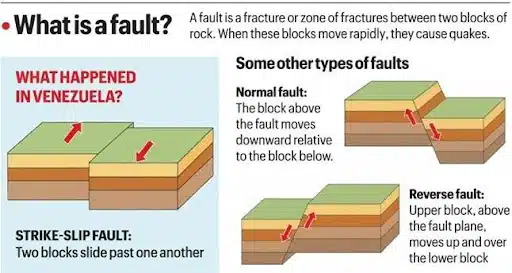
  • These two plates slide horizontally past each other along fault lines in a process called strike-slip faulting
  • The USGS confirmed that Venezuela’s stronger mainshock resulted from shallow strike-slip faulting near this plate boundary.
  • A fault is a fracture or zone of fractures between two blocks of rock. When these blocks move rapidly, they release energy as earthquakes. 
  • Three main fault types exist: 
    • Normal faults (where the upper block moves down), 
    • Reverse faults (where the upper block moves up and over), and 
    • Strike-slip faults (where two blocks slide horizontally past each other). 
      • Venezuela's earthquakes result from the last type.

Earthquake

Historical Seismicity

  • Venezuela has recorded approximately 1,000 earthquakes of magnitude 4.0 or above in the past decade alone. 
  • Prior to this event, a series of earthquakes in Zulia state had reached magnitudes of 6.2 and 6.3. 
  • The previous strongest recorded earthquake was the 1900 San Narciso earthquake (M 7.7), which killed at least 21 people and devastated parts of Caracas. The 2026 doublet is feared to be far deadlier.
  • Venezuela's neighbours — Mexico and Chile — lie along the Pacific Ring of Fire, a 40,000 km arc that hosts 75% of the world's volcanoes and generates 90% of the world's earthquakes. 
  • Venezuela itself does not sit on the Ring of Fire but lies in a comparably active intraplate boundary zone.

Source: IE | NDTV

Seismic Doublet FAQs

Q1: What is a Seismic Doublet and how did it affect Venezuela?

Ans: A Seismic Doublet consists of two powerful earthquakes occurring within a short interval, causing prolonged shaking and widespread destruction, as witnessed in Venezuela.

Q2: Why was the Venezuela Seismic Doublet particularly destructive?

Ans: The Seismic Doublet involved shallow earthquakes occurring seconds apart, leaving weakened buildings vulnerable to collapse during the stronger second shock.

Q3: How is a Seismic Doublet different from an aftershock sequence?

Ans: Unlike aftershocks, a Seismic Doublet comprises two nearly equal-magnitude earthquakes originating from separate but closely related fault ruptures.

Q4: Why is Venezuela prone to a Seismic Doublet and other earthquakes?

Ans: Venezuela lies along the boundary of the Caribbean and South American plates, where strike-slip faulting generates frequent seismic activity, including rare Seismic Doublet events.

Q5: What lessons does the Venezuela Seismic Doublet offer for disaster preparedness?

Ans: The Seismic Doublet highlights the importance of earthquake-resistant infrastructure, rapid emergency response, hazard mapping and public preparedness in seismically active regions.

PCPNDT Act Reform: Balancing Gender Justice with Diagnostic Access

PCPNDT Act Reform

PCPNDT Act Reform Latest News

  • A 45-year-old woman in rural Assam noticed a breast lump but refused to travel two hours to a cancer hospital. 
  • By the time she finally went, she had advanced breast cancer. She died six months later. A portable ultrasound at a community health camp could have given her a timely diagnosis. 
  • But under India's current law, using an ultrasound machine outside a registered facility is a criminal offence — carrying a minimum three months' non-bailable imprisonment.

The PCPNDT Act: Origin and Purpose

  • The Pre-Conception and Pre-Natal Diagnostic Techniques (PCPNDT) Act was enacted in 1994 to address a serious demographic and ethical crisis — the sharp decline in India's child sex ratio.
  • This decline was driven by the misuse of ultrasonography for prenatal sex determination followed by selective abortion of female foetuses.
  • The problem had become acute from the 1980s as imaging technology became more accessible. 
  • The Act was thus not merely a medical regulation — it was a response to deep-rooted gender discrimination.

Key Provisions of the Act

  • All genetic clinics, ultrasound centres, and laboratories must be registered with district authorities. 
  • Sex of the foetus cannot be communicated or disclosed under any circumstances. 
  • Purchasing an ultrasound machine without prior registration of the facility is illegal. 
  • Manufacturers must verify buyer credentials and obtain a written undertaking that the machine will not be used for sex determination. 
  • Once installed, the machine must remain at the approved location permanently. 
  • Strict patient-level documentation is mandatory for every scan.

Impact of the Act: Achievements and Unintended Consequences

  • Following the Act, India's sex ratio at birth has shown gradual improvement at the national level. 
  • The law established a critical regulatory framework signalling societal and state commitment against female foeticide.

Unintended Adverse Effects

  • Families with a firstborn girl — unable to use sex selection — tended to have more children to achieve a son. 
  • This resulted in a 25% higher child mortality rate among firstborn girls compared to firstborn boys, likely due to reduced parental investment in girls' health. 
  • Fertility increased in these families, diluting resources per child and widening gender disparities in education and healthcare.

Continued Illegal Practices

  • Despite three decades of legal prohibition, sex-selective practices persist. 
  • In October 2025, authorities uncovered an organised illegal racket in Karnataka conducting prenatal sex determination using portable ultrasound devices through informal providers and covert networks. 
  • The problem is not confined to India — reports from the United Kingdom suggest son preference persists among some Indian-origin diaspora communities even in settings with stricter oversight. 
  • This underscores a fundamental limitation: laws alone cannot drive social change where gender bias is deeply rooted.

The Case for Reform: Technology Has Moved Ahead of the Law

  • Modern portable, handheld ultrasound devices — often connected to smartphones or tablets — make it technically feasible to bring diagnostic services directly to patients' homes and communities. 
  • This is particularly critical for early cancer detection in underserved rural areas where nearly 70% of India's population resides and access to specialist radiologists is severely limited.
  • Currently, using such devices at the community level is illegal under the PCPNDT Act. 
  • High-frequency linear probes — used for detecting superficial conditions like breast cancer — are physically incapable of imaging a foetus for sex determination. 
  • Yet they are subject to the same blanket restrictions as conventional ultrasound machines. The law makes no such distinction.

Role of Artificial Intelligence

  • Recent developments in AI-enabled ultrasound further strengthen the case for reform. 
  • AI systems can assist with image acquisition and interpretation — in some configurations generating automated diagnostic reports based on pattern recognition without requiring full image storage or display. 
  • This creates a pathway for purpose-specific, safeguarded use of ultrasound that substantially reduces misuse risk.
  • A pilot study demonstrated that portable ultrasound scans performed by individuals with minimal training, combined with AI analysis, could identify suspicious breast lesions with high accuracy — correctly flagging all confirmed cancer cases. 
  • This means frontline health workers like ASHA workers or ANMs could potentially use AI-assisted ultrasound.

What Should Change: The Reform Agenda

  • Technological shifts and India's high cancer burden together demand a regulatory update. 
  • Specifically, they recommend two changes to the PCPNDT Act.
  • First, an amendment should legalise community-based ultrasound using high-frequency linear probes — since these probes cannot be used for foetal sex determination, their community use poses no threat to the Act's core purpose.
  • Second, the Act should incorporate provisions addressing emerging technologies — including AI-enabled and technically safeguarded ultrasound imaging systems — designed to prevent foetal sex determination irrespective of intent.

Source: TH

PCPNDT Act Reform FAQs

Q1: Why is PCPNDT Act Reform being debated in India?

Ans: PCPNDT Act Reform is being discussed because current restrictions on portable ultrasound machines may delay early diagnosis of diseases, particularly in rural areas.

Q2: What is the primary objective of PCPNDT Act Reform?

Ans: PCPNDT Act Reform seeks to retain safeguards against sex-selective practices while allowing safe diagnostic technologies that cannot be misused for prenatal sex determination.

Q3: How can artificial intelligence support PCPNDT Act Reform?

Ans: PCPNDT Act Reform proposes using AI-enabled ultrasound systems to improve early disease detection while incorporating technical safeguards against illegal fetal sex determination.

Q4: What challenges does PCPNDT Act Reform attempt to address?

Ans: PCPNDT Act Reform aims to balance gender justice, women's rights, healthcare accessibility, technological innovation and effective regulation of diagnostic imaging.

Q5: Why is PCPNDT Act Reform important for India's healthcare system?

Ans: PCPNDT Act Reform could improve access to timely diagnosis in underserved regions while preserving the law's original objective of preventing female foeticide.

Enquire Now