Seismic Doublet Latest News
- Venezuela has been struck by two powerful earthquakes within 39 seconds of each other — a rare phenomenon called a seismic doublet. The first quake measured magnitude 7.2 and the second, stronger one measured magnitude 7.5.
- The US Geological Survey (USGS) estimates the death toll at between 10,000 and 100,000, making it potentially Venezuela’s deadliest natural disaster.
What Happened: The Two Earthquakes
- The first quake (M 7.2) — classified by USGS as the foreshock — struck about 24 km from San Felipe in Yaracuy state, approximately 160 km west of Caracas.
- Just 39 seconds later, the second quake (M 7.5) — the mainshock — hit near Morón in neighbouring Carabobo state, about 168 km west of Caracas.
- The second earthquake was the largest to strike Venezuela or its coast since 1900.
- USGS noted that the sequence “likely indicates a complex rupture interaction process” — forming what seismologists call a seismic doublet.


What Is a Seismic Doublet
- In a typical earthquake sequence, one large quake (the mainshock) is followed by progressively smaller aftershocks. A doublet is fundamentally different.
- A seismic doublet consists of two earthquakes of similar magnitude that originate from distinct but closely related fault ruptures and occur within a very short span — seconds, minutes, or at most a few hours — in close geographic proximity.
- Crucially, the two events are independent — not triggered by each other in the way aftershocks are.
- Aftershocks result from stress redistribution caused by the mainshock and are typically one or more magnitudes smaller. Doublets are two separate rupture events happening in near-simultaneous succession.
Why Doublets Are So Destructive
- Shallow Depth
- The mainshock occurred at a relatively shallow depth of about 10 km.
- Shallow earthquakes are far more destructive than deep ones because seismic energy dissipates less before reaching the surface.
- The shockwaves hit the ground — and buildings — with very high intensity.
- Prolonged and Extended Ground Shaking
- This is the defining danger of a doublet. Various studies found that a second major shock has potential to double both the duration of ground shaking and the area affected by the strongest shaking.
- In Venezuela’s case, buildings already severely weakened or partially damaged by the 7.2 magnitude foreshock were immediately subjected to an even stronger 7.5 magnitude mainshock — with no time for people to evacuate or structures to be assessed.
- This dramatically increased both the risk of collapse and the complexity of rescue operations.
Why Is Venezuela Seismically Vulnerable
- Venezuela lies along the boundary between the Caribbean Plate and the South American Plate — one of the most seismically active zones in northern South America.
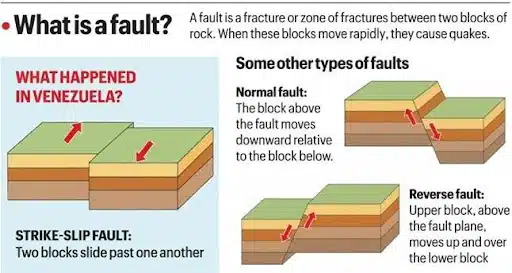
- These two plates slide horizontally past each other along fault lines in a process called strike-slip faulting.
- The USGS confirmed that Venezuela’s stronger mainshock resulted from shallow strike-slip faulting near this plate boundary.
- A fault is a fracture or zone of fractures between two blocks of rock. When these blocks move rapidly, they release energy as earthquakes.
- Three main fault types exist:
- Normal faults (where the upper block moves down),
- Reverse faults (where the upper block moves up and over), and
- Strike-slip faults (where two blocks slide horizontally past each other).
- Venezuela’s earthquakes result from the last type.
Historical Seismicity
- Venezuela has recorded approximately 1,000 earthquakes of magnitude 4.0 or above in the past decade alone.
- Prior to this event, a series of earthquakes in Zulia state had reached magnitudes of 6.2 and 6.3.
- The previous strongest recorded earthquake was the 1900 San Narciso earthquake (M 7.7), which killed at least 21 people and devastated parts of Caracas. The 2026 doublet is feared to be far deadlier.
- Venezuela’s neighbours — Mexico and Chile — lie along the Pacific Ring of Fire, a 40,000 km arc that hosts 75% of the world’s volcanoes and generates 90% of the world’s earthquakes.
- Venezuela itself does not sit on the Ring of Fire but lies in a comparably active intraplate boundary zone.

 Last updated on Oct, 2026
→ UPSC 2027 Notification will be released on 13 January 2027 at upsconline.nic.in.
→ Asian Games 2026 are being held in Aichi-Nagoya, Japan, from 19 September to 4 October.
→ Check Nobel Prize 2026 Winners List here.
→ Download PIB PRiSM Monthly Magazine 2026 here.
→ Check UPSC Monthly Current Affairs Magazine The Recitals here.
→ Check out the latest UPSC Syllabus here.
→ Download UPSC Model Answers for Mains 2026
→ UPSC Mains Question Paper 2026 is out now for Essay & GS Paper 1, 2, 3 & 4.
→ UPSC Calendar 2027 has been released.
→ Enroll in Vajiram & Ravi’s UPSC Mains Test Series 2027 for structured answer writing practice, expert evaluation, and exam-oriented feedback.
→ Join Vajiram & Ravi’s UPSC Mentorship Program 2027 for personalized guidance, strategy planning, and one-to-one support from experienced mentors.
→ Go through the UPSC Mains Previous Year Papers to enhance your preparation.
→ UPSC has released UPSC Toppers List 2025 with the Civil Services final result on its official website.
→ Also check Best UPSC Coaching in India
Seismic Doublet FAQs
Q1. What is a Seismic Doublet and how did it affect Venezuela?+
Q2. Why was the Venezuela Seismic Doublet particularly destructive?+
Q3. How is a Seismic Doublet different from an aftershock sequence?+
Q4. Why is Venezuela prone to a Seismic Doublet and other earthquakes?+
Q5. What lessons does the Venezuela Seismic Doublet offer for disaster preparedness?+
Tags: mains articles Seismic Doublet upsc current affairs upsc mains current affairs