Vikram-1 Latest News
- India achieved a historic milestone as Hyderabad-based Skyroot Aerospace's Vikram-1 became the country's first privately built rocket to successfully place payloads into Low Earth Orbit (LEO).
- The Mission Aagaman marks India's emergence as the third country (after US and China) where a private company has independently demonstrated orbital launch capability.
- So far, all orbital rockets India has launched have been statefunded and led by the ISRO, but Skyroot Aerospace changed this, reflecting the growing maturity of India's commercial space ecosystem following space-sector reforms.
Mission Aagaman - Key Highlights
- Historic achievement:
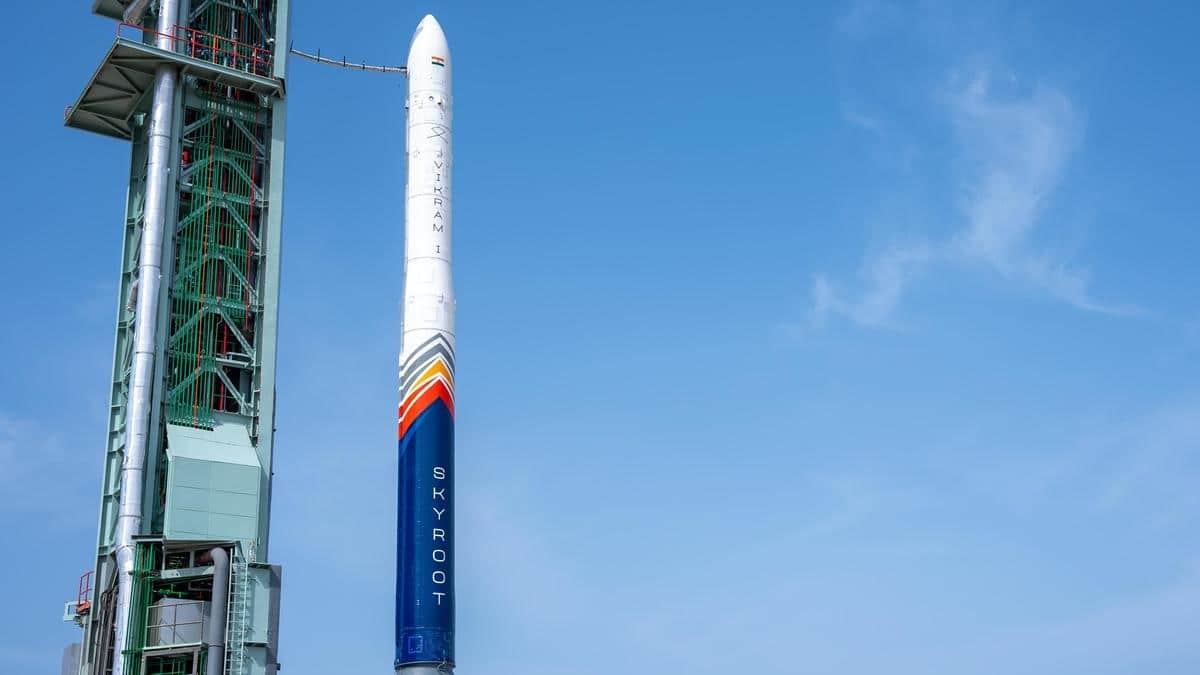
- Vikram-1, a 22-metre, three-stage orbital launch vehicle, was successfully launched from Satish Dhawan Space Centre, Sriharikota.
- The mission, titled 'Aagaman' (Arrival), validated the rocket's ability to achieve full orbital flight.
- India joins a select group of nations where private enterprises possess orbital launch capability.
- Technical features:
- Payload capacity: Up to 350 kg to Low Earth Orbit (450 km).
- Rocket built using: All-carbon composite structure, 3D-printed engines, high-thrust solid-fuel boosters, and indigenous propulsion systems.
- Successfully validated: Propulsion; stage separation; Guidance, Navigation and Control (GNC); avionics; telemetry; and overall vehicle performance.
Payload and Technological Demonstrations
- Besides validating the launch vehicle, Vikram-1 carried several experimental payloads, including -
- Technology demonstration payloads from Grahaa Space, Cosmoserve and DCubed.
- A lab-grown diamond.
- A miniature 18-carat gold sculpture celebrating India's space programme.
- A micro-art tribute to Vikram Sarabhai, Dr. A.P.J. Abdul Kalam and C.V. Raman.
- Letters from well-wishers, including the Prime Minister.
- The rocket is also equipped with robotic arms capable of assisting future space-debris removal missions, highlighting India's growing focus on sustainable space operations.
Evolution of Skyroot Aerospace
- Founded in 2018, Skyroot emerged after the liberalisation of India's space sector.
- It became India's first unicorn in the space sector (valuation exceeding $1 billion).
- Earlier launched Vikram-S (2022), a suborbital mission that demonstrated launch capability but did not achieve orbit.
- Vikram-1 represents the transition from demonstration to operational orbital launch capability.
- The company’s future plans: Additional test launches; commercial launch services; and manufacturing capacity of one Vikram-1 rocket per month (12 annually).
Significance for India’s Space Programme
- Strengthening the commercial space ecosystem: The success demonstrates that India's private sector can now complement ISRO in launch services, satellite deployment and commercial missions.
- Boost to space reforms: The mission validates policy reforms initiated after 2020, including -
- Opening the space sector to private participation.
- Establishment of IN-SPACe for authorisation and promotion.
- Commercialisation through NewSpace India Limited (NSIL).
- Growing startup ecosystem in launch vehicles, satellites and downstream applications.
- Strategic importance:
- Enhances India's self-reliance in critical space technologies.
- Strengthens India's position in the rapidly expanding global space economy.
- Encourages innovation, entrepreneurship and high-technology manufacturing.
Challenges Before Skyroot
- While the technological achievement is significant, commercial success remains uncertain.
- Challenges are -
- Challenging global market: The small-satellite launch market has become highly competitive. Several startups in the US, Europe, China, Japan and Australia have struggled or exited due to limited launch demand.
- Competition from rideshare launches:
- Small satellites increasingly use rideshare missions aboard larger rockets such as SpaceX's Falcon 9, significantly reducing launch costs.
- Dedicated launch vehicles like Vikram-1 offer orbital flexibility but often at a higher price.
- Competition from ISRO: Vikram-1 will also compete with ISRO's Small Satellite Launch Vehicle (SSLV) and the well-established Polar Satellite Launch Vehicle (PSLV).
- Limited domestic demand:
- India's current demand for dedicated small-satellite launches remains modest.
- To fully utilise its proposed production capacity, Skyroot must secure international commercial customers.
- Low-margin industry: Launch services are capital-intensive; comparatively low-margin; and subject to increasing compliance costs, including space debris mitigation and regulatory obligations.
India’s Competitive Advantages
- Despite market challenges, India enjoys several structural strengths -
- Lower manufacturing and labour costs.
- Access to ISRO's launch infrastructure and expertise.
- Strong engineering talent.
- Expanding satellite manufacturing ecosystem.
- Government emphasis on advanced manufacturing and innovation.
- India's emerging commercial ecosystem includes startups such as - Pixxel, Bellatrix Aerospace, and Dhruva Space.
- Together, they can build integrated capabilities spanning launch vehicles, satellites and downstream space services.
Big Picture
- The Skyroot factory is capable of producing 12 Vikram1 rockets every year.
- This will be an asset if there is demand for 12 Vikram1 launches every year.
- But even ISRO does not launch 12 small satellites a year today.
- In other words, Skyroot will have to find and secure international customers.
Way Forward
- For sustained success, Skyroot must move beyond a single successful launch by -
- Demonstrating consistent launch reliability.
- Reducing launch costs.
- Expanding into higher-value segments such as satellite manufacturing, space applications and data services.
- Leveraging India's growing reputation as a trusted, cost-effective space partner.
- The successful launch of Vikram-1 marks a watershed moment for India's private space industry and validates years of policy reforms encouraging private participation.
- For India, the mission represents another major step towards becoming a leading player in the global space economy and advancing the vision of Atmanirbhar Bharat in strategic technologies.
Vikram-1 FAQs
Q1: How has the successful launch of Vikram-1 strengthened India's commercial space ecosystem?
Ans: It established India's first private orbital launch capability, boosting private participation, innovation, and global competitiveness.
Q2: What are the major commercial challenges facing India's private launch vehicle companies?
Ans: Intense global competition, limited domestic demand, low-margin launch services, etc.
Q3: What is the significance of India's space-sector reforms in promoting private participation?
Ans: Reforms such as the liberalisation of the space sector have enabled startups to develop indigenous launch capabilities.
Q4: Why are dedicated small-satellite launch vehicles still relevant?
Ans: They provide greater launch flexibility, customised orbital insertion, and mission-specific deployment.
Q5: What strategic advantages does India possess in becoming a global hub for commercial space launches?
Ans: India benefits from cost-effective manufacturing, skilled human resources, ISRO's infrastructure, indigenous technology, etc.