Chabahar Port: Why India’s Strategic Gateway Faces New Geopolitical Challenges

Chabahar Port

Chabahar Port Latest News

  • A dramatic image posted by the US Secretary of War showing the maritime control tower at Iran's Chabahar port collapsing after US military strikes has sparked fresh concern in India. 
  • This comes even as New Delhi already grapples with the impact of US sanctions on the strategically vital port project, in which it has invested billions.

Was the Indian Terminal Damaged?

  • The Ministry of External Affairs (MEA) clarified that the terminal India operates at Chabahar Port, Shahid Beheshti, was not damaged in the US strikes. 
  • It stated that while there were reports of damage, the terminal itself remained unaffected. 
  • India reiterated its position that civilian infrastructure should not be targeted during conflicts.

India's Stakes in Chabahar

  • Chabahar port has two main terminals, Shahid Beheshti and Shahid Kalantari, with India managing the former. 
  • It is operated by India Ports Global Ltd (IPGL), a wholly owned subsidiary of India Ports Global Chabahar Free Zone (IPGCFZ), under a 10-year renewable agreement with Iran's Ports and Maritime Organisation.

Strategic rationale

  • Chabahar offers India an alternative trade route to Afghanistan, bypassing Pakistan, which does not permit Indian goods transit through its territory.
  • For Iran, Chabahar is its only oceanic port with direct access to the Indian Ocean, bypassing the congested Strait of Hormuz.

The 2024 contract

  • India and Iran signed a landmark 10-year contract in May 2024, replacing earlier short-term arrangements, to equip and operate the Shahid Beheshti terminal. 
  • To avoid financial penalties from US sanctions, India prepaid its $120 million investment and transferred its operational stake at Shahid Beheshti to local entities.

History of US Sanctions on Chabahar

  • American sanctions on Chabahar stem from Washington's broader economic and military measures against Tehran:
    • The Trump administration withdrew the US from the Iran nuclear deal in 2018 and imposed sanctions on dealing with Iran.
    • However, it simultaneously granted a targeted sanctions waiver for Chabahar to support humanitarian and economic efforts in Afghanistan, given the port's role in delivering Indian wheat and medical supplies there.
    • In September 2025, the US withdrew this waiver, then reinstated it through a six-month waiver in October, which officially expired on April 26.
  • Following the waiver's expiry, India has been in discussions with "relevant stakeholders" on how to proceed, but is effectively losing direct operational control over the Chabahar project as a result.

Strategic Importance for India and Iran

  • For India:
    • Chabahar provides secure, direct access to Afghanistan and Central Asia.
    • It serves as a counterweight to China's Gwadar Port in Pakistan, located just 140 km away.
    • It forms part of the International North-South Transport Corridor (INSTC), a multi-modal transport network connecting India with Iran, Russia, Europe, and Central Asia.
  • For Iran:
    • Chabahar is a crucial economic hub for the Sistan-Baluchistan province, serving as a gateway connecting Iran to landlocked Central Asian states, Afghanistan, and Russia.

India's Investment So Far

  • In 2021, External Affairs Minister S Jaishankar informed Parliament that:
    • Grant assistance for equipment supply to Chabahar had been enhanced to $120 million.
    • India committed a Line of Credit of $250 million (in rupee equivalent) for the port's development.
    • Since 2018, the port had handled over 450 vessels, 1,34,082 TEUs of containerised cargo, and more than 8.7 million tonnes of bulk and general cargo.
    • India had already supplied port equipment worth about $24 million, with procurement of remaining equipment underway.

Future Hangs in the Balance

  • Chabahar received an allocation of ₹400 crore in the previous financial year, but the Union Budget for 2026-27 made no allocation for the port, raising questions about the future of this strategic trade route to Afghanistan and Central Asia.
  • Why this matters
    • Without Chabahar, India loses its primary non-Pakistani corridor to landlocked markets, undoing decades of connectivity planning.
    • The port had reduced transit times by 40% and costs by nearly a third.
    • The situation raises strategic concerns for India if China, via the China-Pakistan Economic Corridor and Gwadar, expands its geopolitical footprint in Iran. 
    • The lapse of the Chabahar waiver by default tilts the regional balance toward China and Pakistan.

Conclusion

  • Chabahar embodies India's long-term vision of connectivity beyond Pakistan, but its fate remains entangled in the broader US-Iran standoff. 
  • With sanctions waivers lapsed and budgetary support withdrawn, India risks losing not just an infrastructure investment, but strategic ground to China and Pakistan in a critical geopolitical space.

Source: IE | NDTV

Chabahar Port FAQs

Q1: Why is Chabahar Port strategically important for India?

Ans: Chabahar Port provides India with direct access to Afghanistan and Central Asia while bypassing Pakistan, strengthening regional connectivity and supporting the International North-South Transport Corridor.

Q2: How have US sanctions affected Chabahar Port?

Ans: US sanctions have complicated Chabahar Port operations by creating financial and operational uncertainties, limiting India's direct involvement despite temporary sanctions waivers.

Q3: How does Chabahar Port counter China's regional influence?

Ans: Chabahar Port serves as India's strategic counterweight to China's Gwadar Port, enhancing India's presence in the Arabian Sea and strengthening regional trade connectivity.

Q4: What investments has India made in Chabahar Port?

Ans: India has invested in Chabahar Port through equipment grants, a Line of Credit, terminal operations and infrastructure development to improve regional trade access.

Q5: Why is the future of Chabahar Port important for India's foreign policy?

Ans: Chabahar Port remains central to India's connectivity strategy, energy security and geopolitical interests by providing an alternative trade corridor beyond Pakistan.

Vande Mataram Bill: Understanding the Proposal to Protect India’s National Song

Vande Mataram Bill

Vande Mataram Bill Latest News

  • The Prevention of Insults to National Honour (Amendment) Bill, 2026, is set to be introduced in the Rajya Sabha during the monsoon session. 
  • The Bill seeks to amend the Prevention of Insults to National Honour Act, 1971, granting the national song, 'Vande Mataram', the same statutory protection currently reserved for the national anthem, 'Jana Gana Mana'.

What Does the Bill Propose?

  • Under Section 3 of the 1971 Act, intentionally preventing the singing of the national anthem, or causing a disturbance to any assembly engaged in such singing, is a criminal offence punishable with imprisonment of up to three years, a fine, or both. 
  • The Bill proposes to bring the national song within the scope of this same provision, effectively criminalising disruption of its singing as well.

Current Legal Status of the National Song

  • Earlier this year, the Union Ministry of Home Affairs issued guidelines on the singing and playing of the national song. 
  • These "orders relating to the National Song of India":
    • Specified the authorised lyrics, written by Bankim Chandra Chatterjee.
    • Identified occasions for mass singing, such as during the unfurling of the National Flag, cultural occasions, or ceremonial functions.
    • Stated that the audience must "stand to attention" whenever the official version is sung or played.
    • Suggested that school days could begin with community singing of the national song.

Supreme Court's Response to the Guidelines

  • Following the government's order, a petition was filed challenging the directives, with the petitioner's counsel questioning whether people could be "compelled to sing the song in the garb of an advisory." 
  • A three-judge bench headed by the Chief Justice of India dismissed the plea as "premature" and based on a "vague apprehension of discrimination."
  • Crucially, the Court noted at the time that the government's directive was advisory in nature, with no penal consequences for non-compliance. 
  • If the new Bill is passed, however, it would introduce precisely the penal consequences that were absent when the Court made this observation.

How Courts Have Interpreted the Existing Anthem Law

  • Since Section 3 of the 1971 Act currently applies only to the national anthem, past judicial interpretation offers a guide to how the amended law might work.

Salman v. State of Kerala (2014)

  • The Kerala High Court clarified what constitutes a "disturbance" under the Act. 
  • It refused to quash an FIR against a petitioner accused of "making noise and hue and cry" during the singing of the national anthem.
  • It held that "causing obstruction or prevention... by making loud or contemptuous noise" falls within the offence defined under Section 3, warranting police investigation.

The Right to Respectful Silence: A Key Precedent

  • A landmark distinction exists between actively disrupting the anthem's singing (an offence) and simply choosing not to sing (not an offence), established in Bijoe Emmanuel & Ors v. State of Kerala (1986).
  • The case: Three children belonging to the Jehovah's Witnesses Christian sect were expelled from school for refusing to sing the national anthem during morning assembly, despite standing respectfully in silence. Their refusal stemmed from religious belief that did not permit singing praises to anyone except in prayer to God.
  • The ruling: The Supreme Court ruled in favour of the students, holding that their expulsion violated:
    • Article 19(1)(a): Freedom of speech and expression
    • Article 25(1): Freedom of religion
  • The Court held there is no legal provision obliging anyone to sing the national anthem.
  • It stated: "Proper respect is shown to the National Anthem by standing up when the National Anthem is sung... It will not be right to say that disrespect is shown by not joining in the singing."
  • The bench also emphasised the constitutional value of religious freedom.
  • It also noted that "the real test of a true democracy is the ability of even an insignificant minority to find its identity under the country's Constitution," and concluded with the observation: "Our tradition teaches tolerance; our philosophy preaches tolerance; our constitution practices tolerance; let us not dilute it."

Conclusion

  • The proposed amendment marks a significant step in elevating 'Vande Mataram' to near-equal legal standing with the national anthem, criminalising deliberate disruption of its singing. 
  • Yet, as the Bijoe Emmanuel judgment reminds us, respect for national symbols coexists with constitutionally protected individual freedoms, and any new law will likely be tested against this delicate balance between national honour and personal liberty.

Source: IE | ME

Vande Mataram Bill FAQs

Q1: What does the Vande Mataram Bill seek to achieve?

Ans: The Vande Mataram Bill seeks to extend the same legal protection available to the National Anthem by criminalising intentional disruption during the singing of the National Song.

Q2: How would the Vande Mataram Bill change the existing law?

Ans: The Vande Mataram Bill proposes amending the Prevention of Insults to National Honour Act, 1971, to include the National Song within its penal provisions.

Q3: What constitutional concerns does the Vande Mataram Bill raise?

Ans: The Vande Mataram Bill raises questions about balancing national honour with the freedoms of speech, expression and religion guaranteed under Articles 19 and 25.

Q4: Which Supreme Court judgment is significant in understanding the Vande Mataram Bill?

Ans: The Bijoe Emmanuel judgment held that respectfully remaining silent does not amount to disrespect, an important precedent likely to influence interpretation of the Vande Mataram Bill.

Q5: Why is the Vande Mataram Bill significant for constitutional law?

Ans: The Vande Mataram Bill highlights the continuing challenge of reconciling respect for national symbols with individual liberties and constitutional protections in a democratic society.

Judicial Yashwant Varma Resignation Case – Judicial Accountability and the Power to Resign

Judicial Accountability

Judicial Accountability Latest News

  • The report of the Inquiry Committee against former Allahabad and Delhi High Court judge Yashwant Varma is set to be taken up in Parliament, raising key questions about judicial accountability, the power to resign at will, and gaps in the constitutional framework.

Background of the Case

  • The Yashwant Varma case originated in March 2025 with the discovery of partially burnt currency notes in an outhouse at his official residence. This led to the following developments:
    • The Speaker of the Lok Sabha appointed a committee under the Judges (Inquiry) Act, 1968 to investigate charges of misbehaviour.
    • Justice Varma resigned on April 9, 2026, before the inquiry proceedings could be concluded.
    • The committee's report is set to be tabled in Parliament during the ongoing Monsoon Session.
    • The case has generated significant public and legal interest regarding judicial accountability.

Constitutional Framework for Judicial Resignation

  • The "Power to Resign at Will"
    • The Constitution vests 13 constitutional functionaries with the power to resign at will, without their resignation being subject to acceptance by any authority. 
    • They may resign merely by writing under their hand, addressed to a specified authority. The offices with this power include:
      • The President
      • The Vice-President
      • The Deputy Chairman of the Rajya Sabha
      • The Speaker and Deputy Speaker of the Lok Sabha
      • A judge of the Supreme Court
      • A judge of the High Courts
      • The Governor
      • The Speaker and Deputy Speaker of a State Assembly
      • The Chairman and Deputy Chairman of a State Legislative Council
      • A member of the Public Service Commissions
  • Purpose of the Power
    • The power to resign at will is an essential safeguard for judicial independence. 
    • It protects incumbents from being forced to work under coercion by any authority, ensuring that judges can leave office without fear of retaliation.
  • Contrast with Legislators
    • Members of Parliament: subject to acceptance by the Speaker of the Lok Sabha or the Chairman of the Rajya Sabha under Article 101(3)(b).
    • Members of State Legislatures: subject to acceptance by the Speaker or the Chairman under Article 190(3)(b).

Supreme Court Ruling

  • A five-judge Constitution Bench of the Supreme Court in Union of India vs Gopal Chandra Misra (1978) unanimously reaffirmed the power of Supreme Court and High Court judges to resign at will. The court held that:
    • The effectiveness of the resignation does not depend upon acceptance by the President.
    • The resignation acts ex proprio vigore (automatically without requiring any external action).
  • Since 2017, at least 12 High Court judges have resigned, and Justice Dalveer Bhandari resigned from the Supreme Court in 2012 to join the International Court of Justice. 
  • Publicly available data suggests these resignations have been handled in compliance with the law.

News Summary

  • Three months after his resignation, Justice Yashwant Varma continues to be listed as a sitting judge by:
    • The Allahabad High Court
    • The Department of Justice of the Union government
  • This has created confusion about whether his resignation has taken effect or remains subject to acceptance by the President.
  • Justice Varma's resignation took effect automatically on April 9, 2026, when he submitted his written resignation. No acceptance by the President is required.
  • Hence, describing him as a sitting judge after that date in the Department of Justice's list or on the Allahabad High Court's website is clearly wrong.
  • There is no justification for retaining his name in lists of sitting judges for over three months.

Do the Proceedings Survive the Resignation?

  • The Inquiry Committee's report pertains to Justice Varma's conduct prior to his resignation. Therefore:
    • The resignation does not affect the laying of the report before both Houses.
    • The report will be made public as there is a statutory duty to do so.
  • The public has a legitimate right to know whether the Committee found any proved misbehaviour on the part of a sitting judge of a constitutional court.

What Happens if He is Found Guilty of the Charges?

  • If the report finds Justice Varma not guilty of the charges, the matter ends there. However, even if the report finds him guilty:
    • The motion for his removal can no longer be moved.
    • Having resigned, Justice Varma does not hold the office of a judge and cannot be removed from it.
    • Under Section 6 of the Judges (Inquiry) Act, the report is to be discussed by Parliament along with the motion.
  • Since the motion lapses and cannot be discussed, the report too cannot be discussed by Parliament under the Act.

The Accountability Loophole

  • There is a genuine concern that the framework for judicial accountability through removal proceedings under the Judges (Inquiry) Act, 1968, suffers from a significant loophole.
  • Judges may resign at will before Parliament takes up the motion for their removal. This effectively halts the entire process.
  • It allows judges facing serious charges to evade accountability by simply resigning.
  • The public interest in knowing the outcome of proceedings against sitting judges is compromised.

Proposed Constitutional Amendment

  • Legal experts suggest that this loophole is best addressed by amending the Constitution rather than by executive or judicial interpretation. 
  • The proposed amendment could include the following provisions:
    • The resignation of a judge facing removal proceedings should be subject to acceptance during their pendency.
    • To safeguard judicial independence, the power to accept the resignation should vest in the Chief Justice of India rather than in the President.
    • Parliament should be empowered to discuss the report submitted by the Inquiry Committee despite the judge's resignation.
    • Interpreting inadvertent silences in the Constitution or the Act to suit the concerns of Parliament or the Executive would be against the rule of law.

Significance and Implications

  • For Judicial Independence
    • The power to resign at will remains crucial for protecting judges from coercion.
    • Any reform must carefully balance accountability with independence.
    • Vesting acceptance power in the Chief Justice of India, rather than the executive, would preserve independence.
  • For Judicial Accountability
    • The current framework allows accused judges to escape scrutiny by resigning.
    • Public confidence in the judiciary requires transparent accountability mechanisms.
    • Completed inquiries should be publicly disclosed even if the judge has resigned.
  • For Constitutional Governance
    • Highlights the need for periodic review of constitutional provisions.
    • Emphasises the importance of clarity in administrative procedures.
    • Underscores the role of Parliament in exercising oversight over the judiciary.
  • For Public Trust
    • The case tests the credibility of judicial institutions.
    • Transparency in handling such matters is essential for maintaining public confidence.
    • Media and civil society scrutiny play a critical role.

Source: TH

Judicial Accountability FAQs

Q1: When did Justice Yashwant Varma resign?

Ans: Justice Yashwant Varma resigned on April 9, 2026, after allegations arose from the discovery of partially burnt currency notes at his official residence in March 2025.

Q2: Does the resignation of a High Court judge require presidential acceptance?

Ans: No. As per the Supreme Court ruling in Union of India vs Gopal Chandra Misra (1978), a judge's resignation takes effect automatically without requiring acceptance by any authority.

Q3: Which constitutional functionaries have the power to resign at will?

Ans: Thirteen constitutional functionaries have this power, including the President, Vice-President, Supreme Court and High Court judges, Governors, and members of Public Service Commissions.

Q4: Can Parliament proceed with removal after a judge's resignation?

Ans: No. Once a judge resigns, they no longer hold office and cannot be removed. The motion for removal lapses, and the Inquiry Committee report cannot be discussed under the Judges (Inquiry) Act.

Q5: What reform has been suggested to address this loophole?

Ans: Experts suggest a constitutional amendment making the resignation of judges facing removal proceedings subject to acceptance, with the power vesting in the Chief Justice of India to preserve judicial independence.

Revised Index of Core Industries (ICI) – Iron Ore Inclusion and India’s Statistical Overhaul

Index of Core Industries (ICI)

Index of Core Industries (ICI) Latest News

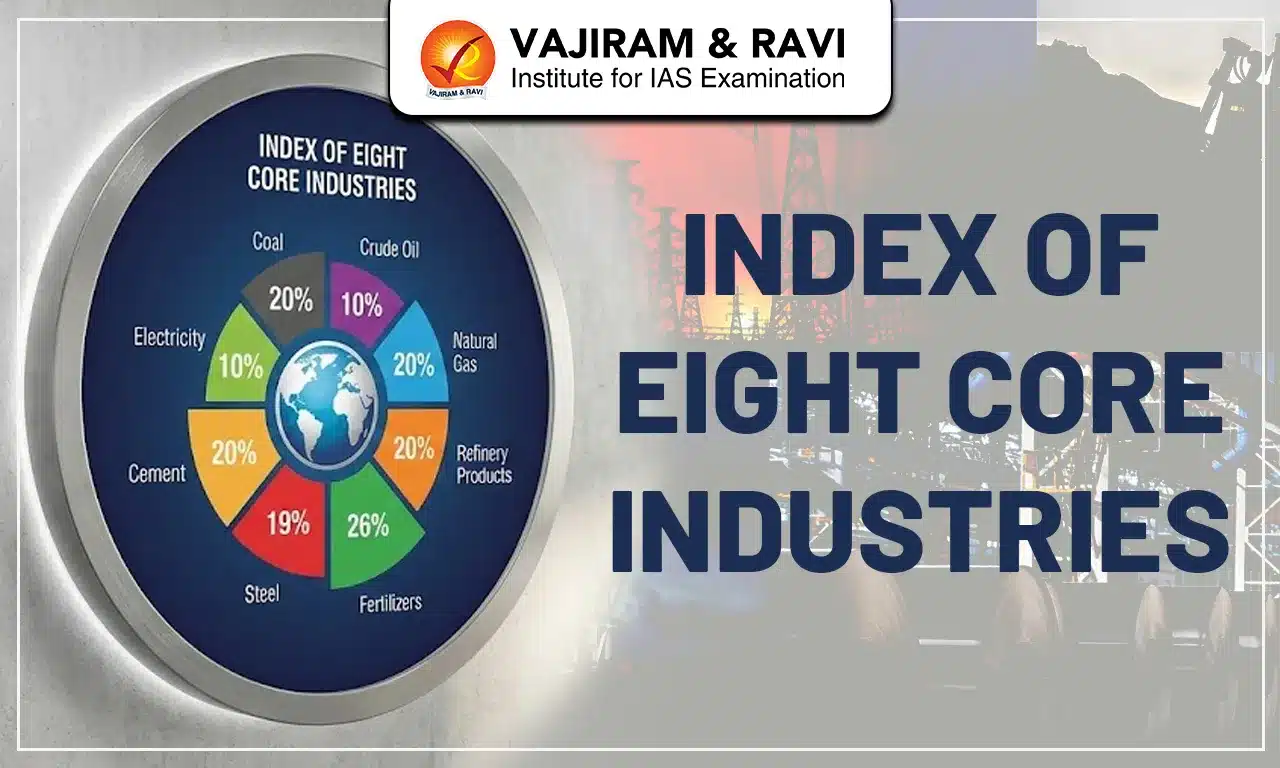
  • The Office of Economic Adviser (OEA) under the Department for Promotion of Industry and Internal Trade (DPIIT) has released the revised Index of Core Industries (ICI) with 2022–23 as the new base year, replacing 2011–12. 
  • The revised index recorded 5% growth in June, the highest in five months, largely driven by the inclusion of iron ore as the ninth core industry.

What is the Index of Core Industries (ICI)?

    • The ICI is a monthly indicator measuring the production performance of India's key infrastructure and industrial sectors. 
    • It serves as an early indicator of industrial activity and significantly influences the Index of Industrial Production (IIP).
  • Core Industries under the revised ICI (2022–23 Base Year): 
      • The index now covers 9 industries - Coal, Crude Oil, Natural Gas, Refinery Products, Fertilisers, Steel, Cement, Electricity, and Iron Ore (newly added).
      • These sectors together account for 32.88% of the weight in the IIP, making ICI an important leading indicator of industrial growth.
  • Timeline of ICI evolution: Initial series (1980–81), first revision (1993–94), Fertilisers and Natural Gas added (2004–05), and previous base year (2011–12).

Major Changes in the Revised ICI

  • Inclusion of iron ore:
    • Iron ore has been added following the recommendations of the Praveen Mahto Committee (2025). It contributes 4.9% to the revised index.
    • Production surged 43.9% in June, significantly boosting overall core sector growth.
  • Updated sectoral weights: Major changes in weights reflect the current structure of the economy -
    • Electricity now carries the highest weight (30.93%), replacing refinery products.
    • Weights of coal, crude oil and refinery products have declined.
    • Iron ore has been assigned a 4.9% weight.
  • Methodological improvements:
    • Steel index is now compiled using gross production data.
    • Coal index includes only raw coal, excluding washed coal and coal middlings to avoid double counting.
    • Weights have been aligned with the revised IIP (2022–23 base year).

Performance of Core Industries (June 2026)

  • Growth drivers:
    • Overall ICI growth: 5% (highest in five months).
    • Iron ore: 43.9% growth due to strong production and a low base effect.
    • Electricity: 9.8% growth, driven by higher power demand amid heatwaves and rainfall deficit.
    • Cement: 9.8% growth.
    • Steel: 4.6% growth.
    • Coal: 1.4% growth after three months of decline.
  • Sectors under pressure: 
    • Production declined in petroleum-related industries -
      • Crude oil: –4.2% (18th consecutive monthly decline).
      • Natural gas: –7.4% (24th consecutive monthly decline).
      • Refinery products: –4.7% (third straight monthly decline).
      • Fertilisers: –3.3% (fourth consecutive decline).
    • Lower global crude oil prices increased imports, reducing domestic production of petroleum products and fertilisers.
  • Revision of historical growth estimates: The revised series has altered earlier estimates -
    • 2024–25: Core sector growth revised down from 6.9% to 4.3%.
    • 2025–26: Growth revised up from 1.1% to 3%.
    • May 2026 growth: Revised upward from 1% to 3.2%.

ICI, IIP and ISP - India’s Three Monthly Economic Indicators

  • ICI: Tracks production of 9 core sectors and released by OEA, DPIIT, with revised base year of 2022–23.
  • IIP: Measures industrial output across Mining; Manufacturing; Electricity; Gas Supply & Water Supply, Sewerage and Waste Management (newly added) and released by National Statistical Office (NSO), MoSPI, with a base year of 2022–23.
  • Index of Services Production (ISP): 
    • India's first official monthly indicator measuring output in the formal services sector, and released by MoSPI, with a base year of 2024–25 (trial).
    • It covers 19 service sub-sectors, representing nearly 60% of India's services sector.
    • Uses GST data and administrative records, rather than direct production surveys. 
    • Health and education are currently excluded due to GST exemption but are proposed to be included using administrative data, which could raise coverage to around 80%.
  • Relationship:
    • ICI is a leading indicator of IIP, as core industries contribute 32.88% to the IIP.
    • ISP complements IIP, enabling monthly tracking of the services sector and providing a more comprehensive picture of economic activity.

Significance for the Economy

  • The revised ICI strengthens India's economic statistics by -
    • Providing an early signal of industrial and economic momentum.
    • Supporting evidence-based policy formulation.
    • Helping forecast GDP growth and industrial performance.
    • Tracking supply-side inflationary pressures.
    • Improving the representativeness and accuracy of official statistics through an updated base year and improved methodology.

Source: IE

Index of Core Industries (ICI) FAQs

Q1: Why is the revised Index of Core Industries (ICI) considered an important leading indicator?

Ans: It tracks the production of nine key infrastructure industries constituting 32.88% of the IIP.

Q2: What are the major reforms introduced in the revised ICI with the 2022–23 base year?

Ans: The revised ICI includes iron ore as the ninth core industry, updates sectoral weights, adopts gross production data for steel, etc.

Q3: What is the significance of the newly introduced Index of Services Production (ISP)?

Ans: The ISP provides India's first official monthly measure of the formal services sector using GST and administrative data.

Q4: How does the revision of the base year improve the quality of India's official economic indices?

Ans: Updating the base year aligns indices with the current economic structure, improves sectoral representation, etc.

Q5: What explains the contrasting performance of different core industries?

Ans: Strong growth in iron ore, electricity, cement, and steel offset declines in crude oil, natural gas, refinery products, and fertilisers.

Enquire Now