Vande Mataram Bill Latest News
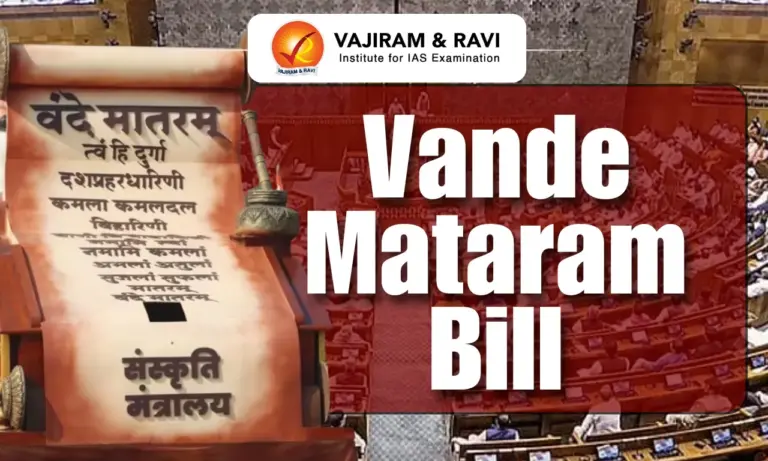
- The Prevention of Insults to National Honour (Amendment) Bill, 2026, is set to be introduced in the Rajya Sabha during the monsoon session.
- The Bill seeks to amend the Prevention of Insults to National Honour Act, 1971, granting the national song, ‘Vande Mataram’, the same statutory protection currently reserved for the national anthem, ‘Jana Gana Mana’.
What Does the Bill Propose?
- Under Section 3 of the 1971 Act, intentionally preventing the singing of the national anthem, or causing a disturbance to any assembly engaged in such singing, is a criminal offence punishable with imprisonment of up to three years, a fine, or both.
- The Bill proposes to bring the national song within the scope of this same provision, effectively criminalising disruption of its singing as well.


Current Legal Status of the National Song
- Earlier this year, the Union Ministry of Home Affairs issued guidelines on the singing and playing of the national song.
- These “orders relating to the National Song of India”:
- Specified the authorised lyrics, written by Bankim Chandra Chatterjee.
- Identified occasions for mass singing, such as during the unfurling of the National Flag, cultural occasions, or ceremonial functions.
- Stated that the audience must “stand to attention” whenever the official version is sung or played.
- Suggested that school days could begin with community singing of the national song.
Supreme Court’s Response to the Guidelines
- Following the government’s order, a petition was filed challenging the directives, with the petitioner’s counsel questioning whether people could be “compelled to sing the song in the garb of an advisory.”
- A three-judge bench headed by the Chief Justice of India dismissed the plea as “premature” and based on a “vague apprehension of discrimination.”
- Crucially, the Court noted at the time that the government’s directive was advisory in nature, with no penal consequences for non-compliance.
- If the new Bill is passed, however, it would introduce precisely the penal consequences that were absent when the Court made this observation.
How Courts Have Interpreted the Existing Anthem Law
- Since Section 3 of the 1971 Act currently applies only to the national anthem, past judicial interpretation offers a guide to how the amended law might work.
Salman v. State of Kerala (2014)
- The Kerala High Court clarified what constitutes a “disturbance” under the Act.
- It refused to quash an FIR against a petitioner accused of “making noise and hue and cry” during the singing of the national anthem.
- It held that “causing obstruction or prevention… by making loud or contemptuous noise” falls within the offence defined under Section 3, warranting police investigation.
The Right to Respectful Silence: A Key Precedent
- A landmark distinction exists between actively disrupting the anthem’s singing (an offence) and simply choosing not to sing (not an offence), established in Bijoe Emmanuel & Ors v. State of Kerala (1986).
- The case: Three children belonging to the Jehovah’s Witnesses Christian sect were expelled from school for refusing to sing the national anthem during morning assembly, despite standing respectfully in silence. Their refusal stemmed from religious belief that did not permit singing praises to anyone except in prayer to God.
- The ruling: The Supreme Court ruled in favour of the students, holding that their expulsion violated:
- Article 19(1)(a): Freedom of speech and expression
- Article 25(1): Freedom of religion
- The Court held there is no legal provision obliging anyone to sing the national anthem.
- It stated: “Proper respect is shown to the National Anthem by standing up when the National Anthem is sung… It will not be right to say that disrespect is shown by not joining in the singing.”
- The bench also emphasised the constitutional value of religious freedom.
- It also noted that “the real test of a true democracy is the ability of even an insignificant minority to find its identity under the country’s Constitution,” and concluded with the observation: “Our tradition teaches tolerance; our philosophy preaches tolerance; our constitution practices tolerance; let us not dilute it.“
Conclusion
- The proposed amendment marks a significant step in elevating ‘Vande Mataram’ to near-equal legal standing with the national anthem, criminalising deliberate disruption of its singing.
- Yet, as the Bijoe Emmanuel judgment reminds us, respect for national symbols coexists with constitutionally protected individual freedoms, and any new law will likely be tested against this delicate balance between national honour and personal liberty.

 Last updated on Oct, 2026
→ UPSC 2027 Notification will be released on 13 January 2027 at upsconline.nic.in.
→ Asian Games 2026 are being held in Aichi-Nagoya, Japan, from 19 September to 4 October.
→ Check Nobel Prize 2026 Winners List here.
→ Download PIB PRiSM Monthly Magazine 2026 here.
→ Check UPSC Monthly Current Affairs Magazine The Recitals here.
→ Check out the latest UPSC Syllabus here.
→ Download UPSC Model Answers for Mains 2026
→ UPSC Mains Question Paper 2026 is out now for Essay & GS Paper 1, 2, 3 & 4.
→ UPSC Calendar 2027 has been released.
→ Enroll in Vajiram & Ravi’s UPSC Mains Test Series 2027 for structured answer writing practice, expert evaluation, and exam-oriented feedback.
→ Join Vajiram & Ravi’s UPSC Mentorship Program 2027 for personalized guidance, strategy planning, and one-to-one support from experienced mentors.
→ Go through the UPSC Mains Previous Year Papers to enhance your preparation.
→ UPSC has released UPSC Toppers List 2025 with the Civil Services final result on its official website.
→ Also check Best UPSC Coaching in India
Vande Mataram Bill FAQs
Q1. What does the Vande Mataram Bill seek to achieve?+
Q2. How would the Vande Mataram Bill change the existing law?+
Q3. What constitutional concerns does the Vande Mataram Bill raise?+
Q4. Which Supreme Court judgment is significant in understanding the Vande Mataram Bill?+
Q5. Why is the Vande Mataram Bill significant for constitutional law?+
Tags: mains articles upsc current affairs upsc mains current affairs Vande Mataram Bill