
Foreign Direct Investment in E-commerce – Government Liberalises Policy

Foreign Direct Investment

Foreign Direct Investment Latest News

  • The Government has amended the Foreign Direct Investment (FDI) policy to permit foreign investment in inventory-based e-commerce entities exclusively for exports of goods manufactured or produced in India.

Background

  • India's FDI policy has traditionally distinguished between two models of e-commerce, marketplace-based and inventory-based.
  • Since 2016, the Government has permitted 100% FDI under the automatic route in the marketplace model of e-commerce, while prohibiting FDI in the inventory-based model for domestic retail trade. 
  • This restriction was intended to protect small retailers and ensure a level playing field by preventing foreign-funded e-commerce companies from directly owning and selling inventory in the Indian market.
  • However, the Government has increasingly focused on promoting e-commerce exports as part of its broader objective of enhancing India's manufacturing competitiveness and increasing merchandise exports. 
  • Measures such as amendments to the Foreign Trade Policy, customs reforms for courier exports, and digital trade facilitation have been introduced to encourage Indian manufacturers and MSMEs to access global markets.
  • In this context, the Department for Promotion of Industry and Internal Trade (DPIIT) issued Press Note 3 of 2026, allowing FDI in inventory-based e-commerce entities exclusively for exports while retaining restrictions on domestic retail operations.

What is the Inventory-Based E-commerce Model?

  • An inventory-based model is an e-commerce model in which the platform owns the inventory of goods and sells them directly to consumers.
  • In contrast, under the marketplace model, the e-commerce entity acts only as a digital intermediary that connects buyers with independent sellers without owning the goods.

Difference Between the Two Models
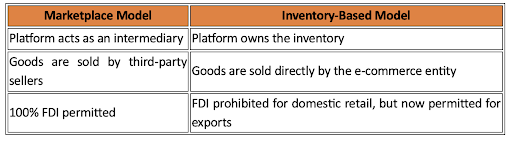
Differences Between Marketplace & Inventory-Based Model

Key Features of the New Policy

  • FDI Permitted Only for Export Operations
    • The amended policy permits 100% FDI in inventory-based e-commerce entities only when they deal exclusively in exports of goods manufactured or produced in India.
    • The liberalisation does not extend to domestic retail sales.
  • No Change in Domestic E-commerce Rules
    • The Government has retained the existing restrictions on Business-to-Consumer (B2C) inventory-based e-commerce within India.
    • Foreign-funded e-commerce companies cannot own inventory for direct sale to Indian consumers.
  • Support for Indian Manufacturers
    • The policy is intended to provide Indian manufacturers, particularly MSMEs and businesses located in Tier-II and Tier-III cities, with easier access to international markets through large global e-commerce platforms.
    • By allowing these platforms to maintain export-oriented inventories, the Government expects to improve logistics, reduce delivery timelines, and enhance the competitiveness of Indian products overseas.
  • Removal of Regulatory Ambiguity
    • The amendment also addresses an interpretational issue under the earlier FDI policy.
    • While FDI was already permitted in Business-to-Business (B2B) e-commerce, uncertainty existed regarding whether inventory restrictions applicable to domestic retail also applied to export-oriented operations.
    • The revised policy clarifies that the inventory restriction is limited to domestic retail trade and does not apply to export-only operations.

Expected Benefits of the Policy

  • Boost to E-commerce Exports
    • The policy is expected to strengthen India's e-commerce export ecosystem by enabling global platforms to procure, store, and ship Indian products more efficiently.
    • The Government has set an ambitious target of achieving $200 billion in e-commerce exports by 2030.
  • Greater Opportunities for MSMEs
    • Small manufacturers often face challenges related to warehousing, logistics, and international market access.
    • The new framework enables them to leverage the infrastructure and global customer networks of major e-commerce companies.
  • Support for Manufacturing Growth
    • The initiative aligns with the Government's objective of increasing the manufacturing sector's share in GDP to 25% by 2035 and expanding merchandise exports.
    • Improved export opportunities may encourage higher domestic production and employment generation.

Concerns and Challenges

  • Possibility of Policy Misuse
    • Some experts have expressed concerns that maintaining separate inventories for export and domestic sales may be difficult to monitor.
    • They argue that the export-only relaxation could eventually lead to demands for similar liberalisation in the domestic market.
  • Impact on Domestic Retail
    • Although the current amendment does not affect domestic retail, there are apprehensions that future policy changes could intensify competition for traditional retailers if inventory-based FDI is permitted beyond exports.
  • Need for Effective Monitoring
    • Successful implementation will require robust monitoring mechanisms to ensure that inventory created for export purposes is not diverted to the domestic market in violation of FDI regulations.

Significance of the Policy

  • The amendment represents a calibrated liberalisation of India's FDI policy.
  • It seeks to balance two important objectives:
    • Promoting exports through global e-commerce platforms 
    • Preserving safeguards applicable to domestic retail trade 
  • The policy also complements India's broader initiatives under Make in India, Foreign Trade Policy, and Districts as Export Hubs, while supporting the country's ambition of becoming a major global manufacturing and export hub.

Source: TOI | BS

Foreign Direct Investment FAQs

Q1: What is an inventory-based e-commerce model?

Ans: It is a model in which the e-commerce entity owns the inventory of goods and sells them directly to customers.

Q2: Does the new policy allow inventory-based FDI for domestic retail sales?

Ans: No. The relaxation applies only to exports of goods manufactured or produced in India.

Q3: Which department issued the amendment?

Ans: The Department for Promotion of Industry and Internal Trade (DPIIT) issued the amendment through Press Note 3 of 2026.

Q4: How does the policy benefit Indian MSMEs?

Ans: It enables MSMEs to utilise the logistics and global distribution networks of large e-commerce platforms, improving access to international markets.

Q5: What is the Government's target for e-commerce exports?

Ans: The Government aims to increase e-commerce exports to $200 billion by 2030.

Fast-Track Courts in India: Legal Basis, Performance, Challenges

Fast-Track Courts in India

Fast-Track Courts in India Latest News

  • PM Modi has proposed setting up fast-track courts (FTCs) to try paper leak cases amid ongoing protests. 
  • This has renewed focus on whether such courts can genuinely deliver on their promise of speedy justice, given India's persistent judicial backlog.

What Are Fast-Track Courts?

  • FTCs are not governed by a single central legislation. Their origin lies in the recommendations of the Fourteenth Finance Commission (2015–2020), which proposed setting up 1,800 FTCs to expedite trials of:
    • Heinous crimes such as murder, kidnapping, and extortion
    • Property disputes pending for over five years
    • Cases involving vulnerable groups — women, children, senior citizens, persons with disabilities, and those with terminal illnesses

Fast-Track Special Courts (FTSCs)

  • In 2019, following a criminal law amendment and a Supreme Court directive, the Union government launched a centrally sponsored scheme for FTSCs. 
  • Partly funded through the Nirbhaya Fund, these courts are dedicated exclusively to time-bound trials of rape cases and offences under the POCSO Act.

Can a Special Court Be Set Up for a Single Case?

  • Setting up special courts must satisfy Article 14 (equality before law). 
  • In State of West Bengal vs Anwar Ali Sarkar (1952), the Supreme Court struck down a law allowing arbitrary selection of cases for special courts merely for "speedier trial," holding that speed alone is too vague a justification. 
  • Any classification for fast-tracking must rest on a rational, objective basis — such as the nature of the offence or victim vulnerability.

Precedents of case-specific special courts

  • Andhra Pradesh High Court set up a special court in 2010 for the Satyam Computer Services scam.
  • The Supreme Court directed a dedicated special court for the 2G spectrum allocation scam (notified March 2011, Patiala House Courts).
  • It remains to be seen whether the NEET paper leak case, currently before a Delhi court, will similarly be referred to a special court.

Speed and Targets

  • Litigants have no automatic statutory right to a fixed trial deadline.
  • The Bharatiya Nagarik Suraksha Sanhita (BNSS) recommends trials be completed within two years generally, and within two months for sexual offences.
  • Each FTSC is expected to dispose of 41–42 cases per quarter, translating to at least 165 cases annually.

Performance So Far

  • As of January 2026: 862 regular FTCs functioning across 21 states/UTs, alongside 774 FTSCs (including 398 exclusive POCSO courts) across 29 states/UTs.
  • FTSC disposal rate stands at around 96%.
  • In 2024, 88,902 new cases were filed in FTSCs while 85,595 were resolved.
  • An FTSC disposes of about 9.5 cases per month — nearly three times the 3.3 cases cleared monthly by a regular trial court of similar jurisdiction.
  • Despite high clearance rates, pendency remains significant: over 2.4 lakh cases were pending in FTSCs by end-2023.

Why Delays Persist

  • The Ministry of Law and Justice, in a March 2026 Lok Sabha response, attributed delays to multiple factors: infrastructure availability, case complexity, investigation quality, evidence nature, and cooperation among the bar, investigating agencies, forensic support, witnesses, and litigants.
  • Legal experts note mixed efficacy across subject areas — FTCs handling POCSO and IPC cases face heavy case volumes and judge shortages, while those under the Prevention of Corruption Act show comparatively better outcomes.

Judicial Position on Trial Timelines

  • In P. Rama Chandra Rao vs State of Karnataka (2002), a seven-judge Constitution Bench ruled it is "neither advisable nor judicially permissible" to prescribe a fixed outer limit for concluding criminal trials, holding that such rigid limitation would amount to impermissible judicial legislation.

Conclusion

  • Fast-track courts offer measurably faster case disposal than regular courts, but their success is constrained by infrastructure gaps, judge shortages, and rising case inflow. 
  • Without addressing these root causes, fast-tracking risks becoming a symbolic response to public pressure rather than a durable fix for India's justice delivery system.

Source: IE

Fast-Track Courts in India FAQs

Q1: What are Fast-Track Courts in India and why were they established?

Ans: Fast-Track Courts in India were created to expedite trials involving heinous crimes, long-pending disputes and cases concerning vulnerable groups through dedicated judicial mechanisms.

Q2: How are Fast-Track Courts in India different from Fast-Track Special Courts?

Ans: Fast-Track Courts in India handle diverse categories of cases, whereas Fast-Track Special Courts primarily conduct time-bound trials for rape and POCSO offences under a centrally sponsored scheme.

Q3: Can Fast-Track Courts in India be established for a single case?

Ans: Fast-Track Courts in India can be created only on a rational and objective classification, as arbitrary case-specific courts would violate Article 14 of the Constitution.

Q4: Why do Fast-Track Courts in India continue to face delays despite higher disposal rates?

Ans: Fast-Track Courts in India are constrained by judicial vacancies, inadequate infrastructure, complex investigations, witness-related issues and increasing case inflow despite faster disposal.

Q5: Why are Fast-Track Courts in India important for judicial reforms?

Ans: Fast-Track Courts in India strengthen access to timely justice, but their long-term success depends on systemic reforms, adequate staffing and sustained judicial infrastructure.

India’s Shift Towards Polymer Currency – Opportunities, Challenges and the Road Ahead

Polymer Currency

Polymer Currency Latest News

  • The Reserve Bank of India (RBI), through its currency-printing arm Bharatiya Reserve Bank Note Mudran Pvt. Ltd. (BRBNMPL), has invited global Expressions of Interest (EOI) for supplying Biaxially Oriented Polypropylene (BOPP) polymer substrates with advanced security features. 
  • This marks India's most significant move towards introducing polymer (plastic) banknotes since the proposal was first made in 2009.

Why is RBI Considering Polymer Currency?

  • Greater durability:
    • Polymer notes last 2.5–4 times longer than conventional cotton-paper notes.
    • Lower denominations such as ₹10 and ₹20, which experience the highest circulation and physical wear, are likely to be introduced first.
    • Longer lifespan reduces the frequency of replacement under the RBI's Clean Note Policy.
  • Better security against counterfeiting:
    • Polymer banknotes can incorporate advanced security features such as -
      • Transparent windows
      • Metallic numerals
      • Magnetic pseudo-threads
      • Holograms
      • Shadow images
      • Iridescent patterns
      • Durable tactile markings for visually impaired persons
    • These features are significantly harder to replicate than those on paper currency.
  • Improved currency management: Although manufacturing costs are higher initially, fewer replacement cycles can reduce printing expenditure, transportation costs, storage and logistics costs, and destruction of soiled notes.

Economic Rationale

  • Current cost of currency management:
    • RBI spends roughly ₹5,000 crore annually on printing and maintaining currency.
    • Security printing expenditure - ₹5,101 crore (FY2023-24), ₹6,373 crore (FY2024-25), and ₹4,875 crore (FY2025-26).
    • India destroys 20–24 billion soiled notes annually, largely lower denominations.
  • Cost challenges:
    • Polymer notes cost 30–60% more to manufacture than paper notes.
    • In several countries, production cost for low-value polymer notes has reached 20–24% of their face value.
    • Additional transition costs include recalibration of ATMs, currency sorting machines, vending machines, and cash-processing infrastructure.

Environmental Dimensions

  • Potential benefits: A TERI study commissioned by RBI found that -
    • Longer circulation life reduces manufacturing and transportation requirements.
    • Over the complete lifecycle, polymer notes may have a lower overall carbon footprint than paper notes.
    • End-of-life polymer notes can be recycled into plastic products.
  • Concerns:
    • Polymer is produced from polypropylene, a petroleum-based product.
    • Higher initial carbon footprint.
    • Need for specialised recycling facilities.
    • Dependence on fossil fuel-derived raw materials raises sustainability concerns.

Unanswered Questions

  • Dependence on petrochemical imports:
    • Polymer substrate is made from BOPP (Biaxially Oriented Polypropylene).
    • India imports around one-fifth of its polypropylene requirement.
    • Volatility in crude oil prices, aggravated by geopolitical tensions (especially West Asia), could increase manufacturing costs.
    • This is despite planned domestic capacity expansion by companies such as Reliance Industries and Indian Oil Corporation.
  • Relevance in an increasingly digital economy:
    • India's payment ecosystem presents a paradox - UPI processes over 24,000 crore transactions annually, accounting for nearly 85% of retail digital payments.
    • Yet, currency in circulation has exceeded ₹41 lakh crore (2025–26), compared to around ₹16–17 lakh crore a decade earlier.
    • The Currency-to-GDP ratio remains above 11%, indicating sustained demand for cash despite rapid digitalisation.
    • Reasons for continued cash demand: Large informal economy, limited digital infrastructure in rural areas, and cash remains essential for financial inclusion and small-value transactions.

Historical Evolution and Global Experience

  • Evolution:
    • 2009: RBI first proposed polymer ₹10 notes.
    • 2012: 
      • Pilot planned in Kochi, Mysuru, Jaipur, Bhubaneswar and Shimla to test diverse climatic conditions.
      • The project was later shelved due to technological challenges and the disruption caused by 2016 demonetisation and subsequent currency redesign.
    • 2026: BRBNMPL's global EOI revives the proposal, with field trials expected to begin for ₹10 and ₹20 notes.
  • Global experience:
    • Australia pioneered polymer currency and has fully transitioned to it. 
    • Around 60 countries now use polymer banknotes in some form, including Canada, United Kingdom, New Zealand, Mexico, Brazil, Saudi Arabia, Romania, and Barbados.
    • Their experience indicates improved durability, enhanced security and lower lifecycle costs despite higher initial production expenses.

Way Forward

  • Begin with limited pilot projects in lower denominations before nationwide adoption.
  • Encourage domestic production of polymer substrates to reduce import dependence.
  • Conduct comprehensive cost-benefit and environmental impact assessments (EIAs).
  • Upgrade ATM and cash-handling infrastructure in a phased manner.
  • Ensure coexistence of paper and polymer notes during transition without demonetisation.
  • Align currency reforms with India's broader objectives of Digital India, financial inclusion, and efficient cash management.

Conclusion

  • India's move towards polymer currency represents an attempt to modernise its cash ecosystem by improving durability, security and lifecycle efficiency. However, concerns warrant a cautious, evidence-based rollout. 
  • The objective should not be merely replacing paper with plastic, but creating a cost-effective, secure and sustainable currency system suited to India's evolving payment landscape.

Source: IE | TH

Polymer Currency FAQs

Q1: Why is the RBI considering the introduction of polymer banknotes in India?

Ans: To enhance currency durability, improve anti-counterfeiting security, reduce long-term currency management costs, etc.

Q2: What is the 'currency demand paradox' highlighted by the RBI?

Ans: Simultaneous rapid growth of digital payments, alongside a continued increase in currency in circulation.

Q3: What are the major challenges associated with adopting polymer currency in India?

Ans: Higher initial production costs, dependence on polypropylene imports, infrastructure upgradation costs, etc.

Q4: Why are ₹10 and ₹20 notes likely to be prioritised for polymer conversion?

Ans: Because they experience the highest circulation, wear and tear, making them the most cost-effective denominations.

Q5: How can polymer banknotes contribute to environmental sustainability?

Ans: Their longer lifespan potentially lowers the overall lifecycle carbon footprint, while recycling polymer substrates.

US-Saudi Nuclear Deal: Implications for West Asia and Global Non-Proliferation

US-Saudi Nuclear Deal

US-Saudi Nuclear Deal Latest News

  • The United States and Saudi Arabia have signed a landmark civilian nuclear cooperation agreement. 
  • Framed as a "peaceful nuclear cooperation agreement," the 30-year pact has sparked concerns that it could enable Saudi Arabia to eventually develop nuclear weapons.

What the Deal Involves

  • The agreement gives American companies substantial access to Saudi Arabia's nuclear energy programme. 
  • Alongside it, a "bilateral safeguards agreement" was also signed, though the full text remains undisclosed. 
  • Reports suggest the deal could permit Saudi Arabia to enrich uranium domestically — fuel primarily meant for power plants, but which can also be diverted toward weapons-grade material.
  • Some US media reports question whether the accompanying safeguards are robust enough.

The 123 Agreement: Legal Backbone of the Deal

  • Named after Section 123 of the US Atomic Energy Act, 1954, a 123 Agreement is mandatory before the US can undertake significant nuclear cooperation with any country.
  • It facilitates transfer of nuclear materials, equipment, and technology for peaceful purposes while ensuring non-proliferation compliance.
  • India precedent: India's 123 Agreement with the US, cleared by Congress on October 1, 2008, ended three decades of technology-denial restrictions. India agreed to place select civilian facilities under India-specific IAEA safeguards in exchange for uninterrupted fuel supply — a model frequently cited in nuclear diplomacy discussions.
  • The Saudi deal must similarly be ratified by the US Congress — a politically uncertain process, since Saudi Arabia lacks the broad bipartisan support Israel enjoys in the US legislature.

Why the Deal Raises Concerns

  • Regional arms race risk: West Asia already has one nuclear power (Israel) and one on the threshold (Iran). A Saudi enrichment capability could trigger a proliferation cascade.
  • Iran factor: Saudi Arabia's then-Crown Prince Mohammed bin Salman stated in 2018 that the Kingdom would pursue nuclear weapons if Iran did. The deal could embolden Iran's own weapons ambitions and push it closer to China and Russia.
  • Weak inspection regime: Unlike the 2009 US-UAE nuclear deal — under which Abu Dhabi does not enrich its own fuel and faces multiple restrictions — the Saudi pact may allow indigenous enrichment, setting a more permissive precedent.
  • Geopolitical timing: The deal comes amid escalating US-Iran hostilities. Saudi Arabia hosts US military bases that have faced Iranian attacks, and it comes just two days after Yemen's Houthis announced a maritime blockade against the Kingdom.
  • Conflict of interest concerns: The Trump Organisation has significant financial dealings with Saudi Arabia, having raised around $50 million in 2024 alone from Saudi-linked business, raising questions about the deal's underlying motivations.

Strategic and Economic Rationale

  • For the US: Opens major sales opportunities for American nuclear firms, notably Westinghouse.
  • For Saudi Arabia: Enables diversification away from oil-based electricity generation toward nuclear power, freeing more crude for export.
  • Both governments have officially framed the deal as mutually beneficial and non-proliferation-compliant.

Conclusion

  • The US-Saudi nuclear deal marks a major diplomatic win for Riyadh but carries significant proliferation risk in an already volatile West Asia. 
  • Its ultimate impact will hinge on the strength of safeguards, Congressional ratification, and whether it triggers a wider regional race for nuclear capability — making it a critical case study in the balance between energy diplomacy and non-proliferation.

Source: IE | BBC

US-Saudi Nuclear Deal FAQs

Q1: What is the significance of the US-Saudi Nuclear Deal?

Ans: The US-Saudi Nuclear Deal expands civilian nuclear cooperation while raising important questions regarding uranium enrichment, regional security and nuclear non-proliferation safeguards.

Q2: How does the 123 Agreement support the US-Saudi Nuclear Deal?

Ans: The US-Saudi Nuclear Deal is based on a Section 123 Agreement, which provides the legal framework for peaceful nuclear cooperation under US domestic law.

Q3: Why has the US-Saudi Nuclear Deal generated non-proliferation concerns?

Ans: The US-Saudi Nuclear Deal may permit domestic uranium enrichment, increasing concerns about nuclear weapons proliferation and a potential arms race in West Asia.

Q4: How could the US-Saudi Nuclear Deal affect regional geopolitics?

Ans: The US-Saudi Nuclear Deal could influence strategic competition involving Iran, Israel and major powers, potentially reshaping the regional nuclear balance in West Asia.

Q5: Why is the US-Saudi Nuclear Deal important for global nuclear governance?

Ans: The US-Saudi Nuclear Deal will test the effectiveness of international safeguards while balancing peaceful nuclear cooperation with global non-proliferation objectives.

Enquire Now

