Public Examination Amendment Bill 2026 – Explained

Public Examination

Public Examination Latest News

  • Parliament has passed the Public Examination (Prevention of Unfair Means) Amendment Bill, 2026, introducing tougher punishments, fast-track courts, and time-bound investigation and trial in paper leak cases.

Public Examinations Law in India

  • To tackle paper leaks and organised exam fraud, Parliament enacted the Public Examination (Prevention of Unfair Means) Act, 2024. 
  • The law aimed to address unfair practices in major public examinations conducted by bodies such as:
    • Union Public Service Commission (UPSC)
    • Staff Selection Commission (SSC)
    • Railway Recruitment Board (RRB)
    • Institute of Banking Personnel Selection (IBPS)
    • National Testing Agency (NTA), including the NEET exam
  • It was the first dedicated central law targeting question paper leaks, organised cheating, and exam-related fraud in public examinations.
  • However, after the NEET-UG paper leak in May 2026, public anger and student protests intensified. 
  • The controversy exposed weaknesses in the existing law, especially in relation to deterrence, speed of investigation, and disposal of cases. 
  • In response, the government moved to strengthen the law through the Public Examination (Prevention of Unfair Means) Amendment Bill, 2026.

Background of the 2024 Law

  • The original 2024 Act provided punishments for individuals and organised groups using unfair means in public exams. Its main objective was to protect the transparency, credibility, and fairness of recruitment and entrance examinations.
  • Under the earlier law:
    • Individuals involved in unfair means faced imprisonment of 3 to 5 years and a fine up to Rs 10 lakh.
    • In certain cases, penalties included a fine up to Rs 1 crore and a ban on exam-related responsibilities for four years.
    • Organised crime related to exam fraud attracted imprisonment of at least 3 years and a fine of Rs 1 crore.
    • In the gravest offences, punishment extended to 5 to 10 years imprisonment and a fine of Rs 1 crore.
  • Even though the law existed, the recent paper leak controversy led to demands for harsher punishment, special courts, and faster justice delivery.

Public Examination Amendment Bill, 2026

  • The Lok Sabha passed the Amendment Bill by voice vote, and the Rajya Sabha also cleared it by voice vote. The Bill strengthens the 2024 law in four important ways.
  • Tougher Punishments
    • Punishment of 3 to 5 years and fine up to Rs 10 lakh has now been raised to 5 to 10 years imprisonment and fine up to Rs 50 lakh.
    • Punishment involving fine up to Rs 1 crore and a ban of four years has been enhanced to fine up to Rs 5 crore and a ban of eight years.
    • Punishment of at least 3 years imprisonment and Rs 1 crore fine has been raised to at least 5 years imprisonment and Rs 5 crore fine.
    • Punishment of 5 to 10 years imprisonment and Rs 1 crore fine has been strengthened to at least 7 years imprisonment and Rs 10 crore fine.
    • Thus, the law now provides a much stronger deterrent against organised paper leak networks.
  • Statutory Backing for Fast-Track Courts
    • The Bill gives statutory backing to fast-track courts for trying offences under the Act.
    • This is significant because it moves beyond an executive announcement and embeds the fast-track mechanism directly in law. Once the amendment comes into force, all future offences under the Act can be tried by fast-track courts.
    • The government has already announced that such courts would initially be set up in the four High Courts where NEET-related cases are ongoing.
  • Five-Month Timeline for Investigation and Trial
    • Another major feature is the imposition of a strict time frame:
      • Investigation must be completed within two months.
      • Trial must be completed within three months.
    • This means that a paper leak case should, in principle, reach a conclusion within five months.
  • Provision for a Special Task Force
    • The Bill also empowers the Union government to establish a Special Task Force to investigate offences under the Act. 
    • This is aimed at strengthening coordination, especially where paper leak networks operate across states or involve organised criminal syndicates.

Significance of the Bill

  • The Amendment Bill is important because it attempts to address both substantive weakness and procedural delay.
  • On the substantive side, it raises punishment sharply, especially in cases involving organised crime. On the procedural side, it introduces:
    • Fast-track adjudication
    • Statutory time limits
    • A Special Task Force
  • This combination is meant to make the law not only stricter but also more effective in practice.
  • The Bill also reflects a broader recognition that exam fraud is no longer a routine malpractice but a serious governance and public trust issue affecting merit, opportunity, and social justice.

Concerns and Challenges

  • Even with stronger penalties, the real effectiveness of the law will depend on implementation.
  • Some important challenges remain:
    • Whether investigations can genuinely be completed within two months.
    • Whether fast-track courts will have the capacity and staffing to meet the deadline.
    • Whether states and investigating agencies can coordinate effectively.
    • Whether digital and logistical vulnerabilities in examination systems are also corrected.
  • Experience with other fast-track courts, including those under special laws such as POCSO, shows that pendency can still rise if infrastructure and staffing do not keep pace.

Source: IE | TH

Public Examination FAQs

Q1: What is the Public Examination Amendment Bill, 2026?

Ans: It is a law amending the Public Examination (Prevention of Unfair Means) Act, 2024 to impose tougher punishments and faster trial mechanisms for paper leak cases.

Q2: What is the maximum punishment under the amended law?

Ans: The amended law provides for imprisonment up to 10 years and fines up to Rs 10 crore, depending on the offence.

Q3: What timeline does the new law prescribe for paper leak cases?

Ans: It provides for a two-month investigation period and a three-month trial period, making the total timeline five months.

Q4: Which exam bodies are covered under the law?

Ans: The law covers examinations conducted by bodies such as UPSC, SSC, RRB, IBPS, and NTA, including NEET.

Q5: What new institutional mechanism does the Bill provide?

Ans: It gives statutory backing to fast-track courts and allows the Union government to create a Special Task Force for investigation.
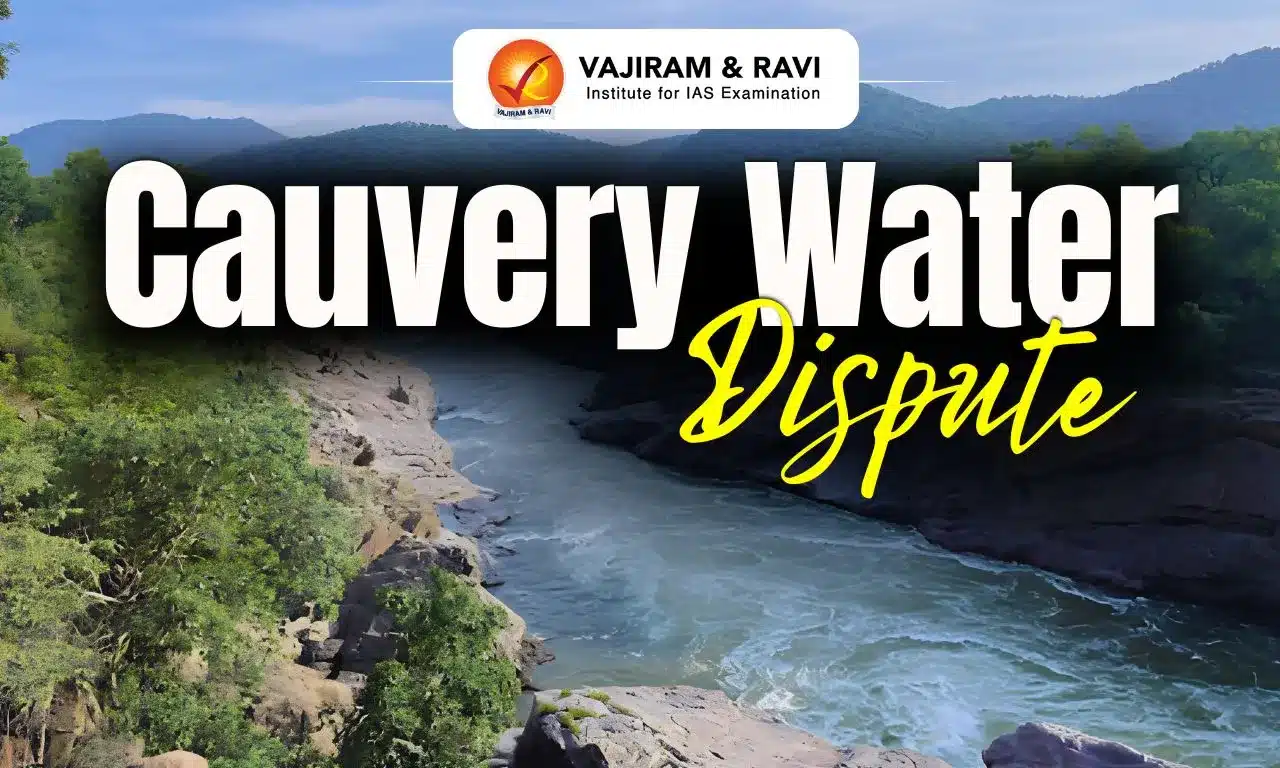

Cauvery Water Dispute – CWMA Upholds Water Release Amid Distress Conditions

Cauvery Water Dispute

Cauvery Water Dispute Latest News

  • The Cauvery Water Management Authority (CWMA) has endorsed the Cauvery Water Regulation Committee (CWRC) decision directing Karnataka to release 3,500 cusecs of water to Tamil Nadu for 15 days (July 29–August 12, 2026).
  • This amounts to nearly 4.5 thousand million cubic feet (tmc ft). 
  • The decision comes amid deficient southwest monsoon rainfall and severe water shortages in the Cauvery basin, reviving concerns over equitable sharing of river waters during distress years.

Institutional Framework for Cauvery Water Management

  • The CWRC functions under the CWMA, which was established in 2018 to implement the Cauvery Water Disputes Tribunal (CWDT) Award (2007) as modified by the Supreme Court (2018).
  • Statutory body: The CWMA is formed under the Inter-State River Water Disputes Act, 1956, operating under the Union Ministry of Jal Shakti.
  • Composition of CWRC:
    • Headquartered in New Delhi, it is headed by the Member (Water Resources), CWMA.
    • Members include -
      • Chief Engineers of all Cauvery basin States.
      • Representatives from the India Meteorological Department (IMD), Central Water Commission (CWC) and Ministry of Agriculture & Farmers’ Welfare.
  • Mandate and functions of CWRC: The committee performs both regulatory and technical functions, including -
    • Monitoring daily water levels, inflows and storage in eight major reservoirs -
      • Karnataka: Hemavathy, Harangi, Krishnarajasagara (KRS), Kabini.
      • Tamil Nadu: Mettur, Bhavanisagar, Amaravathy.
      • Kerala: Banasurasagar.
    • Ensuring scheduled daily and monthly water releases as directed by CWMA.
    • Preparing seasonal (Southwest Monsoon, Northeast Monsoon, Hot Weather) and annual water accounts.
    • Reviewing compliance with previous directions and reassessing basin conditions through fortnightly meetings during the monsoon.
  • CWDT: It was constituted by the Government of India on June 2, 1990, under the Inter-State River Water Disputes Act, 1956.
  • Inter-State River Water Disputes Act, 1956: It is enacted under Article 262 of Constitution of India to resolve the water disputes that would arise in the use, control and distribution of an interstate river or river valley.

How does the CWRC Decide Water Releases?

  • The committee relies on scientific hydro-meteorological assessment rather than fixed allocations during distress years. 
  • Key parameters include -
    • Rainfall received and IMD's forecast.
    • Live storage in reservoirs.
    • Reservoir inflows and outflows.
    • The river flows at Biligundulu (inter-State measuring point).
    • Water availability in intermediate catchments.
    • Compliance with earlier release orders.
  • This data-driven approach seeks to balance drinking water, irrigation requirements and ecological considerations.

Factors Behind the Latest Decision

  • The CWRC considered multiple indicators before fixing the release at 3,500 cusecs -
    • Net inflows into Karnataka reservoirs were nearly 60% below the 30-year average.
    • River flow at Biligundulu showed a 90% deficit, indicating severe basin-wide stress.
    • IMD forecasts suggested continued weak rainfall, limiting future inflows.
    • Combined storage in Karnataka's four major reservoirs stood at 64.15 tmc ft against a capacity of 114.57 tmc ft.
  • Considering these distress conditions, the committee opted for a quantity that would be operationally feasible while partially meeting Tamil Nadu's requirements.

Divergent Responses from the Riparian States

  • Karnataka's position:
    • The State has not commenced irrigation releases due to inadequate rainfall.
    • It considers the CWRC order burdensome under prevailing drought-like conditions.
    • The government is examining the possibility of appealing before the CWMA.
    • Farmers' organisations have demanded application of a "distress-sharing formula" instead of fixed allocations.
  • Tamil Nadu's position:
    • Tamil Nadu views the ordered release as insufficient.
    • It argues Karnataka should release the entire deficit of 9.8 tmc ft calculated by the committee.
    • The kuruvai cultivation season requires nearly 100 tmc ft of water for about 4 lakh acres.
    • Mettur reservoir storage is around 36 tmc ft, of which nearly 10 tmc ft must be reserved for drinking water and dead storage.

Key Challenges and Way Forward

  • Challenges:
    • Absence of an agreed distress-sharing formula during deficient rainfall years.
    • Conflicting priorities between drinking water, irrigation and reservoir conservation.
    • Increasing uncertainty due to climate variability affecting monsoon reliability.
    • Balancing legal water entitlements with ground-level hydrological realities.
    • Recurring inter-State political tensions despite an institutional dispute-resolution mechanism.
  • Way forward:
    • Develop a mutually agreed distress-sharing formula to proportionately distribute shortages among basin States during drought years.
    • Strengthen real-time hydrological monitoring, transparent data sharing and scientific forecasting.
    • Promote cooperative federalism through continuous dialogue between Karnataka, Tamil Nadu and the CWMA.
    • Encourage water-use efficiency, micro-irrigation, crop diversification and basin-level integrated water resources management.
    • Institutionalise periodic reviews to ensure adaptive water allocation under changing climatic conditions.

Source: TH

Cauvery Water Dispute FAQs

Q1: How does the Cauvery Water Regulation Committee (CWRC) determine water releases?

Ans: It bases decisions on hydro-meteorological parameters such as rainfall, reservoir storage, inflows, river flows, etc.

Q2: What is the institutional role of the Cauvery Water Management Authority (CWMA)?

Ans: It implements the Cauvery Water Disputes Tribunal Award (2007), as modified by the Supreme Court (2018).

Q3: Why is the absence of a distress-sharing formula a major challenge?

Ans: It leads to recurring conflicts as States differ on how water shortages should be equitably shared during deficient rainfall years.

Q4: How does climate variability complicate inter-State river water governance in India?

Ans: Uncertain monsoon patterns reduce water availability, making fixed allocations difficult.

Q5: What measures can improve long-term resolution of the Cauvery water dispute?

Ans: A distress-sharing formula, transparent data sharing, cooperative federalism, integrated river basin management, etc.

US-Iran Conflict Reshapes Gulf Security Architecture: Regional Realignments and India’s Energy Security

US-Iran Conflict Reshapes Gulf Security Architecture

US-Iran Conflict Reshapes Gulf Security Architecture Latest News

  • The US-Iran conflict has triggered significant strategic realignments among Gulf Arab states, ranging from renewed defence pacts with Pakistan to a rekindled Houthi-Saudi confrontation, with implications for regional stability and India's energy security.

Background: The US-Iran Standoff

  • US strikes targeted Iran's capability to threaten shipping in the Strait of Hormuz, after Iran rejected American proposals for a new shipping channel through Omani waters and targeted non-compliant vessels.
  • Despite the offensive, Iran retains control over Hormuz, and Tehran-Muscat talks to operationalise Article 5 (joint Iran-Oman administration of the Strait) continue — now expanded to include Saudi Arabia.
    • This was seen in Iranian FM Araghchi's talks with Saudi counterpart Faisal bin Farhan.
  • Washington remains incentivised to strike Iranian nuclear and Hormuz-related targets again, as its self-defined objectives remain unmet.

Fallout One: Gulf States Deepen Ties with Pakistan

  • Recently, Kuwait ratified a June 2023 Defence Cooperation Agreement (DCA) with Pakistan for five years, covering training, intelligence sharing, logistics, and defence technology exchange.
  • Qatar committed to deepening security cooperation with Pakistan during bilateral talks in Doha.
  • Unlike the Saudi-Pakistan Strategic Mutual Defence Agreement (SMDA) of September 2025, Kuwait's DCA does not bind either side to defend the other if attacked.
    • It should be noted that the SMDA has not translated into mutual military action (Pakistan has not struck Iran or Houthi territory; Saudi Arabia has not struck Afghanistan).
    • This suggests its real purpose is entrenching Pakistan's role in long-term capability-building rather than immediate collective defence.
  • For Gulf states, securing dependable defence partners for domestic capability development outweighs intra-Gulf political differences. 
  • Pakistan's economic dependence on these states adds a layer of leverage for the Gulf side.

Fallout Two: Resumption of Houthi-Saudi Hostilities

  • Fighting resumed recently when the Saudi-backed Yemeni government-in-exile bombed Sana'a airport, reportedly to block an Iranian aircraft landing.
  • The Houthis retaliated with ballistic missiles into Saudi territory and declared a naval blockade in the Bab-el-Mandeb strait — unprecedented since the 2022 truce.
  • Saudi Arabia struck the Houthi-controlled Hodeida port, handling over 70% of Yemen's trade and humanitarian aid, provoking Houthi strikes on Saudi Aramco facilities and a partial shutdown of the 400,000 bpd Jazan Refinery.
  • For the first time, both the Red Sea and the Strait of Hormuz were simultaneously under conflict-related disruption.
  • Riyadh, however, is unlikely to seek full-scale war, instead preferring engagement — evident in Saudi participation in US strikes on Iran-backed militias in Iraq rather than direct retaliation against the Houthis.

Why Saudi Arabia Seeks Stability

  • Recently, Saudi Arabia signed a 123 Agreement with the US for civil nuclear cooperation — raising the stakes for regional calm, since a Houthi strike on a future nuclear facility would be far more dangerous than attacks on oil infrastructure.
  • Recent drone strike on the UAE's Barakah nuclear plant had already revived post-Fukushima safety concerns among Arab states.
  • The 123 Agreement may also strengthen Iran's own case for enrichment rights, potentially reducing its willingness to concede ground in nuclear talks.
  • Preventing a "broken windows effect" on Arab economies remains a key regional priority even amid mounting US war fatigue.
    • If the current conflict (Houthi attacks, US-Iran strikes, disruptions to oil facilities and shipping) is allowed to drag on and damage confidence, it could trigger a similar spiral:
      • Investors start losing confidence
      • Businesses and tourists stay away
      • Oil and trade routes seem unsafe
    • This damages the reputation and stability of the whole region, not just the areas directly hit.

Conclusion

  • The US-Iran conflict has exposed the fragility of Gulf security, pushing states like Kuwait and Qatar toward Pakistan for capability-building, while Saudi Arabia balances renewed Houthi threats against its nuclear ambitions. 
  • For India, sustained instability in the Hormuz-Red Sea corridor threatens energy imports and regional equities.

Source: IE

US-Iran Conflict Reshapes Gulf Security Architecture FAQs

Q1: How does US-Iran Conflict Reshapes Gulf Security Architecture affect Gulf countries?

Ans: US-Iran Conflict Reshapes Gulf Security Architecture by encouraging Gulf nations to strengthen defence partnerships, diversify security arrangements, and prepare for prolonged regional instability.

Q2: Why is Pakistan important in US-Iran Conflict Reshapes Gulf Security Architecture?

Ans: US-Iran Conflict Reshapes Gulf Security Architecture highlights Pakistan's growing defence cooperation with Gulf states through military training, intelligence sharing, logistics, and long-term capability building.

Q3: How has the Houthi conflict influenced US-Iran Conflict Reshapes Gulf Security Architecture?

Ans: US-Iran Conflict Reshapes Gulf Security Architecture has intensified with renewed Houthi-Saudi hostilities, disrupting the Red Sea and increasing risks to global shipping and regional stability.

Q4: Why does Saudi Arabia seek stability despite US-Iran Conflict Reshapes Gulf Security Architecture?

Ans: US-Iran Conflict Reshapes Gulf Security Architecture makes regional stability crucial for Saudi Arabia to protect its nuclear cooperation, economic reforms, energy infrastructure, and investor confidence.

Q5: How does US-Iran Conflict Reshapes Gulf Security Architecture impact India?

Ans: US-Iran Conflict Reshapes Gulf Security Architecture affects India's energy security by increasing risks to crude oil imports, shipping routes through Hormuz and the Red Sea, and regional economic interests.

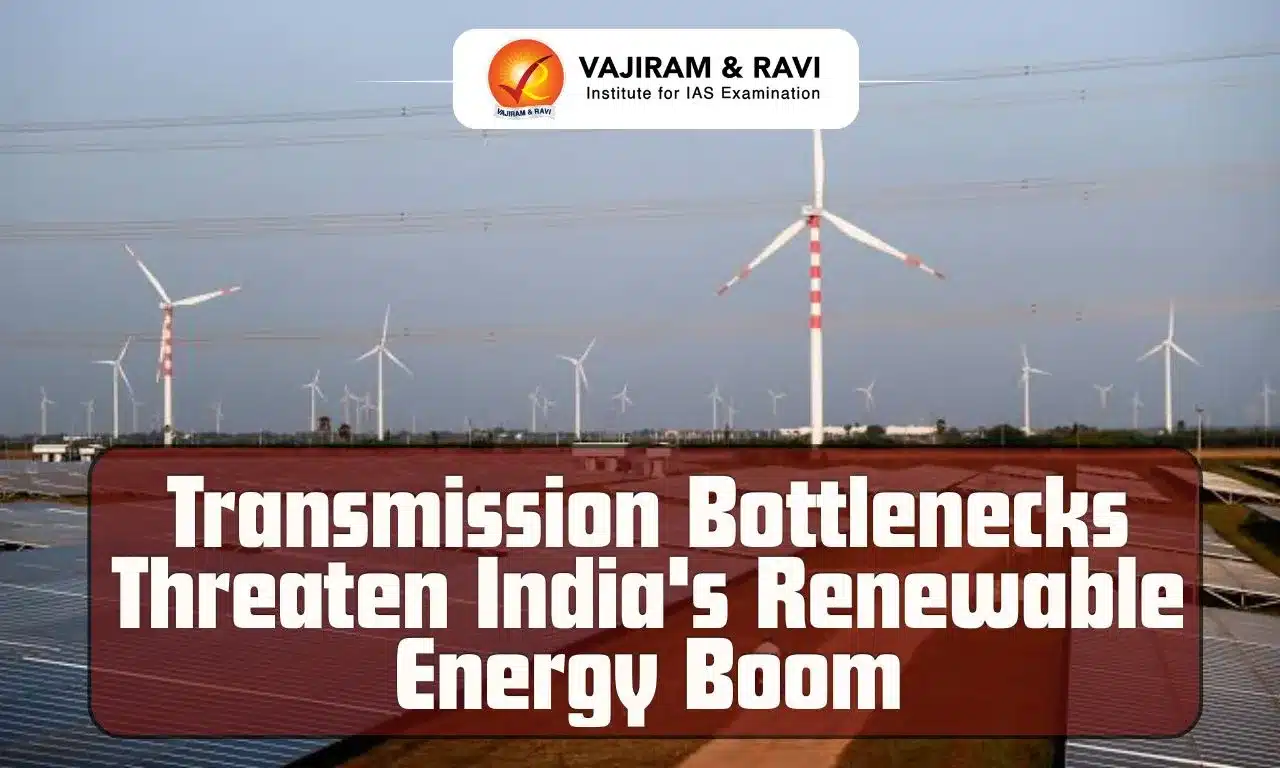
Transmission Bottlenecks Threaten India’s Renewable Energy Boom: Grid Delays, T-GNA and Financial Risks

Transmission Bottlenecks Threaten India's Renewable Energy Boom

Transmission Bottlenecks Threaten India's Renewable Energy Boom Latest News

  • Nearly 21 GW — about 9% of India's installed renewable energy capacity — is running on temporary grid connections due to delayed dedicated transmission infrastructure, putting project revenues and clean energy targets at risk.

The Core Problem

  • Renewable energy capacity is being added faster than the transmission network needed to evacuate that power.
  • Around 12 GW faces restrictions on power evacuation during peak solar generation hours.
    • Power evacuation refers to transferring electricity generated at a plant to the point of consumption.
  • In FY26, about 6,900 GWh of clean electricity faced restrictions due to this mismatch; during April–June alone, 8,133 GWh of solar electricity was curtailed.

Understanding the GNA-TGNA Framework

  • Under the General Network Access (GNA) framework, inter-state transmission-connected projects with long-term GNA get firm evacuation rights — that is, guaranteed access to send their power into the grid.
  • Projects awaiting dedicated transmission infrastructure operate under Temporary General Network Access (T-GNA), a stopgap arrangement that allows scheduling of power only when spare capacity exists.
  • During congestion, long-term GNA projects get priority, forcing T-GNA projects to curtail (reduce) generation — by as much as 70-80% of capacity, according to developers.
  • Electricity curtailment means the intentional reduction of power output from renewable generators.

Financial Stress on Developers

  • Solar power enjoys "must-run" status in India, but can still be backed down for grid security, technical constraints, or transmission bottlenecks.
  • Developers get compensated for grid-security-related curtailment, but not for T-GNA-related curtailment — directly eroding revenues.
  • In Rajasthan, curtailment has reportedly touched 90-95% for some projects, with roughly 4 GW of state capacity affected.
  • Developers are increasingly funding operations through equity and reserves rather than actual power revenue — an unsustainable model over time.
  • As a result, the experts have demanded moratorium on principal repayment during transmission delays, interest-free/concessional bridge financing, extended loan tenure without credit downgrades, and debt restructuring without asset reclassification.

Risk of NPAs and Systemic Impact

  • Industry experts warn affected projects could turn into Non-Performing Assets (NPAs) if the issue persists.
  • They noted generators lose over 50% of generation during peak solar hours due to T-GNA curtailment — a rate unsustainable beyond a few months for loan servicing.
  • 12 public sector banks, along with IREDA, PFC, REC, NaBFID, IIFCL, and SIDBI, cumulatively deployed about Rs 5.08 lakh crore in the renewable sector over FY25-26 — meaning financial institutions also bear risk if project viability deteriorates.
  • Analysts have flagged that continued slippage in transmission commissioning could hit capacity additions, cash flows, Internal Rate of Returns (IRRs), and investor confidence.

Conclusion

  • India's renewable energy growth is being outpaced by transmission infrastructure, trapping a significant share of green capacity in a temporary, low-priority access regime. 
  • Left unaddressed, this mismatch threatens developer solvency, banking sector exposure, and India's broader clean energy targets — making transmission planning as critical as capacity addition itself.

Source: IE | BS

Transmission Bottlenecks Threaten India's Renewable Energy Boom FAQs

Q1: Why do Transmission Bottlenecks Threaten India's Renewable Energy Boom?

Ans: Transmission Bottlenecks Threaten India's Renewable Energy Boom because renewable capacity is growing faster than transmission infrastructure, leading to power curtailment, revenue losses, and delayed clean energy integration.

Q2: How does the T-GNA system contribute to Transmission Bottlenecks Threaten India's Renewable Energy Boom?

Ans: Under T-GNA, projects receive only temporary grid access and face priority restrictions during congestion, making Transmission Bottlenecks Threaten India's Renewable Energy Boom through frequent power curtailment.

Q3: What financial challenges arise because Transmission Bottlenecks Threaten India's Renewable Energy Boom?

Ans: As Transmission Bottlenecks Threaten India's Renewable Energy Boom, developers suffer revenue losses, rely on reserves for operations, seek debt restructuring, and face increasing risks of loan defaults.

Q4: How do Transmission Bottlenecks Threaten India's Renewable Energy Boom and the banking sector?

Ans: Transmission Bottlenecks Threaten India's Renewable Energy Boom by increasing the possibility of NPAs, affecting banks and financial institutions that have invested heavily in renewable energy projects.

Q5: What measures can reduce Transmission Bottlenecks Threaten India's Renewable Energy Boom?

Ans: Faster transmission infrastructure, timely grid connectivity, bridge financing, extended loan tenures, and improved transmission planning can reduce Transmission Bottlenecks Threaten India's Renewable Energy Boom.

Enquire Now