
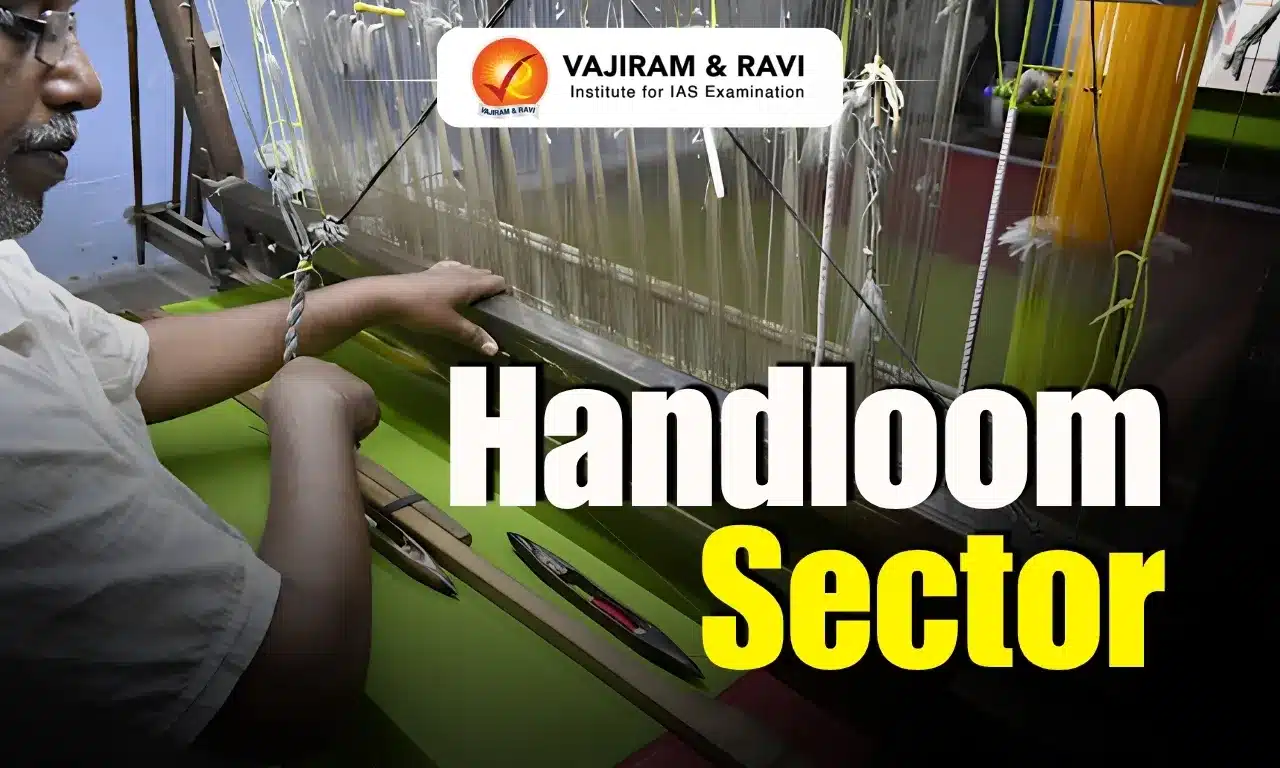
Handloom Sector in India – Economic Significance, Challenges, and the Road Ahead

Handloom Sector

Handloom Sector Latest News

  • National Handloom Day, observed on August 7, has drawn attention to the continuing economic significance of India's handloom sector and the challenges of declining returns, fragmented markets, and vanishing weaving traditions.

Historical Background

  • Handloom weaving in India has a legacy that stretches far beyond craft. Long before the Industrial Revolution transformed manufacturing in Europe, Indian handlooms were among the world's greatest industrial enterprises. 
  • Indian textiles travelled across continents, powered global trade, and established India's reputation as one of history's foremost manufacturing economies.
  • During the freedom struggle, weaving became an instrument of economic resistance and national identity. 
  • The Swadeshi Movement of 1905 called for a boycott of British textiles, and Mahatma Gandhi adopted the spinning wheel as a symbol of self-reliance. 
  • National Handloom Day, marked on August 7, commemorates the launch of the Swadeshi Movement and honours generations of Indian weavers.

Economic Significance of Handloom

  • The handloom sector is often viewed as a small artisanal activity, culturally important but economically peripheral. The data suggests otherwise.
    • It provides livelihoods to more than 35 lakh weavers and allied workers.
    • These workers belong to over 31 lakh households.
    • Women constitute nearly 70% of the workforce.
    • It remains one of rural India's largest sources of non-farm employment.
    • It produces nearly 15% of the country's cloth, despite relying largely on manual technology.
  • This makes handloom particularly valuable in a country where employment generation remains a central policy challenge.

Challenges Facing the Sector

  • While a few celebrated weaving traditions continue to enjoy strong recognition, hundreds of lesser-known traditions face gradual extinction.
  • The main pressures include declining returns for weavers, fragmented markets that limit access to buyers, and the breakdown of skill transmission within families. 
  • Younger generations are leaving the profession as incomes fall and the work is no longer seen as viable or aspirational.
  • Every disappearing weave represents more than the loss of a product. It marks the disappearance of centuries of accumulated knowledge, a distinctive design vocabulary, and a form of cultural identity. 
  • Protecting handloom heritage is therefore both an economic necessity and a civilisational responsibility.

Government Support and Recent Progress

  • Policy and programme support appears to be making a difference.
  • The National Handloom Development Programme has focused on skill development, design innovation, technology adoption, branding, and improved market access. 
  • Greater integration with e-commerce platforms and expanding export opportunities have enabled many artisan clusters to reach consumers who were previously inaccessible.
  • The Office of the Development Commissioner for Handlooms, in collaboration with UNESCO, has begun identifying and documenting India's languishing and endangered weaves. There is a case for extending this documentation across every region of the country.
  • Alongside this, there is a policy focus on promoting Geographical Indication (GI)-tagged handloom and handicraft products and strengthening their presence in both domestic and international markets.

Success Stories

  • The revival of Tangaliya weaving in Gujarat shows how a near-forgotten tradition can be brought back into circulation. 
  • The transformation of Badturang village in Odisha's Sambalpur district demonstrates the impact of cluster-level support. 
  • The growing popularity of Siddipet Gollabhama sarees reflects how design and market access can create fresh demand.
  • These cases share a common pattern: traditional crafts thrive when design, market access, and institutional support converge.
  • The global visibility of Indian weaves has also grown. When a handcrafted shirt in the traditional Tangaliya weave appeared in an international film, it was more than a fashion statement, it signalled the global appeal such crafts can command.

Making Handloom Aspirational

  • The next phase of policy must shift from preservation to aspiration.
  • For younger consumers, particularly Gen Z, handloom needs to be seen as contemporary, fashionable, and aspirational rather than merely traditional. 
  • Celebrity ambassadors, collaborations with leading designers, limited-edition collections, digital storytelling, and partnerships with influencers can reposition India's weaves as premium lifestyle products.
  • The objective should not be to celebrate handloom because it is old, but because it represents craftsmanship, sustainability, and exclusivity. 
  • Limited production, often treated as a constraint, should be repositioned as a premium feature.

Expanding Global Reach

  • India must also think beyond domestic markets. Global consumers increasingly value authenticity, sustainability, and handcrafted luxury, all areas where Indian handlooms enjoy a natural competitive advantage.
  • Expanding exports, however, will require consistent quality standards, stronger branding, better GI protection, and vigilant action against cultural misappropriation. 
  • India can also leverage its traditional weaves, which for some global markets are ancient imports, to build its soft power.

Need for Better Measurement

  • Unlike most manufacturing sectors, India's handloom economy is inadequately measured.
  • Policymakers need reliable data on its contribution to GDP, exports, tax revenues, employment, and household incomes. 
  • Better measurement will enable better policy and allow the sector to be recognised for the economic value it already creates.
  • Establishing a national platform through which States, producer organisations, and cooperatives can exchange successful practices would also accelerate innovation across the sector.

Source: TH

Handloom Sector FAQs

Q1: When is National Handloom Day observed and why?

Ans: It is observed on August 7 to commemorate the launch of the Swadeshi Movement in 1905 and to honour Indian weavers.

Q2: How many people depend on the handloom sector for livelihood?

Ans: More than 35 lakh weavers and allied workers across over 31 lakh households depend on the sector.

Q3: What share of India's cloth production comes from handloom?

Ans: The handloom sector produces nearly 15% of the country's cloth.

Q4: What is the share of women in the handloom workforce?

Ans: Women constitute nearly 70% of the handloom workforce.

Q5: Which programme supports handloom development in India?

Ans: The National Handloom Development Programme supports skill development, design innovation, technology adoption, branding, and market access.


Mecca Agreement: Saudi Arabia, Turkey and Pakistan’s New Defence Pact and India

Mecca Agreement

Mecca Agreement Latest News

  • Recently, Saudi Arabia, Turkey and Pakistan signed the Mecca (Makkah) Joint Defence Agreement in the presence of Crown Prince Mohammed bin Salman.
  • The pact declares that an armed attack on any one of the three states will be treated as an attack on all three, marking a significant new trilateral security arrangement in West Asia with direct implications for India.

Background: From Bilateral Pact to Trilateral Compact

  • The agreement builds on the September 2025 Saudi-Pakistan Strategic Mutual Defence Agreement (SMDA), now widened to include Turkey's NATO-integrated military capabilities and defence-industrial base.
  • Notably, as with the original Saudi-Pakistan pact, the full text of the Mecca Agreement has not been made public — only a joint press release describing its collective-deterrence intent has been issued.

What the Pact Actually Covers

  • According to officials, the agreement rests on four pillars:
    • a collective-deterrence clause modelled on Article 51 of the UN Charter,
    • joint training and military exercises,
    • intelligence-sharing mechanisms, and
    • defence-industrial integration — particularly Turkish drone production feeding into Saudi capacity.
  • Equally significant is what is missing: there is no integrated command headquarters, no standing joint force, no common budget, and crucially, no explicit nuclear-sharing clause.
  • A reported exclusionary clause also denies protection to any member that initiates aggression or allows its territory to be used to attack another state, underlining the pact's defensive character.

Why Now: Three Converging Pressures

  • The timing reflects three factors.
  • First, the widening US-Israel-Iran confrontation since late February 2026 exposed the limits of relying solely on US security guarantees, especially after Saudi Arabia reportedly depleted a large share of its Patriot missile interceptor stockpile defending against Iranian and Houthi strikes.
  • Second, post-October 7 regional recalibration pushed Riyadh to diversify its security partners.
  •  Third, the three states bring complementary strengths:
    • Saudi financial depth and geography astride the Hormuz and Bab el-Mandeb chokepoints,
    • Turkish NATO-standard doctrine and drone/naval industry (Baykar's Akinci drones, the KAAN fighter programme), and
    • Pakistan's manpower and status as the only nuclear-armed Muslim-majority state.

Not Quite a "NATO of the East"

  • Comparisons with NATO's Article 5 are analytically weak. NATO's guarantee rests on a standing treaty organisation, integrated command, and decades of tested doctrine.
  • The Mecca pact instead relies on Article 51 self-defence logic, leaves geographic scope and response triggers undefined, and gives each signatory full discretion over whether to respond at all.
  • Historically, mutual defence pacts are rarely invoked militarily — Pakistan did not act when Saudi Arabia came under missile and drone attack during the SMDA's first year, choosing mediation over military response.

 Who Is It Really Aimed At?

  • While the pact is framed as deterrence against Iran, its deeper subtext may be directed at Israel.
  • Turkey views Israel as a greater long-term security threat than Iran, especially given clashing interests in post-Assad Syria.
  • Israeli figures, including former PM Naftali Bennett, have already labelled Turkey "the new Iran" and accused it of building a "hostile Sunni axis" with nuclear-armed Pakistan.

Global Reactions

  • China has responded with calculated silence, seeing benefit in a stabilised Pakistan-Gulf security architecture that protects its Belt and Road investments without cost.
  • Russia is watching with pragmatic neutrality, balancing its Iran partnership against interest in reduced US centrality in the Gulf.
  • India has adopted a non-committal closely following" posture.

Implications for India

  • For India, the pact signals deeper strategic integration between Saudi Arabia and the Pakistan-Turkey-China axis.
  • Turkey has historically been diplomatically hostile to India and has already demonstrated military cooperation with Pakistan, including during the India-Pakistan conflict of April/May 2025.
  • Saudi Arabia, in contrast, has invested significantly in ties with India over the past decade despite its closeness to Pakistan.
  • However, growing Saudi security dependence may now give Islamabad greater leverage in that relationship, potentially straining India's long-term strategic partnership with Riyadh.
  • Three imperatives follow for India to prevent this grouping from consolidating into a coordinated front against Indian interests:
    • Insulating its bilateral relationship with Saudi Arabia (built on energy, expatriate welfare and counterterrorism cooperation) from spillover effects;
    • Intensifying bilateral defence engagement with Gulf states to prevent diplomatic isolation on Kashmir-related narratives; and
    • Calibrating its own extended-neighbourhood posture — Quad engagement, Indian Ocean naval presence, and defence diplomacy with Israel and moderate Arab states.

Conclusion

  • The Mecca Agreement reflects eroding confidence in single-power security guarantees rather than a fully realised alliance.
  • For India, the sensible course lies not in alarm but in sustained, calibrated diplomatic engagement — ensuring the pact reshapes West Asia's security map without reshaping India's strategic space.

Source: IE | FP | TP 

Mecca Agreement FAQs

Q1: What is the Mecca Agreement?

Ans: The Mecca Agreement is a trilateral defence pact between Saudi Arabia, Turkey and Pakistan treating an armed attack on one member as an attack on all.

Q2: What does the Mecca Agreement cover?

Ans: The Mecca Agreement covers collective deterrence, joint military exercises, intelligence sharing, and defence-industrial cooperation, particularly involving Turkish drone capabilities.

Q3: Why was the Mecca Agreement signed now?

Ans: The Mecca Agreement reflects regional security pressures, concerns over US guarantees, post-October 7 recalibration, and complementary military and strategic capabilities among its members.

Q4: Is the Mecca Agreement similar to NATO?

Ans: The Mecca Agreement is not equivalent to NATO because it lacks integrated command, standing forces, common funding, and clearly defined collective military response mechanisms.

Q5: What are the implications of the Mecca Agreement for India?

Ans: The Mecca Agreement could increase Pakistan's leverage with Saudi Arabia, requiring India to strengthen Gulf defence ties and carefully manage its wider regional partnerships.

Creamy Layer for SC/ST Reservations: Centre Opposes Extension Beyond OBCs

Creamy Layer for SC/ST Reservations

Creamy Layer for SC/ST Reservations Latest News

  • The Union government has filed a counter-affidavit in the Supreme Court opposing petitions that seek to extend the "creamy layer" exclusion — currently applicable to Other Backward Classes (OBCs) — to Scheduled Caste (SC) and Scheduled Tribe (ST) reservations. 
  • The government has argued that historical disadvantage suffered by SCs and STs cannot be equated with the economic backwardness criterion used for OBCs.

Background: How the Issue Arose

  • The current round of litigation traces back to the Supreme Court's August 2024 Davinder Singh judgment, delivered by a seven-judge Bench headed by then Chief Justice D.Y. Chandrachud. 
  • That verdict recognised the heterogeneity within SC and ST communities and permitted State governments to sub-categorise within these lists so that more backward groups are not crowded out by relatively advanced ones. 
  • In his opinion, Justice B.R. Gavai went further, suggesting the government seriously consider a creamy layer exclusion for SC/STs too, similar to what exists for OBCs.
  • This observation triggered a debate around this issue.

The Present Petition Before the Court

  • The present petition, filed by advocate Ashwini Kumar Upadhyay, alleges "elite capture" of SC/ST reservation benefits by affluent families, seeking income-based exclusions across all reserved categories. 
  • It cites four of seven Davinder Singh judges who favoured extending the creamy layer principle to SC/STs.

Understanding the Concepts: Sub-Categorisation vs Creamy Layer

  • These two tools are often discussed together but serve different purposes:
    • Sub-categorisation divides an existing reservation quota into smaller shares within a category, ensuring more backward groups get guaranteed representation. It does not deny reservation to anyone; it only redistributes the existing pie.
    • Creamy layer exclusion identifies individuals or families who have already achieved sufficient social and economic advancement and excludes them entirely from availing reservation benefits.
  • The creamy layer concept originated in the 1992 Indra Sawhney judgment, which upheld OBC reservations based on the Mandal Commission report. 
  • Crucially, that judgment explicitly stated the creamy layer test has no relevance for SCs and STs, since their backwardness stems from untouchability and social exclusion rather than economic status alone.

The Centre's Legal Arguments

  • The government's affidavit rests on several strands of reasoning. 
  • First, it draws a distinction in the basis of identification: SCs are marked by "historical disadvantage" from untouchability, while STs are identified by distinct culture, geographical isolation and backwardness — neither is an economic classification like OBC status. 
  • Second, it cites settled precedent: the 2008 Ashoka Kumar Thakur case confirmed creamy layer does not apply to SC/STs, and the 2005 E.V. Chinnaiah judgment held that any such exclusion, if ever required, could only be introduced by Parliament, not the courts.
  • Third, the Centre invokes separation of powers. Under Articles 341 and 342, only the President notifies SC/ST lists, and any inclusion or exclusion requires an Act of Parliament — no other authority, including State governments or courts, can alter these lists. 
  • On this basis, the government contends that the petition effectively seeks a writ of mandamus asking courts to direct executive policy, which is impermissible since reservation policy requires a holistic review and empirical data, not judicial intervention. 
  • It has also questioned the petition's maintainability under Article 32, arguing no fundamental right violation has been shown.
  • Notably, the Centre has left open a conditional pathway: any change to reservation policy would require a "holistic review and thorough empirical study" of socio-economic data — but such a review must be initiated by the government, not ordered by the judiciary.

Where Sub-Categorisation Has Actually Been Used

  • Unlike creamy layer, sub-categorisation has already been implemented at the State level — for instance, Telangana, Haryana and Punjab have sub-classified their SC category, while Mizoram has done so for STs. 
  • At the Central level, the clearest example is the sub-division of the ST quota in Eklavya Model Residential Schools to ensure representation for Particularly Vulnerable Tribal Groups (PVTGs). 
  • Meanwhile, the Centre has still not acted on the 2017 G. Rohini Commission report on OBC sub-categorisation, nor made its national stance clear.

Conclusion

  • The debate underscores a fundamental distinction between economic and historical-social backwardness in India's reservation framework. 
  • While sub-categorisation strengthens equitable distribution within categories, the Centre insists creamy layer exclusion is constitutionally and legally confined to OBCs, leaving any change to Parliament's exclusive domain.

Source: IE | TH

Creamy Layer for SC/ST Reservations FAQs

Q1: What is the Centre's position on Creamy Layer for SC/ST Reservations?

Ans: The Centre opposes Creamy Layer for SC/ST Reservations, arguing that SC/ST disadvantage is rooted in historical social exclusion rather than economic backwardness.

Q2: How does Creamy Layer for SC/ST Reservations differ from OBC reservations?

Ans: Creamy Layer for SC/ST Reservations differs because SC/ST status reflects historical and social disadvantage, while the OBC creamy layer addresses economic and social advancement.

Q3: What is the difference between sub-categorisation and Creamy Layer for SC/ST Reservations?

Ans: Sub-categorisation redistributes existing quotas among groups, whereas Creamy Layer for SC/ST Reservations would exclude socially and economically advanced individuals from reservation benefits.

Q4: What did the Davinder Singh judgment say about SC/ST reservations?

Ans: The Davinder Singh judgment permitted SC/ST sub-categorisation, while Justice B.R. Gavai suggested considering Creamy Layer for SC/ST Reservations to address unequal benefit distribution.

Q5: Who can change the rules concerning Creamy Layer for SC/ST Reservations?

Ans: The Centre argues that changes involving Creamy Layer for SC/ST Reservations require Parliament's action following comprehensive empirical study, rather than judicial intervention.

Enquire Now
