
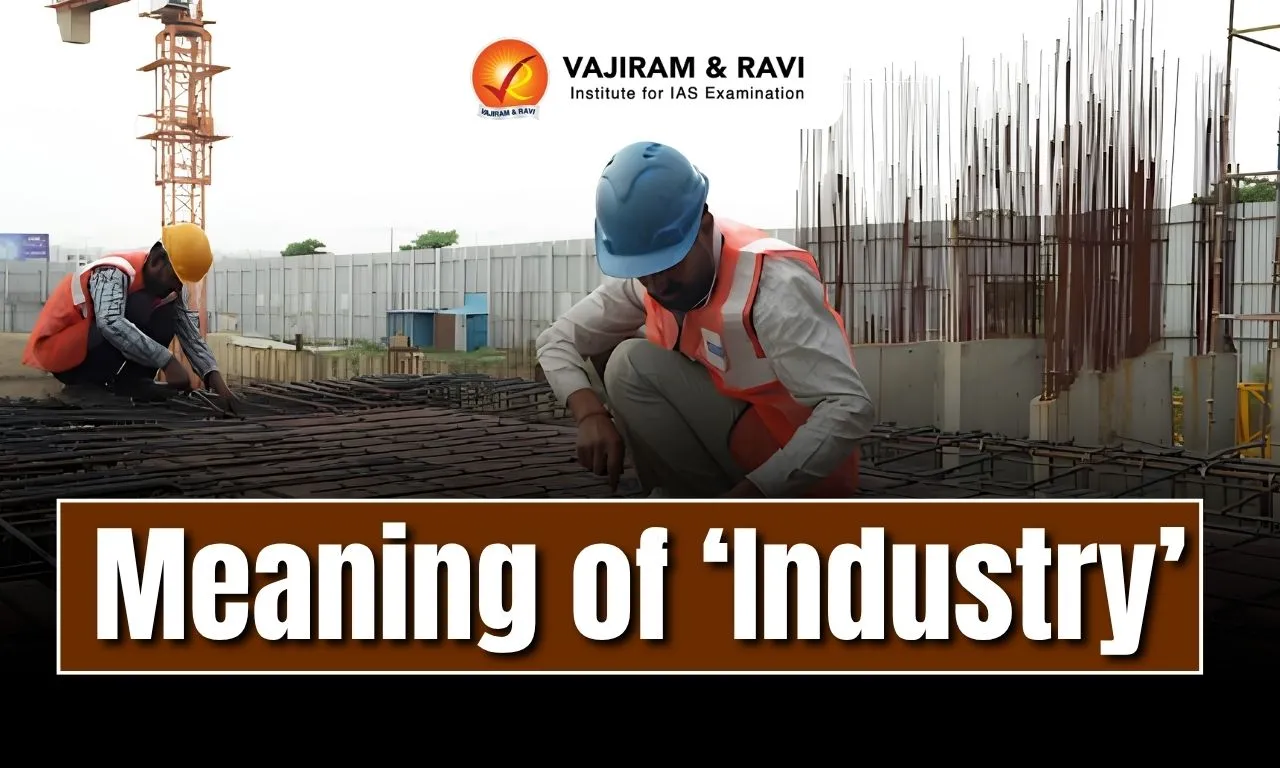
Supreme Court Redefines the Meaning of ‘Industry’

Meaning of ‘Industry’

Meaning of ‘Industry’ Latest News

  • The Supreme Court’s nine-judge Constitution Bench, headed by Chief Justice of India Surya Kant, has delivered a 5:4 verdict on the meaning of ‘industry’ under labour law. 
  • The Court has held that the expansive interpretation laid down in the landmark Bangalore Water Supply & Sewerage Board v. R. Rajappa (1978) will not govern future disputes under the Industrial Relations Code (IRC), 2020.
  • The ruling marks an important shift in India’s labour jurisprudence, particularly regarding the balance between workers’ rights, industrial peace, State functions and ease of doing business.

The 1978 ‘Bangalore Water Supply’ Verdict

  • The 7-judge Bench in 1978 gave an expansive interpretation to “industry” under Section 2(j) of the Industrial Disputes Act, 1947.
  • The ‘triple test’: An activity was treated as an industry if it involved -
    • Systematic activity;
    • Cooperation between employer and employee; and
    • Production or distribution of goods or services to satisfy human wants and wishes.
  • The Court held that the profit motive was not essential. Consequently, institutions such as hospitals, educational institutions, municipalities, clubs and certain welfare activities could fall within labour-law protection.
  • It also evolved the Dominant Nature Test for organisations carrying out multiple or integrated activities.
  • The broad definition enabled workers to seek legal remedies concerning wages, working conditions, unionisation, strikes, collective bargaining and protection against arbitrary dismissal.

Why the Definition Matters

  • The classification of an establishment as an “industry” determines whether statutory labour protections and dispute-resolution mechanisms apply to its employees.
  • The expansive 1978 interpretation, however, generated substantial litigation. A later Constitution Bench referred to the resulting increase in labour litigation as a “docket explosion”.
  • The issue became particularly contentious after LPG (liberalisation, privatisation and globalisation), as activities earlier performed by the State increasingly shifted to private entities.

Supreme Court’s Majority View

  • The majority held that the definition of “industry” under Section 2(p) of the Industrial Relations Code, 2020 must be interpreted on a clean slate.
  • It should not be “burdened” by the 1978 interpretation of Section 2(j) of the repealed Industrial Disputes Act.
  • The 1978 judgment therefore remains relevant for legacy disputes pending under the 1947 Act, but it will not serve as the foundation for interpreting the IRC in future cases.
  • CJI Surya Kant also observed that aspects of the triple test could have been articulated differently to better reflect the statutory provision. The Court’s detailed formulation of the modified test is awaited.

Pending vs Future Cases

  • Pending proceedings under the Industrial Disputes Act, 1947: Continue to be governed by the Bangalore Water Supply interpretation.
  • Future disputes under the IRC, 2020: Will be governed by the new statutory framework and the Court’s prospective interpretation.
  • This distinction prevents retrospective disruption and unequal treatment of workers involved in existing disputes.

Justice Nagarathna’s Dissent

  • Justice B.V. Nagarathna, joined by Justices Dipankar Datta and Ujjal Bhuyan, opposed reconsideration of the 1978 judgment.
  • She argued that the broad definition remains necessary in an economy transformed by privatisation and liberalisation, where workers have increasingly moved from public-sector to private-sector employment.
  • She maintained that merely because an activity is performed by the State, it does not automatically become a sovereign function. 
  • Government-run social welfare schemes and services may constitute industrial activities depending upon their nature.
  • She also defended the Dominant Nature Test, arguing that the focus should be on the character of the activity rather than simply on who performs it.
  • Justice Datta emphasised that institutional credibility requires respect for finality, while Justice Bhuyan supported retaining the established framework.
  • Justice Joymalya Bagchi: Adopting a nuanced position, he held that the IRC should not be encumbered by the 1978 judgment in future disputes, but disagreed with the majority’s proposed reformulation of the triple test.

Legislative and Policy Background

  • The Industrial Disputes (Amendment) Act, 1982 attempted to narrow the definition of “industry”, but the relevant provision was never brought into force.
  • Between 2019 and 2020, Parliament consolidated 29 labour laws into four Labour Codes -
    • Code on Wages, 2019
    • Industrial Relations Code, 2020
    • Occupational Safety, Health and Working Conditions Code, 2020
    • Code on Social Security, 2020
  • The labour reforms have faced strong opposition from trade unions, reflecting the continuing tension between labour protection and labour-market flexibility.

Way Forward

  • The judgment seeks to create a clearer distinction between legacy disputes and the new labour-law regime. 
  • Its ultimate impact will depend on the precise formulation of the new definition of “industry” and whether it succeeds in reducing litigation without weakening workers’ statutory protection.
  • The larger policy challenge is to achieve a balanced labour regime that protects workers from exploitation while providing enterprises and public institutions with sufficient flexibility to function efficiently.

Source: THIE

Meaning of ‘Industry’ FAQs

Q1: What was the ‘triple test’ laid down in Bangalore Water Supply v. R. Rajappa (1978)?

Ans: It required systematic activity, employer–employee cooperation, and production/distribution of goods or services.

Q2: What is the significance of the SC’s 5:4 verdict on the definition of ‘industry’?

Ans: The 1978 interpretation will govern pending disputes under the 1947 Act, but will not determine the meaning of “industry” under the IRC.

Q3: Why did Justice B.V. Nagarathna favour retaining the broad definition of ‘industry’?

Ans: She argued that privatisation and liberalisation have shifted employment from the public to private sector.

Q4: How does the Supreme Court’s ruling address the conflict between labour protection and ease of doing business?

Ans: By allowing the 1978 framework for existing disputes while permitting a fresh interpretation under the IRC.

Q5: Why is the distinction between sovereign and non-sovereign functions important?

Ans: Core sovereign functions remain outside industrial regulation, but State-run welfare and commercial activities can qualify.

Public Streets and Parking Rights: Who Controls Roadside Parking Outside Your Home?

Public Streets and Parking Rights

Public Streets and Parking Rights Latest News

  • As Delhi Police prepares a fresh congestion-management plan, officials hves directed every traffic circle to identify at least one "problem area" marked by encroachment, roadside parking, or chronic congestion. 
  • This crackdown on unauthorised parking raises a key legal question: does living next to a public street give a resident any special right over the parking space outside their home?

Who Owns a Public Street?

  • A public street does not belong to the homeowner whose gates open onto it.
  • The Delhi Municipal Corporation Act, 1957 (DMC Act) defines a "public street" as any street that vests in the Corporation.
  • Section 298 vests all public streets in the Corporation, placing them under the control of the Commissioner, who maintains, controls, and regulates them as per bye-laws.
  • No provision of the DMC Act grants an adjoining resident exclusive rights over the road stretch outside their property
  • Even prolonged use of a parking spot does not create any special entitlement.

Is Roadside Parking Legal?

  • Parking on a public road is not inherently illegal, but it is closely regulated:
    • Section 117, Motor Vehicles Act, 1988: Empowers state governments to designate places where motor vehicles may stand, indefinitely or for specified periods.
    • Section 122: Prohibits leaving a vehicle in a manner causing danger, obstruction, or undue inconvenience to other road users.
    • Section 127: Allows towing or immobilising vehicles left in violation of parking rules.

Delhi-Specific Parking Rules

  • The Delhi Maintenance and Management of Parking Places Rules, 2019 (framed under the Motor Vehicles Act): 
    • Prohibit on-street parking within 25 metres of an intersection.
    • Bar parking in green areas, parks, footpaths, bus stops, and other designated locations.
    • Under Rule 11, Area Parking Plans must include residential areas, developed in consultation with residents or Resident Welfare Associations (RWAs).
    • Mandate that one lane in residential colony roads remain free for emergency vehicles.
  • The Delhi Motor Vehicles Rules, 1993 empower the District Magistrate — in consultation with the State Transport Authority, Deputy Commissioner of Police (Traffic), and local authorities — to notify parking places within their jurisdiction.
  • In essence, curbside parking is governed entirely by the public authority controlling that stretch of road, not by the adjacent resident.

What the Supreme Court Has Said

  • In M.C. Mehta v Union of India (2019), a Bench of Justices Arun Mishra and Deepak Gupta examined Delhi's parking crisis, framing it as a conflict between the rising number of vehicles and shrinking available land, with significant implications for urban planning.
  • The Court directed the Delhi government to notify the 2019 Parking Rules, observing that an effective parking policy helps reduce congestion, pollution, and crime.
  • It also acknowledged ground realities, noting it was "not oblivious to the hard reality" that in many colonies, some roadside parking must be permitted since vehicle numbers exceed available indoor parking space.

Conclusion

  • Legally, no resident holds ownership or exclusive rights over the public road outside their home — such streets vest entirely in the municipal corporation and are governed by statutory rules under the Motor Vehicles Act and DMC Act. 
  • While courts have recognised the practical necessity of some roadside parking in residential areas, this remains a regulated privilege, not a private right, reinforcing that urban road space is fundamentally a shared public resource.

Source: IE

Public Streets and Parking Rights FAQs

Q1: What do Public Streets and Parking Rights mean for residents living beside a road?

Ans: Public Streets and Parking Rights mean adjoining residents do not automatically own or enjoy exclusive rights over the road space outside their homes.

Q2: Who controls public streets under Public Streets and Parking Rights in Delhi?

Ans: Under Public Streets and Parking Rights, public streets vest in the municipal corporation and remain subject to statutory control, regulation, and maintenance.

Q3: Is roadside parking a legal right under Public Streets and Parking Rights?

Ans: Public Streets and Parking Rights treat roadside parking as a regulated activity, permitting authorities to restrict vehicles causing obstruction, danger, or inconvenience.

Q4: What do Delhi's rules say about Public Streets and Parking Rights near intersections and footpaths?

Ans: Public Streets and Parking Rights restrict parking near intersections, green areas, parks, footpaths, and bus stops, while preserving residential emergency access.

Q5: What has the Supreme Court said about Public Streets and Parking Rights?

Ans: Public Streets and Parking Rights recognise practical residential parking needs, but the Supreme Court considers parking regulation essential for reducing congestion, pollution, and crime.

SEBI Bond Tokenisation Pilot: Transforming India’s Bond Market and FPI Onboarding

SEBI Bond Tokenisation Pilot

SEBI Bond Tokenisation Pilot Latest News

What Is Bond Tokenisation?

  • Bond tokenisation converts a traditional bond into digital tokens on a blockchain
  • Each token represents partial ownership of the bond, giving investors the same returns — interest payments and principal repayment — but at much smaller ticket sizes.

How It Differs from Traditional Bond Investing

  • Traditional bonds pass through multiple intermediaries for issuance, settlement, and custody.
  • Tokenised bonds can be issued, traded, and settled digitally with fewer intermediaries, backed by a real-time verifiable transaction record.
  • Accessibility for retail investors: Corporate bonds have traditionally been an institutional product requiring large capital. Fractional ownership through tokenisation removes this barrier, opening fixed income to everyday investors.

Key Benefits

  • Faster Settlement - Corporate bonds currently settle on a T+2 cycle (two days after the transaction). On blockchain, settlement can happen in real time, freeing up capital faster and reducing counterparty risk during the trade-to-settlement window.
  • Greater Transparency - Every transaction on a distributed ledger is recorded and immutable, giving investors full visibility into ownership history, coupon payments, and redemptions without depending on intermediaries for accurate record-keeping.

Key Risks and Concerns

  • Cryptographic vulnerability: SEBI has flagged concerns that future quantum computers could potentially break the cryptographic algorithms securing blockchain systems, risking the integrity of the entire record.
  • Interoperability challenges: Integration between legacy depository systems and new blockchain infrastructure remains untested at scale.
  • Regulatory gaps: India currently lacks a comprehensive legal framework defining ownership rights, dispute resolution, and investor protection for tokenised bonds — a gap that is likely to keep institutional participation limited until addressed.
  • Liquidity constraints: In the early pilot phase, secondary market depth is expected to be limited, meaning entry may be easier than exit for investors.

SEBI's Bond Tokenisation Plan

  • SEBI plans to launch the pilot "in the near future," in coordination with the Reserve Bank of India (RBI), to improve accessibility, transparency, and efficiency in the bond market.
  • The core idea is to test whether a shared ledger can enable simultaneous transfer of the security and money, making settlement more efficient and reducing reconciliation costs.
  • The pilot will also examine the feasibility of automated coupon payments and other bond-servicing events through smart contracts.
  • The move comes as SEBI pushes to deepen the bond market to channel more capital toward economic growth.
  • It aligns with the regulator's broader push to modernise debt market infrastructure using technology.

Credit Risk-o-Meter for Investor Protection

  • SEBI is also consulting on introducing a "Credit Risk-o-Meter" for debt securities to strengthen investor protection in a market that has been gaining traction.
  • It will be a standardised, colour-coded visual scale mapped to existing credit-rating symbols.
  • It will be displayed both in the offer document and on platforms selling the securities, along with the credit rating and the name of the credit-rating agency.

Framework for Fixed Income Channel Partners

  • SEBI will "shortly" introduce a framework for fixed income channel partners, similar to mutual fund distributors, to improve distribution of the corporate bond market.
  • These partners will be certified through the National Institute of Securities Markets (NISM).
  • Importantly, channel partners will not handle client funds or securities, nor charge investors separately — the goal being to expand market reach while maintaining accountability and investor safeguards.

Easing FPI Onboarding: Digital Power of Attorney

  • In a separate move effective immediately, SEBI now allows FPIs to submit a digitally signed Power of Attorney (PoA) to their custodians.
  • A PoA authorises custodians — SEBI-registered institutions responsible for holding and managing FPI investments — to act on the FPI's behalf.
  • This eliminates the need for notarisation, apostillisation, or consularisation of the PoA, significantly reducing onboarding time and improving ease of doing business.
  • This builds on earlier SEBI measures, such as a common application form for FPI registration, aimed at simplifying compliance for foreign investors.

Conclusion

  • SEBI's twin initiatives — piloting blockchain-based bond tokenisation and simplifying FPI onboarding — reflect its dual focus on deepening India's debt market through technology while making the market more accessible to foreign capital. 
  • Together with the proposed Risk-o-Meter and channel partner framework, these steps aim to build a more efficient, transparent, and investor-friendly bond market ecosystem.

Source: IE | LM

SEBI Bond Tokenisation Pilot FAQs

Q1: What is the SEBI Bond Tokenisation Pilot?

Ans: The SEBI Bond Tokenisation Pilot will test blockchain-based digital bond ownership, enabling potentially faster settlement, greater transparency, and smaller investment opportunities.

Q2: How can the SEBI Bond Tokenisation Pilot benefit retail investors?

Ans: The SEBI Bond Tokenisation Pilot can enable fractional ownership, allowing retail investors to access corporate bonds at smaller ticket sizes than traditional investments.

Q3: What risks does the SEBI Bond Tokenisation Pilot face?

Ans: The SEBI Bond Tokenisation Pilot faces cryptographic vulnerabilities, interoperability problems, regulatory gaps, and limited secondary-market liquidity during its initial implementation phase.

Q4: How will the SEBI Bond Tokenisation Pilot improve settlement efficiency?

Ans: The SEBI Bond Tokenisation Pilot will examine simultaneous transfer of securities and money, potentially enabling real-time settlement and reducing reconciliation and counterparty risks.

Q5: How do FPI reforms complement the SEBI Bond Tokenisation Pilot?

Ans: Alongside the SEBI Bond Tokenisation Pilot, digitally signed Powers of Attorney simplify FPI onboarding by eliminating notarisation, apostillisation, and consularisation requirements.

NAMASTE Scheme – Mechanised Sanitation, Safety and Rehabilitation of Sanitation Workers

NAMASTE Scheme

NAMASTE Scheme Latest News

  • The Government is considering expanding the National Action for Mechanised Sanitation Ecosystem (NAMASTE) from urban areas to rural India, while recent government data highlight the progress as well as continuing challenges in ensuring the safety, dignity and rehabilitation of sanitation workers.

NAMASTE Scheme

  • The NAMASTE Scheme was launched in 2023 by the Ministry of Social Justice and Empowerment in collaboration with the Ministry of Housing and Urban Affairs.
  • The scheme seeks to replace hazardous manual cleaning practices with mechanised sanitation solutions while improving the safety and socioeconomic conditions of sanitation workers.
  • The initial focus was on sewer and septic tank workers (SSWs) and was subsequently expanded to include waste pickers.
  • The broader approach of NAMASTE is based on three interconnected objectives:
    • Eliminating hazardous manual cleaning practices.
    • Improving occupational safety and dignity.
    • Providing livelihood, skill development and social-security support.

Key Components of NAMASTE

  • Mechanisation and Capital Assistance
    • The scheme provides financial assistance to eligible sanitation workers for procuring mechanised cleaning equipment.
    • This enables workers and sanitation enterprises to transition from hazardous manual cleaning towards safer mechanised operations.
  • Personal Protective Equipment (PPE)
    • The scheme provides PPE kits to sanitation workers and waste pickers.
    • PPE is particularly important because workers may remain exposed to occupational hazards even when mechanised equipment is used.
  • Training and Skill Development
    • NAMASTE also provides occupational safety and skill development training.
    • The objective is to equip workers with the technical and safety skills required to operate mechanised sanitation equipment and undertake sanitation-related activities safely.
  • Health and Social Security
    • The scheme also seeks to strengthen social protection for sanitation workers through access to health insurance and other welfare measures.
    • This is important because sanitation workers face occupational risks as well as broader socioeconomic vulnerabilities.
  • Rehabilitation of Manual Scavengers
    • NAMASTE is complemented by measures for the rehabilitation of identified manual scavengers.
    • The Government has undertaken surveys to identify persons engaged in manual scavenging and subsequently provide rehabilitation assistance.

Progress & Achievements Under NAMASTE

Image Caption: Achievements of NAMASTE Scheme

  • These figures indicate that the scheme is combining mechanisation with occupational safety and social protection rather than treating mechanisation as a standalone intervention.
  • Rehabilitation of Identified Manual Scavengers
    • Surveys conducted in 2013 and 2018 identified 58,098 manual scavengers across the country. According to the Government:
    • All identified beneficiaries have received one-time cash assistance.
    • 27,926 beneficiaries have undergone skill development training.
    • 2,803 beneficiaries have received capital subsidy for establishing general self-employment projects.
  • These measures are intended to provide alternative livelihood opportunities and facilitate the socioeconomic rehabilitation of identified manual scavengers.

News Summary

  • The Central government has proposed expanding NAMASTE from towns and cities to rural areas.
  • The proposed expansion would broaden the categories of workers covered by the scheme to include:
    • Drain cleaners
    • Workers in sewage treatment plants (STPs)
    • Workers in faecal sludge treatment plants
  • The proposed expanded scheme would have an estimated outlay of approximately Rs. 498.73 crore, to be spent from the current financial year through 2030-31.
  • The proposed expansion is significant because hazardous sanitation work is not confined to urban sewer and septic tank systems. 
  • Extending mechanisation and occupational-safety interventions to rural sanitation infrastructure could widen the reach of the programme.

Significance

  • The expansion of NAMASTE reflects a shift towards a more comprehensive approach to sanitation-worker welfare.
  • The central objective is not merely to prevent manual entry into sewers and septic tanks but to create an ecosystem in which sanitation workers have access to:
    • Mechanised equipment
    • Occupational safety training
    • Protective equipment
    • Health insurance
    • Skill development
    • Alternative livelihood opportunities
  • The proposed rural expansion is particularly important because sanitation infrastructure is increasingly being developed beyond major urban centres.
  • At the same time, the gaps identified in capital subsidy approvals and disbursements demonstrate that effective implementation and timely access to financial assistance remain critical challenges.

Source: TH | PIB

NAMASTE Scheme FAQs

Q1: What is the NAMASTE Scheme?

Ans: NAMASTE, or the National Action for Mechanised Sanitation Ecosystem, is a government scheme launched in 2023 to eliminate hazardous sanitation work through mechanisation while improving the safety, dignity and socioeconomic conditions of sanitation workers.

Q2: Who are the primary beneficiaries of NAMASTE?

Ans: The scheme initially focused on sewer and septic tank workers and was subsequently expanded to include waste pickers. The proposed expansion would also cover drain cleaners and workers in sewage and faecal sludge treatment plants.

Q3: What is the proposed outlay for the expansion of NAMASTE to rural India?

Ans: The Social Justice Ministry has proposed an outlay of approximately Rs. 498.73 crore for the expanded scheme through 2030-31.

Q4: How many sanitation workers have received health insurance under NAMASTE?

Ans: According to the PIB release, 1,81,062 beneficiaries have been covered under health insurance.

Q5: How many manual scavengers were identified through the 2013 and 2018 surveys?

Ans: The surveys identified 58,098 manual scavengers across the country.

Enquire Now
