Making Cement Greener – Decarbonising India’s Construction Sector

Making Cement Greener - Decarbonising India’s Construction Sector

Cement Latest News

  • India aims to become a developed country by 2047 and achieve net-zero emissions by 2070. 
  • Decarbonising the construction sector is essential to meeting both objectives, as construction depends heavily on energy-intensive materials such as cement and steel.
  • The construction sector accounts for an estimated 35–40% of global greenhouse gas (GHG) emissions, considering the broader built environment and its supply chains. 
  • Cement alone contributes approximately 7–11% of global CO₂ emissions, making it one of the hardest sectors to decarbonise.

India’s Cement Industry

  • Overview: 
    • India is the 2nd-largest cement producer in the world, with an installed capacity of roughly 668 to 700 million tonnes per annum (MTPA).
    • Cement became the dominant construction binder following the development of Portland cement in Britain in the 1820s. 
    • Its popularity stems from its versatility, availability, ease of use and relatively rapid strength development.
  • Key facts:
    • Production volume: Reached ~490 million metric tonnes in FY26, showing an 8.6% year-on-year growth.
    • Demand drivers: Housing (accounting for about 65% of demand), commercial real estate, and large-scale public infrastructure projects like PM Gati Shakti.
    • Per capita consumption: Roughly 280 to 290 kg per year, which is lower than the global average.
    • Core industry: It is designated as one of India's eight core industries, carrying a weight of 5.37% in the Index of Industrial Production (IIP).
    • Regional distribution: South India holds the largest share of installed capacity at approximately 32%.
    • Key limestone-rich states: Rajasthan, Andhra Pradesh, Tamil Nadu, and Chhattisgarh.
    • Major cement companies: UltraTech Cement (largest player in India with a market share of around 22%–28%); Adani Cement (Ambuja Cements & ACC); Shree Cement, etc.

Understanding Cement’s Environmental Footprint

  • Energy-intensive manufacturing:
    • Limestone is extracted through mining, often involving the removal of vegetation and topsoil. It is then mixed with clay and heated in kilns to approximately 1,450°C.
    • Traditionally, coal, petroleum coke and natural gas have supplied the required heat. The high energy demand generates substantial emissions.
  • Process emissions:
    • During calcination, limestone (calcium carbonate) decomposes into lime (calcium oxide) and carbon dioxide. This chemical reaction releases CO₂ independently of the fuel used.
    • The resulting material is processed into clinker, which is ground with gypsum and, depending on the cement type, other supplementary materials.
  • Wider environmental impacts:
    • Cement's environmental footprint extends beyond factory emissions and includes -
      • Land degradation: Limestone mining can destroy vegetation, disturb habitats and alter landscapes.
      • Air pollution: Manufacturing releases nitrogen oxides, sulphur dioxide and particulate matter, affecting air quality and human health.
      • Transportation emissions: Moving raw materials and finished cement over long distances adds to the carbon footprint.
      • Loss of carbon sinks: Deforestation and vegetation loss reduce natural carbon sequestration.
      • Resource depletion: Intensive extraction places pressure on mineral resources and local ecosystems.
    • Therefore, a life-cycle approach is necessary to assess the environmental costs of cement production, transportation, construction and subsequent building use.

India’s Cement Decarbonisation Challenge

  • India's cement industry emits approximately 0.62 tonnes of CO₂ per tonne of cement. A decarbonisation roadmap must identify the following targets -
    • Reduce emissions intensity to 0.56 tonnes of CO₂ per tonne of cement by 2030.
    • Further reduce it to 0.51 tonnes by 2047.
  • At the same time, cement production is projected to increase to 1,546 million tonnes by 2070, reflecting India's expanding infrastructure and urbanisation needs.
  • This creates a major policy challenge - reducing emissions intensity while preventing rising production volumes from undermining absolute emission reductions.

Existing and Proposed Solutions

  • Cleaner fuels and energy:
    • Electrification, renewable energy and alternative fuels can reduce dependence on fossil fuels in cement manufacturing.
    • Refuse-derived fuel (RDF), produced by processing combustible fractions of municipal solid waste, can partially replace coal and petroleum coke in cement kilns.
    • NITI Aayog's roadmap recommends achieving a 20% thermal substitution rate using RDF by 2030, potentially reducing cumulative emissions by approximately 80 million tonnes of CO₂-equivalent.
    • However, this requires effective waste segregation at source, reliable waste-processing infrastructure and quality control.
  • Reducing clinker content:
    • India's clinker-to-cement ratio is around 67.5%, already below the global average of 77%, but further reductions remain possible.
    • Builders often prefer Ordinary Portland Cement (OPC contains more than 95% clinker), because of its established performance and faster early-strength development. 
    • Replacing a portion of clinker with supplementary cementitious (gypsum and fly ash) materials can substantially reduce emissions (Replacing one tonne of clinker can avoid approximately 0.83 tonnes of CO₂ emissions - IEA).
    • Green cement adoption can be encouraged through government procurement, revised construction specifications, performance-based standards and awareness among developers.
  • Carbon capture, utilisation and storage (CCUS):
    • Cement cannot be fully decarbonised through fuel substitution alone because calcination generates process emissions. CCUS may therefore be necessary to address residual emissions.
    • However, its large-scale deployment will require technological improvements, investment, suitable transport and storage infrastructure, and effective monitoring.
  • Sustainable building design:
    • Reducing cement demand through better architectural planning can complement cleaner manufacturing. 
    • Climate-responsive buildings that minimise heat gain and heat storage can reduce cooling requirements and operational energy consumption.

Traditional Material and Indigenous Construction

  • India's diverse climatic and geographical conditions have produced construction techniques that can reduce dependence on conventional cement-based systems.
  • For example,
    • Compressed earth blocks and rammed earth: Used in parts of southern India, often with small quantities of cement or lime.
    • Lime-surkhi mortar: Combines lime with finely powdered burnt clay or brick material.
    • Natural binders: Cactus-derived mucilage, lime and mud, and certain industrial by-products such as marble powder can be explored in suitable applications.
    • Kath Kuni architecture: Traditional Himachal Pradesh construction uses alternating timber and dry-stone masonry, often supported by a raised stone plinth.
    • Elevated timber and bamboo houses: Found in flood-prone and earthquake-prone regions, particularly parts of northeastern India.
  • These methods can offer locally appropriate, resource-efficient solutions. However, they are not universally suitable and may require adaptation to meet modern requirements. 
  • The objective should be to reduce cement use wherever technically appropriate, rather than eliminate it indiscriminately.

Way Forward

  • Strengthen circular economy practices: Improve waste segregation and utilise suitable industrial by-products, including fly ash and slag (Example, PPC and PSC).
  • Improve regulatory and market incentives: Encourage low-carbon building codes, green public infrastructure and transparent disclosure of embodied carbon.
  • Balance sustainability with affordability: Ensuring that low-carbon materials remain accessible and using cement more efficiently.

Source: TH

Cement FAQs

Q1: Why is decarbonisation of the construction sector essential?

Ans: Decarbonising it through cleaner energy, low-carbon materials and sustainable building design is vital for achieving net zero by 2070.

Q2: Why is cement considered a hard-to-abate sector?

Ans: Cement emissions arise both from fossil-fuel combustion and from the chemical calcination of limestone.

Q3: How can clinker substitution help reduce emissions from cement manufacturing?

Ans: Replacing clinker with supplementary materials such as fly ash and blast-furnace slag reduces process-related emissions.

Q4: What is the role of refuse-derived fuel (RDF)?

Ans: RDF can replace a portion of fossil fuels in cement kilns, reducing emissions while supporting waste management.

Q5: How can traditional Indian construction practices contribute to sustainable urbanisation?

Ans: Techniques such as lime-surkhi mortar can reduce cement dependence and promote climate-responsive construction.
Carbon Border Adjustment Mechanism (CBAM): How India Could Benefit from the US Probe

US Probes EU’s Carbon Border Tax

Carbon Border Adjustment Mechanism (CBAM) Latest News

  • The United States Trade Representative (USTR) has launched an investigation into the European Union’s expansion of its Carbon Border Adjustment Mechanism (CBAM) — a move that could escalate trade tensions between the two blocs. 
  • The USTR has invited public comments from American small businesses till November 9. Seeking public comments is typically the first step toward possible retaliation — signalling the US may push the EU to soften CBAM’s implementation.
  • For India, this development carries an unusual silver lining: any US-driven softening of CBAM could automatically benefit Indian exporters too, thanks to a clause in the India-EU trade deal.

What Is CBAM, and Why Is the US Investigating It?

  • CBAM is the EU’s carbon pricing mechanism. It requires EU importers of goods in six carbon-intensive sectors to declare the embedded emissions of imported products and pay a carbon price equivalent to what EU domestic producers already pay.
  • Covered Sectors: Aluminium; Cement; Electricity; Fertiliser; Hydrogen; Iron and steel.

The US’s Specific Complaint

  • The EU calculates default emission values using country- and sector-level production/energy data.
  • However, the EU adds a punitive mark-up to these default values — a measure meant to push companies toward submitting verified company-level data instead.
  • Any company-level data must be verified by an EU-accredited third-party verifier — adding cost and compliance burden, which the US says disproportionately hurts American small businesses.

How India Stands to Benefit

  • India had tough negotiations with the EU over CBAM while finalising the India-EU trade deal, since the regulation is expected to hit a wide range of Indian metal exports. 
  • Crucially, however, Indian negotiators secured a ‘forward-Most Favoured Nation’ (MFN) CBAM clause.
  • What this clause does - It ensures that any concession the EU grants to another trading partner (here, the US) under a separate agreement automatically extends to India too.
    • In the EU-US trade deal joint statement (August last year), the EU had already committed: “...the European Commission... commits to work to provide additional flexibilities in the CBAM implementation” for US businesses.
    • If the ongoing USTR probe results in further CBAM flexibilities for the US, India would also receive those same concessions — without needing to renegotiate separately.

The Stakes for Indian Industry

  • According to the Global Trade Research Initiative (GTRI), CBAM could translate into a 20–35% tax on select Indian exports — particularly iron, steel, and aluminium — into the EU. 
  • This is effectively being called a steel bill for India.
  • Added complication — Steel Scrap
    • The EU is the world’s largest producer of steel scrap, and its move to curb steel-scrap exports, combined with CBAM, acts as a non-tariff barrier against Indian industry.
    • Despite Indian objections, the EU kept CBAM outside the scope of the India-EU trade deal.
  • Why Production Method Matters
    • Blast furnace–basic oxygen furnace (BF-BOF) route: highest emissions.
    • Gas-based direct reduced iron (DRI): lower emissions.
    • Scrap-based electric arc furnace (EAF) route: lowest emissions.
  • India’s Vulnerability: Indian manufacturers largely rely on the blast furnace route, making them currently underprepared for CBAM’s carbon-price burden.

India’s Response: The Green Steel Push

  • The government plans to scale up scrap-based steel production via electric arc furnace technology, under its Green Steel Initiative.
  • However, a May 2025 report by the Indian Council for Research on International Economic Relations (ICRIER) flagged a major constraint:
    • Scrap currently makes up only 20% of India’s steelmaking feedstock.
    • This is limited by domestic scrap availability of just ~25 Million Metric Tonnes (MMt) annually.
    • The report notes: hard-to-abate sectors like steel face unprecedented pressure to decarbonise amid tools like CBAM, with scrap steel central to this transition — yet India’s constrained scrap access remains a critical bottleneck.

Conclusion

  • The US probe into CBAM is, at its core, a dispute over how the EU prices carbon at its borders — but it has inadvertently opened a door for India. 
  • Thanks to a carefully negotiated MFN clause, any flexibility the EU grants the US could flow to Indian exporters too, without further bargaining. 
  • Yet this remains a short-term cushion, not a solution: India’s long-term competitiveness in a carbon-taxed world will depend on how fast it can scale scrap-based, low-emission steel production — a transition still constrained by domestic scrap scarcity.

Source: IE

Carbon Border Adjustment Mechanism (CBAM) FAQs

Q1: What is the Carbon Border Adjustment Mechanism (CBAM)?

Ans: The Carbon Border Adjustment Mechanism (CBAM) requires EU importers in six carbon-intensive sectors to report embedded emissions and pay a corresponding carbon price.

Q2: Why is the United States investigating the EU’s CBAM?

Ans: The United States objects to punitive default emissions mark-ups and costly third-party verification requirements, arguing that these disproportionately burden American small businesses.

Q3: How could India benefit from the US investigation into CBAM?

Ans: India could receive additional CBAM flexibilities granted to the United States because the India-EU trade deal contains a forward Most-Favoured-Nation clause.

Q4: How could CBAM affect Indian steel and aluminium exports?

Ans: The Carbon Border Adjustment Mechanism could impose an estimated 20–35% tax on selected Indian exports, particularly iron, steel and aluminium entering European markets.

Q5: What should India do to reduce the long-term impact of CBAM?

Ans: India should expand scrap-based electric-arc-furnace steelmaking, improve domestic scrap availability and accelerate low-emission production to strengthen competitiveness in carbon-priced markets.

RBI Forex Derivative Curbs: Rules to Curb Speculation and Rupee Volatility

RBI’s Forex Derivative Curbs

RBI Forex Derivative Curbs Latest News

  • With the rupee approaching 97 against the dollar and crude oil trading above $100/barrel, the Reserve Bank of India (RBI) has rolled out a fresh package of measures tightening the rupee derivatives market. 
  • The objective: strengthen market discipline, curb excessive speculation, and bring greater transparency to foreign exchange transactions.

Why Now? The Backdrop of Pressure

  • Forex reserves dipped by $12.95 billion to $734.60 billion in the week ended October 2.
  • The rupee remains under pressure despite over $143 billion in inflows under the FCNR scheme.
  • Higher oil prices are fuelling imported inflation, with retail inflation forecast at 5.2% in FY27.
  • The RBI is already on a rate-hiking cycle — it raised the repo rate by 25 bps to 5.50% on October 7.
  • The RBI is targeting a source of pressure it can directly regulate: derivatives market activity. 
    • When traders build positions anticipating rupee depreciation, this amplifies demand for foreign currency, worsening volatility.

Key Measures Announced

  • Underlying Exposure Threshold Slashed — 95% Cut
    • The limit for undertaking forex derivative transactions without proving underlying exposure has been cut from $100 million to $5 million equivalent, across authorised dealers.
      • Earlier, banks and companies could enter into currency betting contracts worth up to $100 million without having to show any real business reason for it — like an actual import payment, export receipt, or loan to protect.
      • Now, that free pass only works up to $5 million. Beyond that, anyone wanting to trade in rupee-dollar contracts must prove they have a real, underlying business transaction.
    • The same cut applies to exchange-traded currency derivatives involving the rupee, across all recognised stock exchanges.
    • Important clarification: This is not a blanket ban on derivatives above $5 million — it only removes the earlier higher exemption limit.
  • No Rebooking of Cancelled Contracts
    • Authorised dealers cannot allow rebooking of a cancelled rupee-forex derivative contract (deliverable or non-deliverable) once cancelled with any dealer, post-directive.
    • Rolling over contracts at maturity remains permitted, subject to existing norms.
    • Why it matters: Repeated cancellation-and-rebooking let traders change positions as market conditions shifted — this loophole is now closed, forcing greater discipline before entering contracts.
  • Ban on Double-Hedging
    • Banks must now obtain and retain a written undertaking from users confirming the same underlying exposure has not been hedged with another authorised dealer.
    • Purpose: Prevents a single commercial exposure from being used to justify multiple derivative positions, improving transparency.
    • Effect: More paperwork and stronger internal controls for businesses; tighter compliance scrutiny for banks.
  • New Foreign Exchange Risk Reserve (FERR) — 20% Cash Reserve
    • FERR is a regulatory requirement introduced by the RBI to defend the Indian Rupee (INR) and curb speculative forex demand.
    • For covered forex derivative contracts involving the rupee with a notional value above $2 million, authorised dealers must maintain a cash reserve with the RBI equal to 20% of each transaction’s rupee-equivalent notional amount.
    • Applies specifically to contracts hedging current-account exposures where the user buys foreign currency against rupees.
    • Clarification: This is a reserve requirement on banks, not an automatic 20% fee charged to customers — but it could raise the cost of providing covered derivatives and influence pricing.

Impact on Market Participants

  • Higher cost of taking large currency positions.
  • Reduced flexibility — last-minute changes to hedging positions become harder.
  • Greater documentation burden for both banks and corporate customers.
  • Message from RBI: The forex market must serve genuine economic needs, not function as a playground for unchecked speculation.

Conclusion

  • The RBI’s latest measures reflect a calculated attempt to decouple genuine hedging needs from speculative currency betting, at a moment when the rupee is under sustained pressure from oil prices, capital outflows, and global uncertainty. 
  • By raising costs, tightening documentation, and closing rebooking loopholes, the central bank aims to restore discipline to the derivatives market — without resorting to a blunt, blanket restriction. 
  • Whether this stabilises the rupee will depend on how global oil prices and capital flows evolve in the coming months.

Source: IE | FE

RBI Forex Derivative Curbs FAQs

Q1: Why did the RBI introduce forex derivative curbs?

Ans: RBI forex derivative curbs aim to strengthen market discipline, reduce excessive speculation and improve transparency amid rupee depreciation pressure, rising crude prices and global uncertainty.

Q2: How did the RBI change the underlying exposure threshold?

Ans: RBI forex derivative curbs reduced the exemption threshold from $100 million to $5 million, requiring traders to demonstrate genuine underlying business exposure above that limit.

Q3: What restrictions apply to cancelled forex derivative contracts?

Ans: RBI forex derivative curbs prohibit rebooking cancelled rupee-forex derivative contracts through authorised dealers, although contract rollovers at maturity remain permitted under existing norms.

Q4: What is the Foreign Exchange Risk Reserve introduced by the RBI?

Ans: The Foreign Exchange Risk Reserve requires authorised dealers to maintain a 20% cash reserve against covered rupee derivative contracts exceeding $2 million in notional value.

Q5: How could RBI forex derivative curbs affect businesses?

Ans: RBI forex derivative curbs could increase hedging costs, reduce flexibility in changing positions and impose additional documentation requirements on banks and corporate customers.

India’s Critical Mineral Stockpiling Policy – Key Developments and Challenges

India’s Critical Mineral Stockpiling Policy - Key Developments and Challenges

Critical Mineral Stockpiling Latest News

  • The Ministry of Mines is planning to finalise a new policy on critical mineral stockpiling within a month to reduce import dependence and protect India against global supply chain disruptions.

About Critical Minerals

  • Critical minerals are raw materials that are essential for economic development, technological advancement and national security, but whose supply may be vulnerable to geopolitical tensions, concentration of production or supply chain disruptions.
  • Important critical minerals include:
    • Lithium and cobalt: Used in rechargeable batteries and electric vehicles.
    • Nickel: Important for battery manufacturing and industrial applications.
    • Copper: Essential for electricity networks, power infrastructure and renewable energy systems.
    • Rare earth elements: Used in wind turbines, advanced electronics and other strategic technologies.
  • These minerals are increasingly important for the clean energy transition, electric mobility and the expansion of modern industrial infrastructure.

Need For Critical Mineral Stockpile

  • A strategic stockpile is a reserve of essential materials maintained to ensure their availability during emergencies or periods of supply disruption.
  • India faces several vulnerabilities in securing critical minerals:
  • High import dependence
    • India has limited processing capacity and is entirely dependent on imports for most critical minerals, according to the report. This exposes domestic industries to international price fluctuations and supply disruptions.
  • Concentration of processing capacity
    • China controls approximately 90% of global critical mineral processing capacity. Such concentration creates strategic risks because disruptions or restrictions affecting a dominant supplier can have consequences for industries worldwide.
  • Geopolitical and trade risks
    • Critical minerals can become instruments of economic leverage during trade tensions. Export restrictions or other supply interruptions could affect battery manufacturing, electric vehicles and renewable energy infrastructure.
  • Challenges in overseas acquisitions
    • India has attempted to secure mineral assets abroad through Khanij Bidesh India Ltd (KABIL). However, proposed investments in mineral extraction projects in countries such as Australia, Vietnam, Mali and Chile have faced delays or setbacks.
    • Progress has been reported in Argentina, where KABIL has acquired five lithium brine blocks in Catamarca province.
    • A domestic stockpile could provide a buffer against these vulnerabilities while longer-term efforts to diversify mineral supplies and develop domestic processing capacity continue.

About National Critical Minerals Mission (NCMM)

  • The NCMM is a government initiative aimed at strengthening India's critical mineral supply chains and improving the availability of minerals required for domestic industries.
  • The mission proposes the development of a National Critical Mineral Stockpile Programme.
  • Key features include:
    • Financial allocation: ₹500 crore has been earmarked for the stockpiling initiative over the mission period of seven years, from 2024-25 to 2030-31.
    • Minimum mineral coverage: The proposed national stockpile will include at least five critical minerals.
    • Institutional participation: A joint initiative involving Central Public Sector Undertakings (CPSUs) and private companies is proposed to establish and operate the stockpiling programme.
    • Primary objective: To mitigate global supply chain risks and ensure the availability of essential minerals for domestic use during emergencies.
  • The proposed policy is expected to establish a more structured approach to building and maintaining these strategic reserves.

Boosting Domestic Critical Mineral Processing

  • Stockpiling can provide short-term protection, but long-term supply security also requires domestic processing capabilities and technological self-reliance.
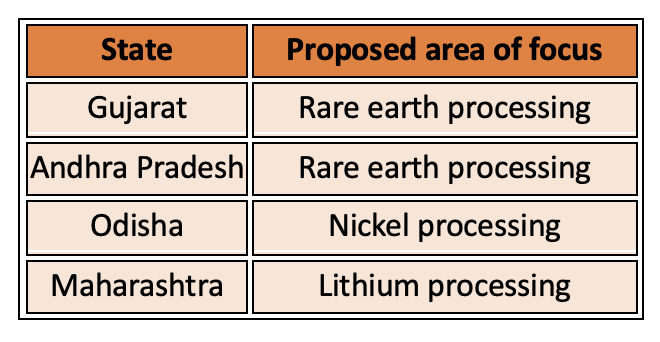
  • The government has identified four states for promoting critical mineral processing plants.

State & Proposed area of focus

  • The government intends to develop each processing park as a complete ecosystem for a particular mineral. 
  • Such an approach could support the development of specialised industrial infrastructure, supply chains and related manufacturing activities.
  • Indigenous technology development
    • Access to processing technology remains a major challenge because countries with established capabilities may be reluctant to share their technological expertise.
    • The Ministry of Mines has therefore emphasised developing indigenous processing technologies or acquiring them wherever available. Nine Centres of Excellence have been identified for this purpose, with some reportedly making substantial progress.
    • The government has also been considering a separate scheme to promote lithium and nickel processing, both of which are important for the battery manufacturing ecosystem.

Challenges and the Way Forward

  • India's critical mineral strategy must address several interconnected challenges.
    • Limited processing capacity: Establishing processing facilities requires specialised technology, infrastructure and skilled personnel.
    • Overseas project delays: Diversifying mineral supplies through foreign acquisitions requires sustained investment and effective project execution.
    • Implementation of stockpiles: The government must determine appropriate reserve levels, storage arrangements, replenishment mechanisms and procedures for releasing minerals during emergencies.
    • Private-sector participation: Clear institutional responsibilities and commercially viable arrangements will be necessary to sustain collaboration between public and private entities.
    • Supply diversification: India should pursue multiple international supply sources while developing domestic exploration, extraction and processing capabilities.
  • A balanced strategy combining strategic reserves, international partnerships, technological development and domestic industrial capacity can reduce vulnerability to external shocks.

Source: IE

Critical Mineral Stockpiling FAQs

Q1: What is a critical mineral stockpile?

Ans: It is a strategic reserve of essential minerals maintained to ensure supply availability during emergencies or international supply chain disruptions.

Q2: Why is India vulnerable to critical mineral supply disruptions?

Ans: India has limited processing capacity, depends entirely on imports for most critical minerals and faces risks arising from the concentration of global processing capacity.

Q3: What is the National Critical Minerals Mission?

Ans: The NCMM is a government initiative aimed at strengthening India's critical mineral supply chains, including through the proposed National Critical Mineral Stockpile Programme.

Q4: Which four states have been identified for critical mineral processing plants?

Ans: Gujarat, Andhra Pradesh, Odisha and Maharashtra have been identified for developing critical mineral processing facilities.

Q5: Why is indigenous critical mineral processing technology important?

Ans: Indigenous technology can reduce dependence on foreign technological capabilities and strengthen India's long-term control over critical mineral processing.

Enquire Now