MyLIC and Super Sales Saathi Mobile Applications

MyLIC and Super Sales Saathi Mobile Applications

MyLIC and Super Sales Saathi Latest News

Life Insurance Corporation of India (LIC) recently launched two advanced mobile applications—MyLIC and Super Sales Saathi.

About MyLIC and Super Sales Saathi

  • These are two advanced mobile applications launched by Life Insurance Corporation of India (LIC); MyLIC for customers and Super Sales Saathi for its vast network of intermediaries.
  • MyLIC App:
    • It offers a comprehensive, 360-degree digital experience, integrating multiple services into a single platform. 
    • Designed to reduce paperwork and improve convenience, it empowers policyholders to manage their insurance needs seamlessly.
    • Key features include:
      • View and manage entire insurance portfolio in one place
      • Instant premium payments
      • Real-time tracking of policy benefits
      • Paperless policy loans
      • Online policy updates and revival of lapsed policies
      • Digital purchase of new insurance plans
      • Fast and secure e-KYC
    • The app aims to put customers in control of their financial protection journey while ensuring faster and more transparent services.
  • Super Sales Saathi App:
    • It is tailored for LIC's intermediaries and agents, enabling them to enhance productivity and customer service through advanced digital tools.
    • Key capabilities include:
      • Digital sales and marketing tools
      • Real-time policy status tracking
      • Automated reminders for follow-ups
      • Integrated communication with customers
      • AI-driven insights to improve customer value
      • Digital sales kits and product explainers
      • Performance dashboards for tracking targets and achievements
    • This platform is expected to significantly improve efficiency across LIC's vast distribution network.
  • Both applications are built on LIC's DIVE (Digital Innovation & Value Enhancement) platform, which provides a secure, integrated, and scalable digital infrastructure.
  • The platform is designed to deliver a seamless experience across customers, intermediaries, and employees—ensuring faster processing, enhanced security, and improved service delivery.

Source: PIB

MyLIC and Super Sales Saathi FAQs

Q1: What are MyLIC and Super Sales Saathi?

Ans: They are mobile applications launched by LIC for customers and intermediaries respectively.

Q2: What is the primary purpose of the MyLIC app?

Ans: To provide a 360-degree digital experience for LIC customers.

Q3: Can premium payments be made through the MyLIC app?

Ans: Yes, instant premium payments are available.

Q4: Who is the Super Sales Saathi app designed for?

Ans: LIC intermediaries and agents.

Q5: What is the main objective of the Super Sales Saathi app?

Ans: To enhance productivity and customer service.
National Backward Classes Finance and Development Corporation (NBCFDC)

National Backward Classes Finance and Development Corporation

National Backward Classes Finance and Development Corporation (NBCFDC) Latest News

The National Backward Classes Finance and Development Corporation achieved a record disbursement of Rs 613.75 crore in FY 2025-26, benefiting over 61,000 people.

About National Backward Classes Finance and Development Corporation (NBCFDC)

  • It is a Govt. of India undertaking under the aegis of the Ministry of Social Justice and Empowerment. 
  • NBCFDC was incorporated on 13th January, 1992, under the Companies Act, 1956 (currently a company under Section 8 of the Companies Act, 2013), as a non-profit entity.
  • The objective of the corporation is to promote economic and developmental activities for the benefit of the backward classes and to assist the poorer section of these classes in skill development and self-employment ventures.
  • The mission of NBCFDC is to provide concessional financial assistance to eligible members of the Backward Classes for self-employment ventures and skill development training. 
  • NBCFDC provides financial assistance through State Channelizing Agencies (SCAs) nominated by the State Governments/UTs and Banks (PSBs & RRBs).
  • The schemes introduced under NBCFDC are listed below:
    • General Loan Scheme
    • Micro Finance Scheme
    • Skill Development Training Programme 
    • Vocational Education and Training Loan Scheme (VETLS)
    • Technology Upgradation of Clusters 

Source: DEVD

National Backward Classes Finance and Development Corporation (NBCFDC) FAQs

Q1: What is the National Backward Classes Finance and Development Corporation (NBCFDC)?

Ans: It is a Govt. of India undertaking under the aegis of the Ministry of Social Justice and Empowerment.

Q2: When was National Backward Classes Finance and Development Corporation (NBCFDC) incorporated?

Ans: NBCFDC was incorporated on 13th January, 1992, under the Companies Act, 1956.

Q3: What is the primary objective of National Backward Classes Finance and Development Corporation (NBCFDC)?

Ans: To promote economic and developmental activities for backward classes.

Q4: Which sections of society are mainly targeted by National Backward Classes Finance and Development Corporation (NBCFDC)?

Ans: Backward classes, especially the poorer sections.

Q5: What is the mission of National Backward Classes Finance and Development Corporation (NBCFDC)?

Ans: To provide concessional financial assistance for self-employment and skill development.

Painted Leopard Gecko

Painted Leopard Gecko

Painted Leopard Gecko Latest News

A rare nocturnal reptile - a Painted Leopard Gecko - was recently spotted at Dilmili railway station in Chhattisgarh’s Bastar district, drawing the attention of the forest department.

About Painted Leopard Gecko

  • It is a colourful terrestrial gecko species.
  • Scientific Name: Eublepharis pictus
  • Eublepharis is a small genus in the lizard family Eublepharidae, which contains 44 species in six genera distributed in parts of North and Central America, West and East Africa, Middle East, South Asia, and the Malayan Archipelago.
  • First described in 1827, the genus is currently represented by seven species, of which five are known from India.

Painted Leopard Gecko Habitat and Distribution

  • It was scientifically described in 2022 from the Eastern Ghats of Andhra Pradesh and Odisha.
  • The Brahmani River, which runs through the Eastern Ghats, separates it geographically from the East Indian Leopard Gecko, with which it shares a lot of similar traits.
  • It prefers dry evergreen forests mixed with scrub and meadows.

Painted Leopard Gecko Features

  • It measures 11.7 cm (4.6 inches) in length.
  • It is usually brown and yellow in colour.
  • Its tail stands out, marked with contrasting black and white bands, unlike the rest of its body. 
  • It possesses over two dozen large, pointed scales.
  • It is strictly nocturnal, actively foraging along trails in forest after dusk. 
  • While foraging, the species has been observed licking surfaces as it moves, likely the tongue is used as a sensory organ. 
  • During daylight, it remains concealed inside burrows, under rocks, or within dense shrubs.

Source: ETVB

Painted Leopard Gecko FAQs

Q1: What is the Painted Leopard Gecko?

Ans: It is a colourful terrestrial gecko species.

Q2: What is the scientific name of the Painted Leopard Gecko?

Ans: Eublepharis pictus.

Q3: Where was the Painted Leopard Gecko discovered?

Ans: In the Eastern Ghats of Andhra Pradesh and Odisha.

Q4: What is the general colour of the Painted Leopard Gecko?

Ans: Brown and yellow.

Q5: Is the Painted Leopard Gecko diurnal or nocturnal?

Ans: Nocturnal

Byzantine Empire

Byzantine Empire

Byzantine Empire Latest News

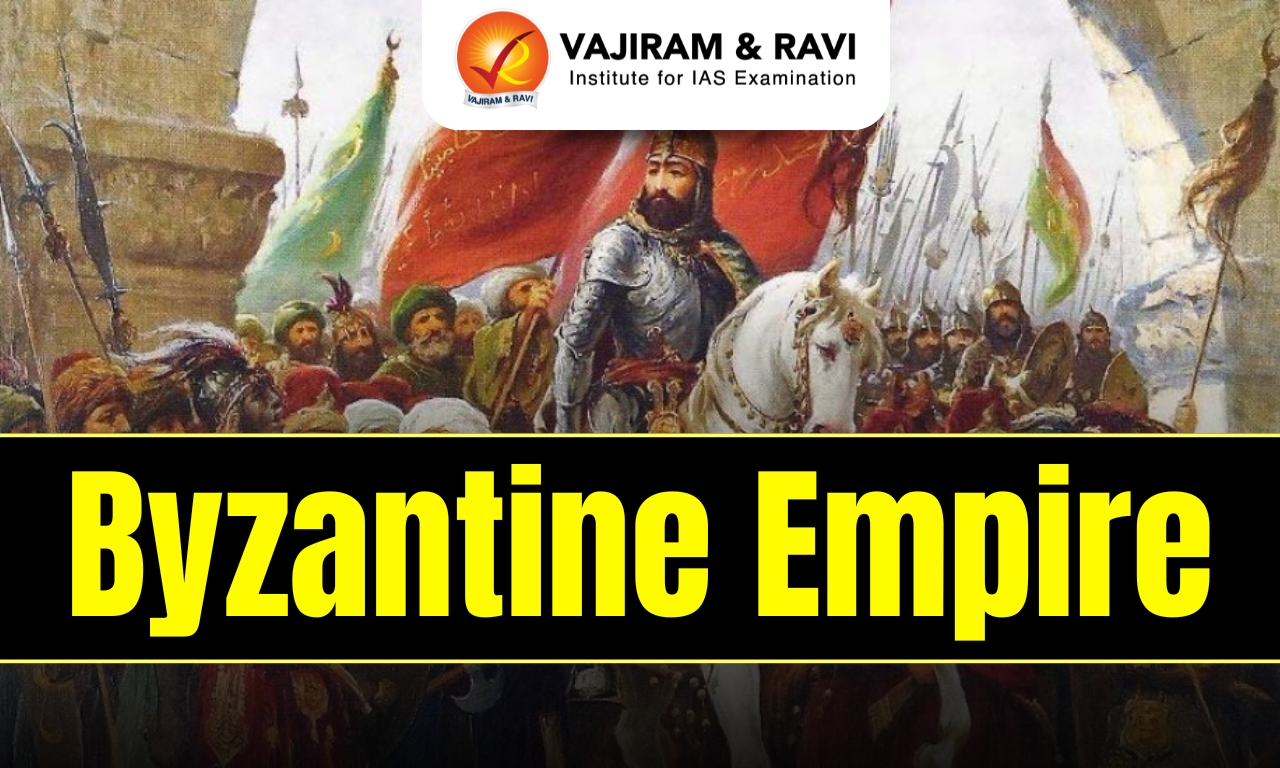
Researchers have identified a fortified hilltop complex in southeastern Spain as a rare Byzantine stronghold established by soldiers and clergy in the late sixth century.

About Byzantine Empire

  • It traces its beginnings to the year 330 CE, when Emperor Constantine split the Roman Empire into a western and eastern half. 
  • It was the eastern half of the Roman Empire that survived for nearly 1,000 years after the western half of the empire collapsed. 
  • It is often called the Eastern Roman Empire or simply Byzantium. 
  • It was based at Constantinople (modern-day Istanbul), and at its peak it controlled territory stretching from southern Spain to Syria. 
    • Strategically located on the Bosphorus Strait, Constantinople quickly rose to become Europe’s most significant urban hub.
  • Throughout their history, the Byzantines rarely controlled Rome and spoke mainly Greek. Despite this, the people of Byzantium continued to refer to themselves as "Romans," .
  • Their broader empire was considered to be a "Roman" empire even though it rarely controlled Rome.
  • The Byzantine Empire flourished and experienced a "golden age" during the reign of Justinian (A.D. 527 to 565), during which the empire's territories extended into Western Europe, and the emperor's builders constructed the Hagia Sophia, a great cathedral that still stands and is now used as a mosque.
  • The governance of the Byzantine Empire was marked by the absolute authority of emperors, who were seen as divinely appointed rulers.
  • The Byzantines developed their own political systems, religious practices, art, and architecture.
  • However, the empire faced numerous challenges, including territorial losses to emerging Muslim powers and internal religious schisms that eventually led to the split between the Roman Catholic and Eastern Orthodox Churches.
  • Decline:
    • After Justinian's death, the Byzantine Empire weakened and lost territory. 
    • In 1204, during the Crusades, the Byzantines were betrayed when crusaders from the west sacked Constantinople in an attempt to gain money. 
    • The Byzantine Empire eventually fell when Constantinople was conquered by the Ottoman Empire in 1453 CE following a siege.
    • The Byzantine Empire was the longest-lasting medieval power, and its influence continues today, especially in the religion, art, architecture, and laws of many Western states, Eastern and Central Europe, and Russia.

Source: EARTH

Byzantine Empire FAQs

Q1: How did the Byzantine Empire originate?

Ans: From the division of the Roman Empire into eastern and western halves.

Q2: What is another name for the Byzantine Empire?

Ans: Eastern Roman Empire or Byzantium.

Q3: Which city was the capital of the Byzantine Empire?

Ans: Constantinople.

Q4: Which language was mainly spoken in the Byzantine Empire?

Ans: Greek.

Q5: Which empire conquered Constantinople in 1453?

Ans: The Ottoman Empire.

Dillenia nagalim

Dillenia nagalim

Dillenia nagalim Latest News

A team of researchers recently discovered a new plant species in Manipur’s Kamjong district, naming it Dillenia nagalim.

About Dillenia nagalim

  • It is a new plant species discovered in Manipur’s Kamjong district.
  • The name “nagalim” is derived from “Naga” (referring to the indigenous Naga communities) and “lim,” meaning land, reflecting the plant’s origin in a region predominantly inhabited by the Tangkhul Naga tribe near the Indo-Myanmar border.
  • The species is currently known only from a single location, making it endemic to the area. 
  • It is a small shrub growing up to about 1.2 metres, with bright yellow flowers and distinctive double-serrated leaves. 
  • While it resembles related species such as Dillenia pentagyna and Dillenia hookeri, it differs in several features, including its shorter size, larger flowers, and a higher number of stamens and carpels.
  • The plant grows in open tropical deciduous forests at altitudes of 250–350 metres and flowers between May and June. 
  • The local communities are familiar with the plant. Its tender leaves are eaten as vegetables, while the fruits are edible and described as having a sweet, pungent flavour.
  • The species has been provisionally classified as “Critically Endangered” under IUCN criteria.

Source: NEN

Dillenia nagalim FAQs

Q1: What is Dillenia nagalim?

Ans: It is a newly discovered plant species.

Q2: Where was Dillenia nagalim discovered?

Ans: In Kamjong district of Manipur.

Q3: What is the colour of the flowers of Dillenia nagalim?

Ans: Bright yellow.

Q4: In what type of habitat does Dillenia nagalim grow?

Ans: Open tropical deciduous forests.

Q5: What is the conservation status of Dillenia nagalim?

Ans: It has been provisionally classified as “Critically Endangered” under IUCN criteria.

Potomac River

Potomac River

Potomac River Latest News

American Rivers, a United States conservation organisation working to make every river clean and healthy for people and wildlife, has nominated the Potomac, the river that flows through Washington, DC as America’s most endangered river for 2026.

About Potomac River

  • It is a river in the east central United States.
  • Course
    • It rises in North and South branches in the Appalachian Mountains of West Virginia. 
    • It flows through West Virginia, Maryland, Virginia, Pennsylvania, and Washington, D.C., before entering Chesapeake Bay, the largest U.S. estuary.
  • Its course is 616 km, of which 188 km are tidal.  
  • It is the fourth largest river along the Atlantic coast and the 21st largest in the United States.
  • The Potomac’s tributaries include the Shenandoah, the Monocacy, and the Anacostia.
  • The river is navigable to Washington, D.C., above which it descends from the Piedmont in a series of rapids and falls, including Great Falls, a cataract about 35 feet (11 metres) high.
  • The Potomac, noted for its beauty, is also rich in historical significance. 
    • The Potomac River is situated in an area rich in American history, which has led to the river's nickname, "The Nation's River".
    • During the Civil War, the Potomac River divided the Union from the Confederacy.  It also gave name to the Union's largest army, the Army of the Potomac.
    • In 1864, Washington, D.C. began using the Potomac River as its principal source of drinking water when the Washington Aqueduct was opened.
    • Mount Vernon, home of George Washington, is on its banks below Washington, D.C. 
    • The river’s name derives from “Patawomeck,” as it was recorded by the colonist John Smith in 1608.

Source: DTE

Potomac River FAQs

Q1: Where is the Potomac River located?

Ans: In the east-central United States.

Q2: Where does the Potomac River originate?

Ans: In the Appalachian Mountains of West Virginia.

Q3: What is the total length of the Potomac River?

Ans: 616 km.

Q4: Up to which city is the Potomac River navigable?

Ans: Washington, D.C.

Tibetan Antelope

Tibetan Antelope

Tibetan Antelope Latest News

Recently, a New Delhi court has convicted an art gallery owner for attempting to illegally export Shahtoosh shawls – made Tibetan Antelope. 

About Tibetan Antelope

  • The Tibetan antelope or chiru (Pantholops hodgsonii) is a medium-sized antelope.
  • Appearance
    • Male Tibetan antelopes are significantly larger than females, and can also be readily distinguished by the presence of horns and by black stripes on the legs, both of which the females lack.
    • The fur of Tibetan antelopes is distinctive, and consists of long guard hair and a silky undercoat of shorter fibers
  • : They inhabit open alpine, montane valleys, and cold steppe environments with sparse vegetation cover.
  • Distribution: They are found almost entirely in China, where they inhabit Tibet, southern Xinjiang, and western Qinghai; a few are also found across the border in Chang Thang, Ladakh, India.
  • Migration: They are a migratory species, often travelling as much as 400 kilometres between their summer and winter grounds. 
  • Diet: They are herbivores (folivores, graminivores) and feed on forbs, grasses, herbs, shrubland, and sedges.

Conservation Status of Tibetan Antelope

  • IUCN Red List: Near Threatened
  • CITES: Appendix I
  • Wildlife (Protection) Act, 1972: Schedule I

What are Shahtoosh Shawls?

  • These are made from the hair of the Tibetan Antelope.
  • It offers high levels of smoothness and warmth, Shahtoosh shawls became a highly expensive commodity.
  • The Shahtoosh shawl trade has been banned globally since 1975 under CITES.

Source: PIB

Tibetan Antelope FAQs

Q1: What is the Scientific name of Tibetan Antelope?

Ans: Pantholops hodgsonii

Q2: What is the average lifespan of Tibetan Antelope?

Ans: 8-10 years

Scarborough Shoal

Scarborough Shoal

Scarborough Shoal Latest News

China is employing ships and a barrier to tighten control of the entrance to the Scarborough Shoal in the South China Sea amid roiling tension with the Philippines over the disputed feature.

About Scarborough Shoal

  • It is a disputed atoll in the South China Sea, claimed by both China and the Philippines as part of their territory.    
  • It is called Huangyan Island by China and Panatag Shoal, or Bajo de Masinloc by the Philippines.
  • It was named for the HMS Scarborough, an English ship chartered by the East India Company that struck the atoll in the 18th century. 
  • It lies roughly 220 km west of Luzon, the Philippines’ main island, and more than 800 km southeast of Hong Kong.
  • It is the largest atoll in the South China Sea.
  • It covers an area of 150 sq.km. which includes a shallow navigable lagoon. 
  • Most of the atoll is submerged at high tide, but several rocks, the most prominent of which is called South Rock, remain above water.
  • What is the Dispute?
    • China’s claim: China makes a historical claim to the area, stating that they can trace their ownership of the area back to the Yuan Dynasty of the 1200s.
    • Philippines claim: The Philippines claim the area on the basis of geography, as it is much closer to the Philippines’ main island of Luzon, which contains the capital, Manila, but lies over 500 miles from China.
  • It is considered within the Philippines’ 200-nautical mile exclusive economic zone, based on the 1982 United Nations Convention on the Law of the Sea (UNCLOS).
  • There are no structures built on Scarborough Shoal, but the feature is effectively controlled by China, which has maintained a constant coast guard presence at the feature since 2012.
  • Commercial Significance: The surrounding waters have rich fishing grounds, and the seabed is believed to hold substantial mineral resources, including petroleum and natural gas.

Source: IT

Scarborough Shoal FAQs

Q1: What is Scarborough Shoal?

Ans: It is a disputed atoll in the South China Sea.

Q2: Which countries claim Scarborough Shoal?

Ans: China and the Philippines.

Q3: Which country currently exercises effective control over Scarborough Shoal?

Ans: China.

Q4: Why is Scarborough Shoal commercially important?

Ans: Due to rich fishing grounds and potential mineral resources.

Andaman Sea

Andaman Sea

Andaman Sea Latest News

Recently, at least 250 people, including Rohingya refugees and Bangladeshi nationals, were missing after a boat capsized in the Andaman Sea.

About Andaman Sea

  • It is a semi-enclosed marginal sea in the northeastern Indian Ocean.
  • Borders
    • It lies between the eastern coast of India and the Malay Peninsula, with Myanmar to the north and the Indonesian island of Sumatra to the south.
    • The Bay of Bengal bounds the Andaman Sea to the west and the Strait of Malacca to the east.
  • It is a complex geological region with a tectonically active plate boundary.
  • It is part of the larger Sunda Plate, which the Indian Plate borders to the northwest and the Australian Plate to the southeast. 
  • Climate: The climate of the Andaman Sea is tropical, with two distinct seasons: the southwest monsoon (May-September) and the northeast monsoon (November-February)
  • Biodiversity: It is home to extensive coral reef systems, seagrass meadows, and mangrove forests, which provide critical habitats for a multitude of marine organisms.

Source: TH

Andaman Sea FAQs

Q1: Which strait connects the Andaman Sea to the South China Sea?

Ans: Strait of Malacca

Q2: Which group of islands separate the Bay of Bengal from the Andaman Sea?

Ans: Andaman and Nicobar Islands

Bacille Calmette-Guerin (BCG) Vaccine

Bacille Calmette-Guerin (BCG) Vaccine

Bacille Calmette-Guerin (BCG) Vaccine Latest News

Recently, India announced that it has supplied 13 tonnes of Bacille Calmette-Guerin (BCG) vaccines to Afghanistan.

About Bacille Calmette-Guerin (BCG) Vaccine

  • It is the live attenuated vaccine form of Mycobacterium bovis.
  • It is used to prevent tuberculosis and other mycobacterial infections.
  • Developed By: It was developed by Calmette and Guérin and was first administered to human beings in 1921.
  • It is the only vaccine against tuberculosis.
  • Other Uses
    • It is the most widely administered vaccine and usually a part of the routine newborn immunization schedule.
    • It also offers protection against non-tuberculous mycobacterial infections like leprosy and Buruli ulcer.
    • It is also used in the treatment of superficial carcinoma of the bladder.
  • The vaccine is administered intradermally.
  • BCG vaccine should be stored and transported between +2 °C and +8°C.
  • It has two components, a freeze-dried vaccine and a diluent to be used to reconstitute the vaccine, presented in amber glass ampoules and colourless ampoules respectively.

Key Facts about Tuberculosis (TB)

  • It is caused by bacteria (Mycobacterium tuberculosis) that most often affect the lungs.
  • It is curable and preventable disease
  • Transmission of TB
    • TB is spread from person to person through the air.
    • When people with lung TB cough, sneeze or spit, they propel the TB germs into the air.
    • Even after inhaling a few drops of these germ, a person can get infected.
  • Symptoms of TB
    • Persistent cough for more than 3 weeks, often with blood
    • Weight loss, night sweats, high fever, fatigue, loss of appetite, chest pain, swollen lymph nodes.
  • Treatment: The Bacillus Calmette-Guérin (BCG) vaccine provides moderate protection, mainly for severe TB in infants and children.

Source: DD News

Bacille Calmette-Guerin (BCG) Vaccine FAQs

Q1: BCG vaccine contains which type of organism?

Ans: Live attenuated Mycobacterium bovis

Q2: How BCG vaccine is supplied?

Ans: Freeze-dried vaccine in amber ampoule and diluent in colourless ampoule

Enquire Now