Actinarctus odissi

Actinarctus odissi

Actinarctus odissi Latest News

Scientists recently discovered a new species of tardigrade, fondly known as the marine water bear, named Actinarctus odissi, off the northeast coast of India.

About Actinarctus odissi

  • It is a new species of tardigrade.
  • The microscopic creature was discovered in the shallow marine waters of the Bay of Bengal, near the coastal region of Markandi in Odisha
  • The name ‘’odissi’’ was chosen to honour the famous traditional classical dance form originating from Odisha
  • This marks the first time in 43 years that a new member of its elusive genus has been found.   
  • Features:
    • It boasts a dome-shaped body surrounded by transparent, wing-like flaps called alae, which are supported by translucent pillars. 
    • While other species in this genus feature long wings and elaborate internal supports, this new water bear has noticeably shorter lateral wings. 
    • Its back legs possess simple, un-split sensory organs that are much shorter than those of its cousins. 
    • It also features blunt-tipped sensory appendages, rather than sharp ones, and its back is uniquely heavily sculptured with tiny, trombone-shaped pillars. 

What are Tardigrades?

  • Tardigrades, also called ‘’water bears’’ or ‘’moss-piglets’’, are tiny microscopic animals.   
  • Scientists have identified about 1,300 tardigrade species. 
  • Tardigrades can be found in almost every habitat on Earth. 
  • Most species live in freshwater or semiaquatic terrestrial environments. 
  • Marine tardigrades account for 17% of all known tardigrade species.
  • They are short (0.05 mm - 1.2 mm in body length), plump, bilaterally symmetrical, segmented organisms. 
  • They have four pairs of legs, each of which ends in four to eight claws.  
  • They feed on the fluids of plant cells, animal cells, and bacteria.  
  • They are famous for their extraordinary ability to survive extreme environmental conditions. 
  • They can survive punishing heat, freezing cold, ultraviolet radiation, and even outer space. 
  • Under unfavourable conditions, they go into a state of suspended animation called the “tun” state—in which the body dries out and appears as a lifeless ball (or tun). 
    • In this state their metabolism may decline to as little as 0.01 percent of its normal rate. 
    • Tardigrades can survive as tuns for years, or even decades, to wait out dry conditions. 

Source: RM

Actinarctus odissi FAQs

Q1: What is Actinarctus odissi?

Ans: Actinarctus odissi is a newly discovered species of tardigrade.

Q2: Where was Actinarctus odissi discovered?

Ans: It was discovered in the shallow marine waters of the Bay of Bengal near Markandi in Odisha.

Q3: What is the body shape of Actinarctus odissi?

Ans: It has a dome-shaped body.

Q4: What are tardigrades commonly called?

Ans: Tardigrades are commonly called “water bears” or “moss-piglets.”

Anal Naga Tribe

Anal Naga Tribe

Anal Naga Tribe Latest News

For generations, the Anal Naga tribe in Manipur has followed Uju and Rangkang, community-led forest systems that protect trees, water sources and village life.

About Anal Naga Tribe

  • They are an indigenous Tibeto-Burman ethnic group found in Manipur, India, and in Myanmar.
  • They are one of the first settlers of 19 Naga tribes in Manipur. 
  • They are confined mostly in Chandel District, Manipur. 
  • They are recognized as a Scheduled Tribe in India.
  • The population of Anal, according to the 2011 census, is 24,301.
  • They speak the Anāl language, a Northern Kukish dialect of the Sino-Tibetan family.
  • Religion:
    • The ancient religion of Anal is ‘animist’. 
    • At present, the overwhelming majority of the population are Christians.  
  • Livelihood:
    • They make their living by farming and animal husbandry.  
    • For generations, the Anal Naga tribe has protected forests through Uju and Rangkang-community-led systems.

What is Uju? 

  • It refers to community-managed reserved forests located near Anal villages. 
  • These are protected collectively, usually under the supervision of village authorities and elders, who regulate how resources can be used. 
  • Decisions are made collectively during annual assemblies attended by residents. 
  • Discussions range from land disputes and road repairs to forest regulations and jhum cultivation cycles. 
  • Commercial logging is prohibited. 
  • Trees cannot be cut without permission.
  • Forest products such as mushrooms, herbs, wild vegetables, flowers, fruits, berries, and medicinal plants may be gathered carefully for household use, but extraction for profit is restricted.

What is Rangkang?

  • It refers to untouched forest areas located deeper within jhum cultivation landscapes.
  • Unlike Uju, which is actively managed, Rangkang forests are left largely undisturbed. 
  • Over generations, communities have intentionally avoided cultivating these regions, allowing dense ecosystems to regenerate naturally.

Source: BI

Anal Naga Tribe FAQs

Q1: Who are the Anal Naga Tribe?

Ans: Anal Naga Tribe are an indigenous Tibeto-Burman ethnic group found in Manipur, India, and Myanmar.

Q2: In which Indian state is the Anal Naga Tribe mainly found?

Ans: The Anal Naga Tribe is mainly found in Manipur.

Q3: Which language is spoken by the Anal Naga Tribe?

Ans: They speak the Anāl language, a Northern Kukish dialect of the Sino-Tibetan family.

Q4: Which religion is followed by the majority of the Anal Naga Tribe today?

Ans: The majority of the Anal Naga Tribe today are Christians.

Q5: What are the main livelihoods of the Anal Naga Tribe?

Ans: Their main livelihoods are farming and animal husbandry.

India’s Cold Water Fisheries

India’s Cold Water Fisheries

India’s Cold Water Fisheries Latest News

India’s cold water fisheries sector is emerging as an important component of the Blue Economy by generating livelihoods, improving nutrition, promoting eco-tourism, and supporting sustainable mountain development.

About India’s Cold Water Fisheries

  • Cold-water fisheries are practiced in high-altitude snow-fed rivers, streams, lakes, and reservoirs with temperatures ranging between 5°C and 25°C, dissolved oxygen above 6 mg/L, and pH levels between 6.5 and 8.0. 
  • They flourish across Jammu & Kashmir, Ladakh, Himachal Pradesh, Uttarakhand, Arunachal Pradesh, Sikkim, Meghalaya, and Nagaland, along with hill districts of West Bengal, Kerala, Karnataka, and Tamil Nadu. 
  • Together, these ecosystems cover more than 5.33 lakh sq. km. of mountainous terrain. 
  • India has identified over 278 cold-water fish species. 
  • Species such as rainbow trout, golden mahseer, and snow trout are cultivated using specialized infrastructure, including hatcheries, raceways, RAS, biofloc systems, and cold chain facilities. 
  • Trout farming is generally practiced above 1,500 metres altitude, while mahseer culture is suitable at relatively lower elevations. 
  • Current Status and Production:
    • India’s total fish production reached approximately 197.75 lakh tonnes during 2024–25, with cold-water fisheries contributing nearly 3 percent of inland fish production. 
    • National cold-water fish production currently stands at around 7,000 metric tonnes. 
    • Trout production alone has increased nearly 1.8 times over the last decade to about 6,000 metric tonnes in 2024–25. 
    • Jammu & Kashmir has emerged as India’s leading trout-producing region, followed by Himachal Pradesh and Uttarakhand.
  • Policy Initiatives: 
    • Under the Pradhan Mantri Matsya Sampada Yojana (PMMSY) during 2020–26, projects worth over ₹5,638.76 crore sanctioned specifically for cold-water states.
    • The Fisheries and Aquaculture Infrastructure Development Fund (FIDF) approved projects worth ₹7,761.78 crore during 2018–26 for hatcheries, training centres, and fisheries infrastructure. 
    • The Blue Revolution Scheme (2015–20) laid the foundation for scientific trout farming through support for raceways, hatcheries, and reservoir stocking. 
    • Under Pradhan Mantri Matsya Kisan Samridhi Sah-Yojana (PM-MKSSY), with an outlay of ₹6,000 crore, support is being provided for aquaculture insurance, performance grants to fisheries startups/microenterprises, and value chain efficiency.
    • The Government has also issued Model Guidelines for Cold Water Fisheries Development, 2026, covering site selection, hatchery standards, disease management, biosecurity, branding, certification, e-trading, and skill development. 
    • India is also strengthening international collaborations with Norway and Iceland for knowledge exchange.

Source: NOA

India’s Cold Water Fisheries FAQs

Q1: What are cold-water fisheries?

Ans: Cold-water fisheries are fisheries practiced in high-altitude snow-fed rivers, streams, lakes, and reservoirs.

Q2: What is the ideal temperature range for cold-water fisheries?

Ans: The ideal temperature range is between 5°C and 25°C.

Q3: What is the suitable pH range for cold-water fisheries?

Ans: The suitable pH range is between 6.5 and 8.0.

Q4: In which regions of India are cold-water fisheries mainly practiced?

Ans: They are mainly practiced in Jammu and Kashmir, Ladakh, Himachal Pradesh, Uttarakhand, Arunachal Pradesh, Sikkim, Meghalaya, and Nagaland.

Q5: What percentage of inland fish production comes from cold-water fisheries?

Ans: Cold-water fisheries contribute nearly 3 percent of inland fish production.

Himalayan Tricarinate Hill Turtle

Himalayan Tricarinate Hill Turtle

Himalayan Tricarinate Hill Turtle Latest News

Forest officials recently found the rare Himalayan Tricarinate Hill Turtle in the Udanti Sitanadi Tiger Reserve forests of Chhattisgarh, marking an unusual sighting of the Himalayan species in central India.

About Himalayan Tricarinate Hill Turtle

  • It is a small, terrestrial turtle species belonging to the family Geoemydidae.
  • It derives its name from the three distinct keels on its shell, which provide it with a striking appearance.  
  • Scientific Name: Melanochelys tricarinata 

Himalayan Tricarinate Hill Turtle Habitat and Distribution

  • It is found along the narrow sub-Himalayan belt, stretching across northeastern India, southern Nepal, southern Bhutan, and northern Bangladesh. 
  • The species primarily inhabits temperate forests, as well as grasslands and foothills of the Himalayas.  

Himalayan Tricarinate Hill Turtle Features

  • It is characterised by a highly domed carapace with three longitudinal keels.
  • It has a small olive-to-dark coloured head with a narrow snout.
  • It has scaly limbs adapted for terrestrial movement.

Himalayan Tricarinate Hill Turtle Conservation Status

It is classified as 'Endangered' under the IUCN Red List.

Source: TOI

Himalayan Tricarinate Hill Turtle FAQs

Q1: What is the Himalayan Tricarinate Hill Turtle?

Ans: It is a small terrestrial turtle species belonging to the family Geoemydidae.

Q2: Why is it called the “Tricarinate” Hill Turtle?

Ans: It is called “Tricarinate” because of the three distinct keels on its shell.

Q3: In which geographical belt is the Himalayan Tricarinate Hill Turtle found?

Ans: It is found along the narrow sub-Himalayan belt, stretching across northeastern India, southern Nepal, southern Bhutan, and northern Bangladesh.

Q4: What is the IUCN Red List status of the Himalayan Tricarinate Hill Turtle?

Ans: Its IUCN Red List status is Endangered.

Hutti Gold Mines Company Limited (HGML)

Hutti Gold Mines Company Limited

Hutti Gold Mines Company Limited Latest News

Hutti Gold Mines, the only functional gold mine in the country, earned a whopping ₹633.34 crores more in 2025-26, thanks to the skyrocketing price of gold in the world market.

About Hutti Gold Mines Company Limited

  • It is a Government of Karnataka undertaking established in 1947
  • It has the unique distinction of being the only producer of primary gold in the country. 
  • HGML has been active in the exploration, development, and exploitation of gold deposits occurring in Karnataka
  • The company's corporate office is situated in Bangalore.
  • It currently processes the ore from the Hutti Gold mine and two satellite mines, the Uti opencast mine and the Heera-Buddinni exploratory underground mine. 
  • The Hutti mine is probably one of the most ancient metal mines in the world, dating to the Pre-Ashokan period.  
  • Production:
    • The company produced 1,691.57 kg of gold during 2025-26.
    • Hutti’s gold production meets less than 1% of India’s annual demand for gold that is estimated to be over 700 tonnes. 
    • The company also produced 145.76 kg of silver as a byproduct of the gold ore beneficiation process.

Source: TH

Hutti Gold Mines Company Limited FAQs

Q1: What is Hutti Gold Mines Company Limited (HGML)?

Ans: It is a Government of Karnataka undertaking engaged in gold mining activities.

Q2: In which year was Hutti Gold Mines Company Limited (HGML) established?

Ans: HGML was established in 1947.

Q3: What unique distinction does Hutti Gold Mines Company Limited (HGML) hold in India?

Ans: HGML is the only producer of primary gold in India.

Q4: Which main mine supplies ore to HGML?

Ans: The Hutti Gold Mine supplies ore to HGML.

Q5: How much gold did Hutti Gold Mines Company Limited (HGML) produce during 2025–26?

Ans: HGML produced 1,691.57 kg of gold during 2025–26.

Red-Necked Phalarope

Red-Necked Phalarope

Red-Necked Phalarope Latest News

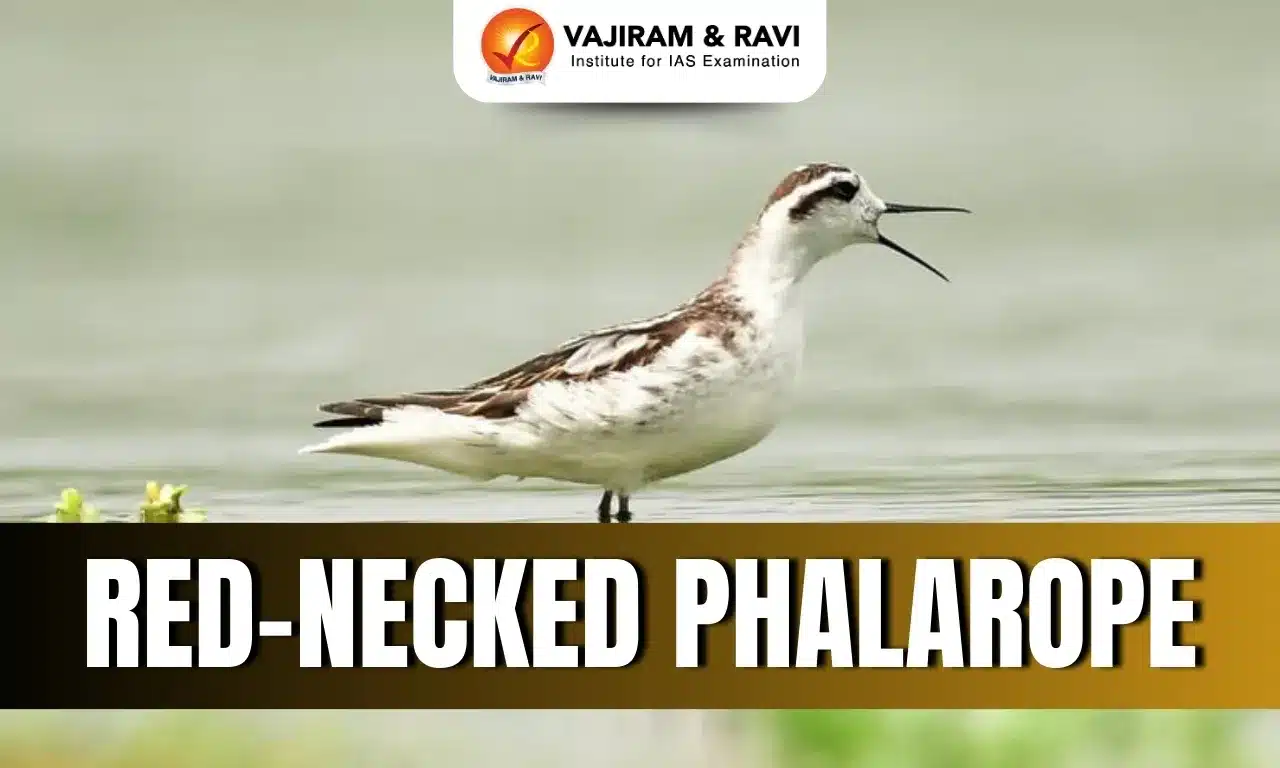
Chandu Budhera wetland recently emerged as a migratory stopover for the rare red-necked phalarope.

About Red-Necked Phalarope

  • It is a small shorebird known for spinning frantically on water to stir up small invertebrates.
  • Scientific Name: Phalaropus lobatus 

Red-Necked Phalarope Habitat and Distribution

  • This species has a circumpolar distribution. 
  • A long-distance migrant, it breeds in Arctic bogs and winters at sea in the tropics, often travelling overland. 
  • Russian breeders winter in the southwest Pacific, North American birds off Peru, and European birds mainly in the Arabian Sea. 

Red-Necked Phalarope Features

  • It has a small head, short legs, and a thin needle-like bill. 
  • Both sexes have a dark head with a white spot above the eye, white throat, and a dark back with bold, buff-coloured streaking. 
  • The bright, chestnut-red stripe down the sides of the neck is distinctive. 
  • Like all phalaropes, red-necked phalaropes show reversed sexual dimorphism.
  • Females are the more brightly colorful and typically larger sex. 
  • Males are responsible for incubating eggs and feeding young. 

Red-Necked Phalarope Conservation Status

It is classified as 'Least Concern' under the IUCN Red List

Source: HT

Red-Necked Phalarope FAQs

Q1: What is Red-Necked Phalarope?

Ans: It is a small shorebird.

Q2: What unique feeding behaviour is shown by the Red-Necked Phalarope?

Ans: It spins frantically on water to stir up small invertebrates.

Q3: Where does the Red-Necked Phalarope breed?

Ans: It breeds in Arctic bogs.

Q4: Where does the Red-Necked Phalarope spend the winter?

Ans: It winters at sea in tropical regions.

Q5: What is the IUCN conservation status of the Red-Necked Phalarope?

Ans: Its IUCN Red List status is Least Concern.

Indian Cybercrime Coordination Centre (I4C)

Indian Cybercrime Coordination Centre (I4C)

Indian Cybercrime Coordination Centre (I4C) Latest News

The Indian Cybercrime Coordination Centre (I4C) recently identified a sophisticated phishing campaign targeting Apple iPhone users whose devices have been lost or stolen, according to an advisory issued by the agency.

About Indian Cybercrime Coordination Centre (I4C)

  • I4C has been established under the Ministry of Home Affairs (MHA) to act as a nodal point at the National level in the fight against cybercrime. 
  • It is designed to provide a framework and ecosystem for law enforcement agencies (LEAs) to deal with cybercrime in a coordinated and comprehensive manner.
  • I4C brings together academia, industry, public, and government in the prevention, detection, investigation, and prosecution of cybercrimes.
  • Headquarters: New Delhi.

Indian Cybercrime Coordination Centre (I4C) Objectives

  • To act as a nodal point to curb Cybercrime in the country.
  • To strengthen the fight against Cybercrime committed against women and children.
  • Facilitate easy filing of cybercrime-related complaints and identifying cybercrime trends and patterns.
  • To act as an early warning system for LEAs for proactive cybercrime prevention and detection.
  • Awareness creation among the public about preventing cybercrime.
  • Assist states/UTs in the capacity building of Police Officers, Public Prosecutors and Judicial Officers in the area of cyber forensics, investigation, cyber hygiene, cyber-criminology, etc.
  • Identify the research problems and needs of LEAs and take up R&D activities in developing new technologies and forensic tools in collaboration with academia/research institutes within India and abroad.
  • Suggest amendments, if required, in cyber laws to keep pace with fast-changing technologies and international cooperation.
  • To coordinate all activities related to the implementation of Mutual Legal Assistance Treaties (MLAT) with other countries related to cybercrimes in consultation with the concerned nodal authority in MHA.

Indian Cybercrime Coordination Centre (I4C) Components

  • National Cybercrime Threat Analytics Unit (TAU)
  • National Cybercrime Reporting Portal (NCRP)
  • National Cybercrime Training Centre (NCTC)
  • National Cybercrime Research and Innovation Centre
  • Platform for Joint Cyber Crime Coordination Team
  • Cybercrime Ecosystem Management Unit
  • National Cybercrime Forensic Laboratory (Investigation) Ecosystem

Indian Cybercrime Coordination Centre (I4C) Initiatives

  • Citizen Financial Cyber Fraud Reporting and Management System: For immediate reporting of financial cyber frauds and preventing the siphoning of funds by cyber criminals on a near-real-time basis.
  • National Toll-Free Helpline number ‘1930’ has been operationalized to provide citizen assistance in lodging online cyber complaints.
  • The social media handle “CyberDost”, which provides cyber safety tips at regular intervals.
  • I4C has envisaged the Cyber Crime Volunteers Program to bring together citizens with a passion to serve the nation on a single platform and contribute to the fight against cybercrime in the country.
  • Pratibimb geospatial crime mapping platform maps locations of criminals and crime infrastructure on a map to give visibility to jurisdictional officers.    

What is Phishing?

  • It is a type of cyberattack that uses deceptive messages from seemingly reputable sources to trick victims into revealing sensitive information like login credentials, passwords, or financial data for malicious use.
  • Attackers utilize various sophisticated methods, including domain spoofing, fake websites, and generative AI, to execute a phishing attack via email, SMS, phone calls, or social media.
  • The most common examples of phishing are used to support other malicious actions, such as account takeovers, ransomware attacks, or business email compromise.

Source: TH

Indian Cybercrime Coordination Centre (I4C) FAQs

Q1: What is the Indian Cybercrime Coordination Centre (I4C)?

Ans: It is a national-level nodal agency established to fight cybercrime in India.

Q2: Under which ministry was Indian Cybercrime Coordination Centre (I4C) established?

Ans: I4C was established under the Ministry of Home Affairs.

Q3: Where is the headquarters of Indian Cybercrime Coordination Centre (I4C) located?

Ans: The headquarters of I4C is located in New Delhi.

Q4: Which toll-free helpline number is used for cybercrime complaints in India?

Ans: The toll-free helpline number is 1930.

Q5: What is “CyberDost”?

Ans: CyberDost is a social media initiative that shares cyber safety tips regularly.

Nereid

Nereid

Nereid Latest News

New observations from the James Webb Space Telescope suggest that Nereid may not have originated from the Kuiper Belt, as its crystalline water ice and unique spectral signature differ from known Kuiper Belt objects.

About Nereid

  • It is the third-largest moon of Neptune. 
  • It was discovered on May 1, 1949, by  Dutch astronomer Gerard Kuiper, who named the moon after the sea nymphs in Greek mythology. 
  • Nereid is about 170 kilometers across.
  • It is unique because it has one of the most eccentric orbits of any moon in our solar system. 
  • It is so far from Neptune that it requires 360 Earth days to make one orbit. 
  • Like so many other moons in the outer solar system, Nereid was long suspected of migrating to Neptune's neighborhood from the Kuiper Belt
  • But using the Webb telescope, scientists determined that Nereid’s composition was inconsistent with Kuiper Belt objects — it had too much ice. 
  • That suggests it was part of Neptune's system all along. 

What is the Kuiper Belt?

  • It is a large, doughnut-shaped cold region of icy bodies located in the outer reaches of our solar system beyond the orbit of Neptune.  
  • It's sometimes called the "third zone" of the solar system. 
  • It is similar to the main asteroid belt, found between Mars and Jupiter, in that its objects are composed of material leftover from the formation of the solar system around 4.6 billion years ago. 
  • However, it is far larger than the main asteroid belt, up to 20 times as wide and 20 to 100 times its mass.
  • Like the asteroid belt, it has also been shaped by a giant planet, although it's more of a thick disk (like a donut) than a thin belt.
  • The icy bodies in the Kuiper Belt are called "Kuiper Belt Objects", or KBOs for short. Pluto is the best-known KBO.
  • In addition to rock and water ice, objects in the Kuiper Belt also contain a variety of other frozen compounds like ammonia and methane.  

Source: TH

Nereid FAQs

Q1: What is Nereid?

Ans: Nereid is the third-largest moon of Neptune.

Q2: Who discovered Nereid?

Ans: It was discovered on May 1, 1949, by Dutch astronomer Gerard Kuiper.

Q3: Why is Nereid considered unique among moons in the Solar System?

Ans: It has one of the most eccentric orbits of any moon in the Solar System.

Q4: How long does Nereid take to complete one orbit around Neptune?

Ans: Nereid takes about 360 Earth days to complete one orbit.

Q5: Why is Nereid’s composition inconsistent with Kuiper Belt objects?

Ans: Its composition contains more ice than typical Kuiper Belt objects.

Stroke

Stroke

Stroke Latest News

The World Health Assembly (WHA) recently passed the first-ever resolution on strokes, urging member states to recognise the medical condition as a public health priority.

About Stroke

  • It is a medical emergency that occurs when blood flow to the brain is interrupted, either due to a blockage or bleeding. 
  • This lack of blood flow can lead to brain cell death and serious complications. 
  • A stroke can cause lasting brain damage, long-term disability, or even death. 
  • The types of strokes are:
    • Ischaemic stroke: A blood clot blocks a blood vessel in your brain, leading to loss of blood flow.
    • Haemorrhagic stroke: Intracerebral haemorrhage (ICH) by rupture of a blood vessel in the brain leading to bleeding.
    • Transient ischaemic attack (TIA): A short period of symptoms similar to those of a stroke, caused by a brief blockage of blood flow to the brain. A TIA usually lasts only a few minutes and doesn't cause long-term damage.
  • Most of the stroke burden is attributable to 10 modifiable risk factors, including high blood pressure, air pollution, smoking, high LDL cholesterol, diet high in sodium, high fasting blood glucose, kidney dysfunction, excess body weight, physical inactivity, and harmful use of alcohol
  • Non‑modifiable risk factors are:
    • Age
    • A prior stroke
    • Pre-existing cardiac conditions (e.g., atrial fibrillation and heart failure) and chronic kidney disease.
  • The symptoms of a stroke often happen quickly. They include:
    • Sudden numbness or weakness of the face, arm, or leg (especially on one side of the body).
    • Sudden confusion, trouble speaking, or understanding speech.
    • Sudden trouble seeing in one or both eyes.
    • Sudden difficulty walking, dizziness, loss of balance, or coordination.
    • Sudden severe headache with no known cause.
  • Treatment:
    • Treatments for stroke include medicines, surgery, and rehabilitation. 
    • Prevention of another stroke is also important, since having a stroke increases the risk of getting another one. 
    • Prevention may include heart-healthy lifestyle changes and medicines. 

Source: TH

Stroke FAQs

Q1: What is a stroke?

Ans: Stroke is a medical emergency that occurs when blood flow to the brain is interrupted.

Q2: What are the two main causes of a stroke?

Ans: A stroke can occur due to a blockage or bleeding in the brain.

Q3: Why is interrupted blood flow dangerous during a stroke?

Ans: Interrupted blood flow can lead to brain cell death and serious complications.

Q4: What is an ischaemic stroke?

Ans: An ischaemic stroke occurs when a blood clot blocks a blood vessel in the brain.

Q5: What is a haemorrhagic stroke?

Ans: A haemorrhagic stroke occurs when a blood vessel in the brain ruptures and causes bleeding.

Jharia Coalfield

Key Facts about Jharia coalfield

Jharia Coalfield Latest News

A new study has found that the long-burning underground fires in the Jharia Coalfield may be burning hotter and emitting more greenhouse gases than previously estimated.

About Jharia Coalfield

  • It is located in the Dhanbad district of Jharkhand.
  • It lies in the Damodar River valley and covers about 280 sq.km.
  • It is known for its vast deposits of high-quality coking coal and holds the largest coal reserves in the country, having estimated reserves of 19.4 billion tonnes.
  • Coal mining began in Jharia in 1894, and there are now more than 20 underground mines and several large open-cast coal mines there.  
  • Underground fires were first noted in Jharia in 1916, and they have continued to spread, destroying properties and killing miners.  

What is Coking Coal?

  • Coking coal (or metallurgical coal) is a naturally occurring sedimentary rock found within the earth’s crust.
  • It typically contains more carbon, less ash, and less moisture than thermal coal, which is used for electricity generation.
  • It is a bituminous coal with a suitable quality that allows the production of metallurgical coke, or simply named coke. 
  • Coke is the main product of the high-temperature carbonisation of coking coal. 
  • It is an essential input material in steelmaking, as it is used to produce pig iron in blast furnaces, acting as the reducing agent of iron ore and as the support of the furnace charge.  
  • Major Producers: 
    • The largest producers of coking coal were China, Australia, Russia, USA, and Canada.
    • India has an estimated 37.37 billion tonnes of coking coal resources, largely located in Jharkhand, with additional reserves in Madhya Pradesh, West Bengal, and Chhattisgarh.

Source: TH


Jharia Coalfield FAQs

Q1: Where is the Jharia Coalfield located?

Ans: Jharia Coalfield is located in the Dhanbad district of Jharkhand.

Q2: In which river valley is the Jharia Coalfield situated?

Ans: It is situated in the Damodar River valley.

Q3: What type of coal is Jharia Coalfield famous for?

Ans: It is famous for high-quality coking coal.

Q4: Which coalfield holds the largest coal reserves in India?

Ans: The Jharia Coalfield holds the largest coal reserves in India.

Q5: When did coal mining begin in Jharia?

Ans: Coal mining began in Jharia in 1894.

Enquire Now