
Logistics Port Performance Index

Logistics Port Performance Index

Logistics Port Performance Index Latest News

Recently, the Union Minister of Ports, Shipping and Waterways (MoPSW) launched the logistics port performance index (LPPI) for FY2024- 25 and 4 major digital initiatives. 

About Logistics Port Performance Index

  • It is developed under the Sagar Aankalan framework.
  • It is a national benchmarking mechanism designed to assess and improve the operational performance of Indian ports.
  • The LPPI evaluates ports across three cargo segments dry bulk, liquid bulk and container cargo using operational indicators such as;
    • Cargo handled, vessel turnaround time, berth idle time, pre-berthing waiting time, container dwell time and ship berth day output.
  • The framework assigns equal weightage to absolute performance and year-on-year improvement, encouraging continuous enhancement of port operations.
  • The index aligns with the PM Gati Shakti National Master Plan, Maritime India Vision 2030 and Maritime Amrit Kaal Vision 2047, and seeks to strengthen India's position in global logistics and maritime trade.

Highlights of Logistics Port Performance Index

  • Paradip Port Authority topped the Dry Bulk Cargo category handling more than 5 million tonnes.
  • Sikka Port and Terminals led the Liquid Bulk Cargo segment.
  • Mundra Port emerged as the highest-ranked port in the Container Cargo category handling more than 0.5 million TEUs.
  • Jawaharlal Nehru Port Authority secured the second position among major container ports in the same category.

Other Initiatives Launched

  • 24x7 Grievance Redressal Module
    • It was launched under the e-Navik platform, a Ship Registration Module on the e-Samudra platform, a Medical Practitioner Module and a Unified Ship Recycling Credit Note Module.
  • Unified Ship Recycling Portal for Ship Recycling Credit scheme
    • It is part of the Government's ₹70,000-crore maritime development package announced in 2025.
    • Under the scheme, ship owners recycling vessels at Hong Kong Convention-compliant Indian yards can receive a credit note equivalent to 40 per cent of the vessel's scrap value, redeemable against new shipbuilding projects in India.

Source: PIB

Logistics Port Performance Index FAQs

Q1: Sagar Aankalan guidelines were released in which year?

Ans: 2024

Q2: What is the main objective of Sagar Aankalan?

Ans: National benchmarking for Indian ports based on global best practices
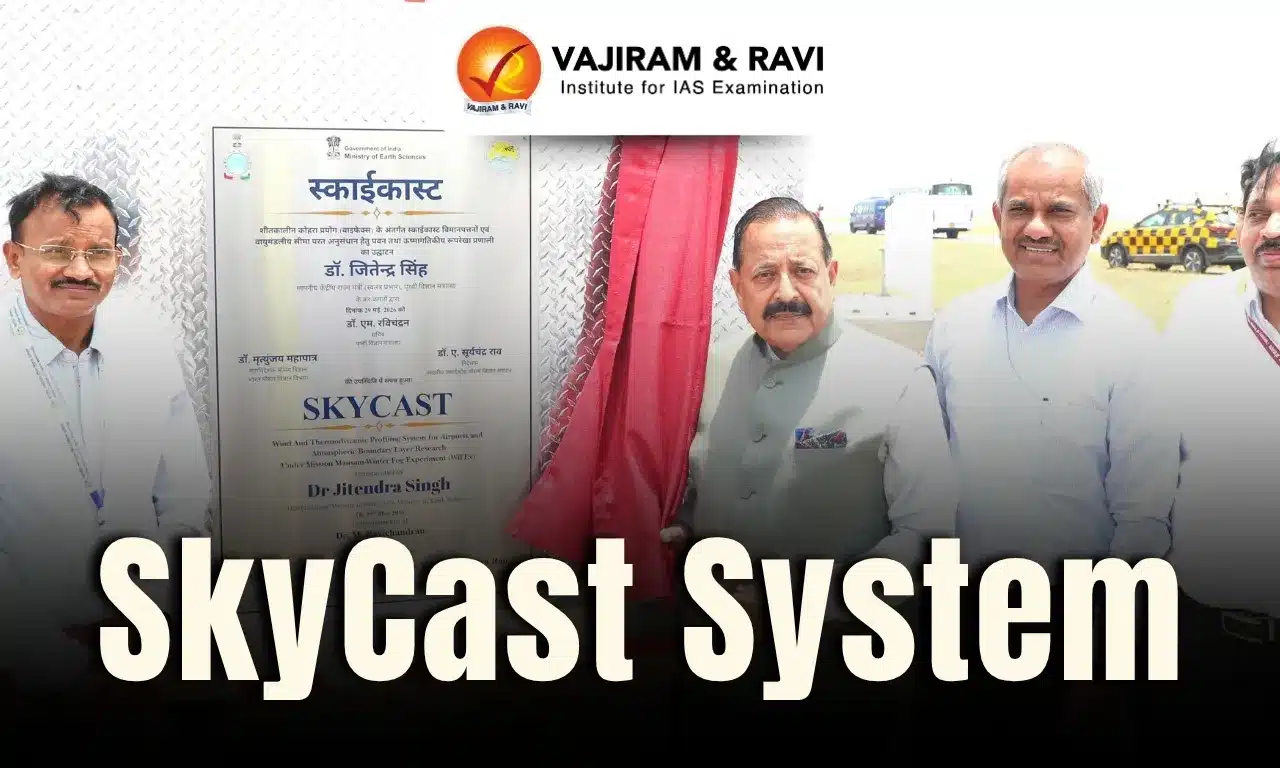
SkyCast System

SkyCast System

SkyCast System Latest News

Recently, the Union Minister of Earth Sciences inaugurated India's first SkyCast system at the Indira Gandhi International Airport in New Delhi.

About SkyCast System

  • It is an advanced integrated aviation weather monitoring system.
  • It is developed under "Mission Mausam".
  • The scientific foundation of SkyCast comes from the Winter Fog Experiment (WiFEX), jointly initiated by IITM and IMD under the Ministry of Earth Sciences at IGI Airport in 2015. 
  • India becomes 19th in the world to deploy advanced integrated aviation weather monitoring systems.

Key Features of SkyCast System

  • The system integrates state-of-the-art atmospheric remote sensing technologies which includes
    • Radar Wind Profiler: It forms the core of the system and measures wind speed, wind direction, turbulence, vertical velocity and boundary-layer dynamics.
    • Ground-based Fog Aerosol Spectrometer (GFAS): It is an advanced fog monitoring instrument which provides detailed information on fog droplets, aerosols and aerosol-fog interactions. 
    • CL61 Lidar-based Ceilometer: It monitors the vertical structure of fog and visibility conditions in real time,
    • It improves understanding of fog formation and atmospheric behaviour affecting aviation operations.
  • It brings together real-time measurements of fog, aerosols, turbulence, moisture, visibility and atmospheric conditions into a single advanced aviation weather intelligence framework.
  • It can assess atmospheric conditions from the surface up to nearly 10 km altitude and generate aviation meteorological parameters (wind shear, turbulence, fog formation indicators and icing potential).

Significance of SkyCast System

  • It will provide real-time weather intelligence to Pilots, reducing flight delays, diversions and cancellations caused by fog and turbulence.
  • It will support advanced forecasting models, artificial intelligence-enabled decision support systems, urban weather forecasting, pollution management, transport advisories and disaster preparedness initiatives.

Source: PIB

SkyCast System FAQs

Q1: For what purpose SkyCast System has been deployed at IGI Airport, New Delhi ?

Ans: Used for fog/low visibility nowcasts to help flight operations

Q2: Under which mission SkyCast System developed ?

Ans: Mission Mausam

Unclaimed Assets Portal

Unclaimed Assets Portal

Unclaimed Assets Portal Latest News

Recently, the Department of Financial Services (DFS), Ministry of Finance launched the Unclaimed Assets Portal. 

About Unclaimed Assets Portal

  • It is a common landing portal for unclaimed financial assets.
  • It is developed in collaboration with the Public Sector Bank Alliance (PSBA) to facilitate easier access to information relating to unclaimed financial assets.
  • This portal serves as a unified platform providing access to search facilities relating to unclaimed bank deposits, insurance claims, shares, dividends and mutual funds available across the financial ecosystem. 
  • The initiative builds upon the nationwide campaign “Your Money, Your Right”, undertaken by the Department of Financial Services in coordination with financial sector regulators, banks and other stakeholders.

What is the Public Sector Bank Alliance?

  • PSBA is a centralised umbrella organisation jointly promoted by 12 public sector banks in the country.
  • It was set up to deliver tech-driven, secure services to the banking sector that foster innovation and redefine banking excellence.

Source: PIB

Unclaimed Assets Portal FAQs

Q1: What was the purpose of Public Sector Bank Alliance (PSBA)?

Ans: PSBA developed Doorstep Banking Services platform

Q2: PSBA currently has how many PSBs as members?

Ans: All 12 Public Sector Banks are part of PSBA

Lokayan 26

Lokayan 26

Lokayan 26 Latest News

Recently, INS Sudarshini visited Antigua after successfully completing a historic trans-Atlantic passage as part of the ongoing Lokayan 26 expedition. 

About Lokayan 26

  • It is a 10-month transoceanic expedition of INS Sudarshini ship.
  • It will sail over 22,000 nautical miles, visiting 18 foreign ports across 13 countries.
  • During the course of the voyage, over 200 Indian Navy and Indian Coast Guard trainees will undergo intensive sail training, gaining invaluable experience in long-range ocean navigation and traditional seamanship at sea. 
  • It will strengthen India’s maritime cooperation and advance the vision of MAHASAGAR.

Key Facts about  INS Sudarshini

  • It is an indigenously built Sail Training Ship (STS).
  • It was built by Goa Shipyard Limited and based at Kochi, Kerala under the Southern Naval Command of the Indian Navy. 
  • It was successfully built and was commissioned on 27 Jan. 2012.
  • The aim of using such ships is to make sailors sea-friendly, as they are taught how to survive alone at sea, understand rough weather conditions and train themselves to become good sailors.
  • It has a very high endurance and can be deployed at sea continuously for a period of twenty days.

Source: News On air

Lokayan 26 FAQs

Q1: Lokayan 26 is a flagship expedition undertaken by which Indian Navy ship?

Ans: INS Sudarshini, sail training ship

Q2: Lokayan 26 began on which date?

Ans: Embarked on 20 Jan 2026 from Kochi

Gamgul Siyabehi Wildlife Sanctuary

Gamgul Siyabehi Wildlife Sanctuary

Gamgul Siyabehi Wildlife Sanctuary Latest News

Recently, a rare Himalayan Brown Bear (Ursus arctos isabellinus) has been captured on camera inside the Gamgul Siyabehi Wildlife Sanctuary in Chamba of Himachal Pradesh. 

About Gamgul Siyabehi Wildlife Sanctuary

  • Location: It is located in the state of Himachal Pradesh.
  • It is nestled in the catchment of Siul nala (a tributary of Ravi River).
  • It is adjoined at the northern end by the union territory of Jammu and Kashmir.
  • The Sanctuary is situated at elevations from 1,800 to 3,900 meters.
    • The famous Kashmir Stag has been reported to be found only in this sanctuary located in Himachal Pradesh.
  • Vegetation: Western Mixed Coniferous Forests, Moist temperate deciduous forests, Kharsu Oak forest, Birch/ Rhododendron forests and Alpine pastures.
  • Flora: The typical high altitude vegetation found here includes deodar forests, coniferous forests and alpine pastures.
  • Fauna: Asiatic Black Bear (Ursus thibetanus), Ibex (Capra ibex), Himalayan Tahr (Hemitragus jemlahicus), Common Leopard (Panthera pardus), Red Fox, Himalayan Tahr, small populations of Musk Deer, and Pheasants. etc.

Source: NIE

Gamgul Siyabehi Wildlife Sanctuary FAQs

Q1: Gamgul Siyabehi Wildlife Sanctuary is located in which state?

Ans: Himachal Pradesh

Q2: Gamgul Siyabehi WLS was established in which year?

Ans: Established 1962

Nickel

Nickel

Nickel Latest News

India's electric vehicle and stainless-steel sectors face rising nickel prices and supply uncertainties due to the West Asia war. 

About Nickel

  • It is a silver-white metal with the chemical symbol Ni.
  • It is a metallic element with a silvery-white, shiny appearance.
  • It is the fifth-most common element on earth and occurs extensively in the earth’s crust and core.
  • Occurrence of Nickel
    • It is usually found in laterite deposits.
    • It occurs naturally in soil and water. It is also an essential nutrient for plants. 
    • It is also a common element in meteorites.
  • Properties of Nickel
    • It is high ductility, toughness, and provides strength.
    • Nickel occurs principally as oxides, sulphides and silicates in India.
    • It is highly resistant to corrosion and oxidation.
    • It has high thermal and electrical conductivity.
  • India has substantial nickel laterite reserves, particularly in Odisha’s Sukinda region.
  • World Distribution: Indonesia (22%), Australia (21%), Brazil (17%), Russia (7%), Cuba (6%) and Philippines (5%) are the major countries having reserves of Nickel.

Applications of Nickel 

  • Alloying Agent: Its biggest use is in alloying – particularly with chromium and other metals to produce stainless and heat-resisting steels.
  • Electric Vehicles: It is an important metal used in several clean energy technologies, especially Electric Vehicles (EVs).
  • Batteries: It is used in batteries, including rechargeable nickel-cadmium batteries and nickel-metal hydride batteries used in hybrid vehicles.
  • Nickel is often used to form protective coatings on other metals using electroplating.

Source: LM

Nickel FAQs

Q1: Which type of nickel ore is found in Sukinda, Odisha?

Ans: Lateritic nickel ore

Q2: Nickel belongs to which group of elements in the periodic table?

Ans: Atomic number 28, transition metal, group 10

Banni Grassland

Banni Grassland

Banni Grassland Latest News

NTPC’s proposed solar project in Gujarat’s Banni grassland threatens one of Asia’s most fragile ecosystems.

About Banni Grassland

  • Location: It is located along the northern border of Kachchh district in the state of Gujarat.
  • The Kutch Desert Wildlife Sanctuary and Chhari Dhand Conservation Reserve are part of the Banni Grasslands.
  • It is also home to 22 ethnic groups, the majority of whom are pastoralists such as the Maldharis, the Rabaris, the Jats, the Mutwas, and the Meghwals.
  • It is home to great biological diversity, having 37 grass species, 275 bird species, and domesticated animals like Buffalo, Sheep, Goat, Horses and Camel, as well as wildlife. 
  • Flora: The vegetation here mainly comprises Prosopis Juliflora, Cressa critica, Cyperus spp, Sporobolus, Dichanthium, and Aristida.
  • Fauna: It is home to mammals such as the Nilgai, Chinkara, Blackbuck, Wild boar, Golden Jackal, Indian Hare, Indian Wolf, Caracal, Asiatic Wildcat and Desert Fox etc.

Source: TH

Banni Grassland FAQs

Q1: Which two protected areas lie within Banni Grasslands?

Ans: Kutch Desert Wildlife Sanctuary & Chhari Dhand Conservation Reserve

Q2: Banni Grassland is located in which state?

Ans: Kutch district

Lavender Cultivation

Lavender Cultivation

Lavender Cultivation Latest News

The CSIR-Indian Institute of Integrative Medicine (IIIM), Jammu, is set to organize the 4th Lavender Festival under the theme, ”Lavender goes global”.

About Lavender

  • Lavandula (common name lavender) is a genus of 47 known species of flowering plants in the mint family, Lamiaceae.
  • It is a small, perennial aromatic herb shrub.
  • The flowers may be blue, violet or lilac in the wild species, occasionally blackish purple or yellowish.
  • These flowers grow in temperate areas and are drought-resistant crops.
  • A single lavender plant bears flowers for up to 15 years, requires minimal maintenance, and can be harvested from the second year onward.
  • It is a crop native to Europe but was introduced in the temperate regions of Jammu &Kashmir state by the CSIR Aroma Mission.
  • Propagation: Propagation of lavender can be done by seeds, rooted cuttings, tissue culture, and layering.
  • Applications: Food and flavouring, Pharmaceutical and therapeutic, Cosmetic, and Industrial purposes etc.

Required Climatic Conditions

  • Climate: It is a hard and temperate plant that can tolerate drought and frost conditions. The ideal climatic conditions are cool winters and cool summers.
  • It requires a good amount of sunlight.
  • Soil: It can grow well in light well-aerated soil rich with organic matter. It grows best in neutral to alkaline soil which is free draining.
  • It is very sensitive to waterlogging however can go well with poor or eroded soil.
  • Rainfall: It can produce well with an annual rainfall range from 300 to 1400 mm per year.

Source: PIB

Lavender FAQs

Q1: Purple Revolution is part of which mission?

Ans: CSIR Aroma Mission for aromatic crop cultivation

Q2: Purple Revolution’ in India is related to cultivation of?

Ans: Lavender

Border Security Force

Border Security Force

Border Security Force Latest News

The Union Home Minister has said that the government is considering assigning additional areas of responsibility to the Border Security Force (BSF) to make it more effective in dealing with emerging security challenges. 

About Border Security Force

  • It is one of the seven Central Armed Police Forces (CSPFs) of the Union of India under the administrative control of the Ministry of Home Affairs. 
  • It was raised in the wake of the 1965 War on 1 December 1965.
  • It is meant to secure India’s borders with its neighbouring nations and is empowered to arrest, search and seize under several laws.
  • Currently, BSF is deployed at the Indo-Pakistan International Border, the Indo-Bangladesh International Border, and Line of Control (LoC) along with the Indian Army, and in Anti-Naxal Operations.
  • Role: 
    • The primary role of BSF is to protect the country’s land borders during peacetime and prevent transnational crime. 
    • They help the Indian Army during wartime as they are familiar with local people and topography. 
  • Motto: The motto of BSF, “DUTY UNTO DEATH” is placed at the bottom. 
  • It has a separate camel and dog wing that lets them expand their reach into varied terrain such as the India-Pakistan border in the Rann of Kutch.
  • BSF is the only CAPF to have its own Air Wing, Marine Wing, and artillery regiments, which support the General Duty Battalions in their operations. 
  • Powers: It has been given powers of arrest, search, and seizure under various Acts. “These Acts include Passport Act 1967, Passport Act (Entry into India) 1920, Customs Act, NDPS Act and Arms Act. 
  • The head of the BSF is known as the Director General (DG), and he should be an officer from Indian Police Services (IPS).

 Source: News On Air

Border Security Force FAQs

Q1: BSF functions under which ministry?

Ans: Ministry of Home Affairs

Q2: BSF is primarily tasked with guarding which international borders?

Ans: India-Pakistan and India-Bangladesh

Hog Deer

Hog Deer

Hog Deer Latest News

Recently, the Chief Minister of Assam brought to light a rare albino hog deer sighting in Kaziranga National Park. 

About Hog Deer

  • It gets its name from the hog-like manner in which it runs through the forests with its head hung low.
  • It is a solitary creature but sometimes spotted feeding in small groups in open fields when food there is plentiful.
  • Habitat
    • It appears to prefer dense forests; however, they are often observed in clearings, grasslands and occasionally wet grasslands.
    • This variation is usually associated with time of year and food distribution.
  • Distribution
    • It has a native geographic range throughout India, including the Himalayan foothill zone and Southeast Asia, including Burma and Thailand.
    • Humans have introduced free-ranging populations of this deer in Sri Lanka, Australia and the United States, including Texas, Florida, and Hawaii.
  • Characteristics
    • For the most part it is sedentary and does not migrate.
    • Males tend to be territorial and mark their territory with glandular secretions.
    • This species exhibits sexual dimorphism. The females are slightly smaller than males and lack antlers.
  • Conservation status
    • IUCN: Endangered
    • Wildlife Protection Act 1972: Scheduled I.

Source: IE

Hog Deer FAQs

Q1: Why is it called 'Hog Deer'?

Ans: Runs ducking under obstacles instead of jumping over them

Q2: Hog Deer is mainly found in which habitat?

Ans: Prefers tall grasslands along rivers, especially in Terai

Enquire Now