New Hoverfly Species

New Hoverfly Species

New Hoverfly Species Latest News

Researchers from the Zoological Survey of India (ZSI) recently discovered two new species of hoverflies named Eristalinus sapphirinus and Eristalinus brunettii from the Gangetic Plains of West Bengal.

About Eristalinus sapphirinus and Eristalinus brunettii

  • These are two new species of hoverflies.
  • They were discovered from the Gangetic Plains of West Bengal. 
  • Eristalinus sapphirinus is named for its striking, sapphire-blue metallic coloration. 
  • Eristalinus brunettii is named in honour of entomologist  Enrico Adelelmo Brunetti, acknowledging his immense historical contributions to the study of Indian Diptera (flies). 
  • The discovery expands the known diversity of the Eristalinus genus in India, with the last major contribution to the group's taxonomy dating back to 1923.
  • Members of the Eristalinus genus support ecosystems in two distinct life stages.
    • As adults, they act as critical pollinators for wild and cultivated plants. 
    • As larvae (commonly known as "rat-tailed maggots"), they develop in aquatic habitats where they decompose organic matter and recycle essential nutrients. 

What are Hoverflies?

  • Hoverflies, often referred to as flower flies or drone flies, are beneficial insects that appear in large numbers during the spring and summer. 
  • They belong to the order Diptera and the family Syrphidae. 
  • They are often mistaken for bees or wasps and can cause undue fear over possible stings.
  • However,  they do not possess stingers. 
  • Hoverflies can be readily distinguished from wasps and bees by their single pair of wings. In comparison, bees and wasps have two pairs of wings. 
  • Hover flies also have a typical fly head with short antennae and bulbous eyes.
  • Adult hover flies are 4-10 mm long and have dark flattened bodies with black and yellow markings.
  • During flight, many hover flies move in a characteristic way. As their name suggests, they hover over objects but will also dart to and fro.
  • Hoverflies are among the most important pollinators globally, providing pollination services to many crops and natural vegetation.

Source: PIB

New Hoverfly Species FAQs

Q1: What are Eristalinus sapphirinus and Eristalinus brunettii?

Ans: They are two newly discovered species of hoverflies.

Q2: Where were Eristalinus sapphirinus and Eristalinus brunettii discovered?

Ans: They were discovered in the Gangetic Plains of West Bengal.

Q3: Why was Eristalinus sapphirinus given its name?

Ans: It was named for its striking sapphire-blue metallic coloration.

Q4: Who is Eristalinus brunettii named after?

Ans: It is named after entomologist Enrico Adelelmo Brunetti.

Pennar River

Pennar River

Pennar River Latest News

Pennar River is strangely also called Peenigula Penna, in other words, a river course with dead bodies lying around, even though other rivers in Andhra Pradesh are overflowing with water.

About Pennar River

  • The Pennar River, also known as Penna, Pinakini, or Penneru, is a river in southern India that flows through the states of Karnataka and Andhra Pradesh. 
  • The name Penna is derived from the Telugu word “Pennu” which means “silt”. 
  • The river gets its name due to the high amount of silt it carries, which has been instrumental in shaping the land around it. 
  • The Penna River is also mentioned in ancient Indian literature, including the Ramayana and Mahabharata. 
  • Course:
    • It originates in the Nandi Hills of Karnataka and flows through the Deccan Plateau before entering Andhra Pradesh. 
    • The river then flows through the Eastern Ghats, creating several waterfalls and rapids before reaching the flat plains of the coastal region. 
    • The river finally meets the Bay of Bengal near the town of Nellore. 
  • It travels approximately 597 kilometers, forming a semi-arid yet agriculturally important river basin. 
  • The river basin lies in the rain shadow region of the Eastern Ghats.
  • The river is seasonal, becoming a torrent after the rains and a thin stream during dry periods.
  • Tributaries
    • The Penna River has several tributaries, most of which are seasonal
    • Major ones include the Chitravati, Papagni, Cheyyeru, and Kunderu rivers. 
  • The Penna River is crucial to agriculture in parts of Andhra Pradesh, particularly the drought-stricken Rayalaseema region.
  • Several irrigation projects, such as the Somasila, Mylavaram, and Gandikota projects, have been constructed to use the river’s waters for farming and drinking purposes.

Source: DC

Pennar River FAQs

Q1: Through which states does the Pennar River flow?

Ans: It flows through Karnataka and Andhra Pradesh.

Q2: Where does the Pennar River originate?

Ans: It originates in the Nandi Hills of Karnataka.

Q3: Into which water body does the Pennar River drain?

Ans: The Bay of Bengal.

Q4: What is the approximate length of the Pennar River?

Ans: Approximately 597 kilometres.

Virupaksha Temple

Virupaksha Temple

Virupaksha Temple Latest News

The Archaeological Survey of India (ASI) recently removed the walls built inside the main gopuram of Virupaksha Temple, where a mantapa was converted into an office.

About Virupaksha Temple

  • The Virupaksha, also known as the Pampapathi temple, is a Hindu temple dedicated to Lord Virupaksha, a form of Lord Shiva.
  • It is located in Hampi, within the Vijayanagara district of Karnataka.
  • Situated on the southern bank of the Tungabhadra River, it is part of the Group of Monuments at Hampi, designated as a UNESCO World Heritage Site since 1986.
  • Considered the most renowned and significant temple in Hampi, Virupaksha Temple has been operational without interruption since its establishment in the 7th century AD, making it one of the oldest functioning temples in India. 
  • Development
    • Initially a modest shrine, it was later expanded during the Chalukyas and Hoysala periods. 
    • The temple experienced considerable growth and enhancement during the Vijayanagara Empire (14th-16th centuries), evolving into a prominent religious and cultural hub.  
    • The rulers of Vijayanagara, especially King Deva Raya II and King Krishnadevaraya, played a crucial role in the temple's expansion, contributing structures such as the eastern gopuram and the central pillared hall. 

Virupaksha Temple Architecture

  • The temple is built in the Dravidian architectural style, featuring towering gopurams, detailed carvings, pillared halls, and expansive courtyards
  • The design of the temple includes repeating patterns, showcasing the architectural and mathematical expertise of the era. 
  • The triangular form of the temple and the manner in which patterns are divided and repeated are particularly remarkable. 
  • The temple complex includes a sanctum sanctorum, multiple pillared halls (the most elaborate being a hall with 100 pillars), antechambers, and grand gopurams (gateway towers).
  • The temple has three prominent gopurams, with the eastern gopuram being the largest, reaching a height of 160 feet and consisting of nine tiers.
  • The gopurams are adorned with beautiful sculptures of various Hindu deities.
  • The temple’s design incorporates principles of physics, such as the Rectilinear Light Theory and the pinhole camera effect.
  • Notably, the temple features an inverted pinhole image of its tower on the inner wall, a remarkable example of ancient engineering.

Source: TOI

Virupaksha Temple FAQ's

Q1: Where is the Virupaksha Temple located?

Ans: It is located in Hampi, Vijayanagara district, Karnataka.

Q2: What is the Virupaksha Temple dedicated to?

Ans: The Virupaksha Temple is dedicated to Lord Virupaksha, a form of Lord Shiva.

Q3: On the bank of which river is the Virupaksha Temple situated?

Ans: It is situated on the southern bank of the Tungabhadra River.

Q4: During which empire did the Virupaksha Temple witness major growth and development?

Ans: During the Vijayanagara Empire.

Q5: Which Vijayanagara rulers played a major role in the expansion of the Virupaksha Temple?

Ans: King Deva Raya II and King Krishnadevaraya.

Crotalaria phulei

Crotalaria phulei

Crotalaria phulei Latest News

Indian botanists recently identified a previously unknown species of flowering plant named Crotalaria phulei from forests of Nagpur.

About Crotalaria phulei

  • It is a new species of flowering plant.
  • It was discovered in the Khairi-Umred forest near Nagpur, Maharashtra.
  • It was named in honour of Krantijyoti Savitribai Phule, India's first woman teacher and one of India's most influential social reformers.
  • Belonging to the Fabaceae family, Crotalaria phulei is an undershrub that grows up to 1.5 metres in height. 
  • Young branches are covered with silvery silky hair, while the plant bears large bright yellow flowers measuring 3.4 to 3.5 centimetres. 
  • It produces pods containing seeds of a distinctive mottled creamy-olive colour, which researchers identified as unique within the genus. 
  • The species flowers between November and January and fruits between December and January. 
  • The species most closely resembles Crotalaria juncea, commonly known as sunhemp, and Crotalaria shrirangiana from the Western Ghats of Maharashtra. 
  • The species has been assigned a preliminary conservation status of Data Deficient under the IUCN criteria. 

Source: TOI

Crotalaria phulei FAQs

Q1: What is Crotalaria phulei?

Ans: Crotalaria phulei is a newly discovered species of flowering plant belonging to the Fabaceae family.

Q2: Where was Crotalaria phulei discovered?

Ans: It was discovered in the Khairi-Umred forest near Nagpur, Maharashtra.

Q3: After whom was Crotalaria phulei named?

Ans: It was named in honour of Krantijyoti Savitribai Phule, India's first woman teacher and a prominent social reformer.

Q4: What is the colour of the flowers of Crotalaria phulei?

Ans: The flowers are bright yellow in colour.

Q5: What is the preliminary IUCN conservation status assigned to Crotalaria phulei?

Ans: It has been assigned the status of Data Deficient (DD).

South Africa

South Africa

South Africa Latest News

Recently, India and South Africa agreed to scale up bilateral cooperation in future technologies, with Artificial Intelligence, Digital Infrastructure. 

About South Africa

  • It is the southernmost country on the African continent.
  • Bordering Countries: Namibia, Botswana and Zimbabwe (North); Mozambique (Northeast) and Eswatini (East) and Lesotho (an enclave in East).
  • Maritime Boundaries: It has coastline on both Indian Ocean and Atlantic Ocean.
  • Capital: Pretoria (Executive), Cape Town (Legislative), and Bloemfontein (Judicial)

Geographical Features of South Africa

  • Climate: South Africa experiences a generally subtropical and temperate climate.
  • Mountain Range: The Drakensberg is the highest mountain range in southern Africa.
  • Highest Point: Mafadi peak is the highest point in South Africa at a height of 11,320 feet which is located at the border South Africa and Lesotho
  • Major Rivers: Limpopo, Orange
  • Natural Resources: It mainly consists of manganese, chromium, gold and aluminum and Platinum-group metals etc.

Source: PIB

South Africa FAQs

Q1: Jal Sanchay Jan Bhagidari (JSJB) Initiative was launched in which year?

Ans: Launched in 2024

Q2: Which Ministry is the nodal ministry for JSJB Initiative?

Ans: Ministry of Jal Shakti

Jal Sanchay Jan Bhagidari Initiative

Jal Sanchay Jan Bhagidari Initiative

Jal Sanchay Jan Bhagidari Initiative Latest News

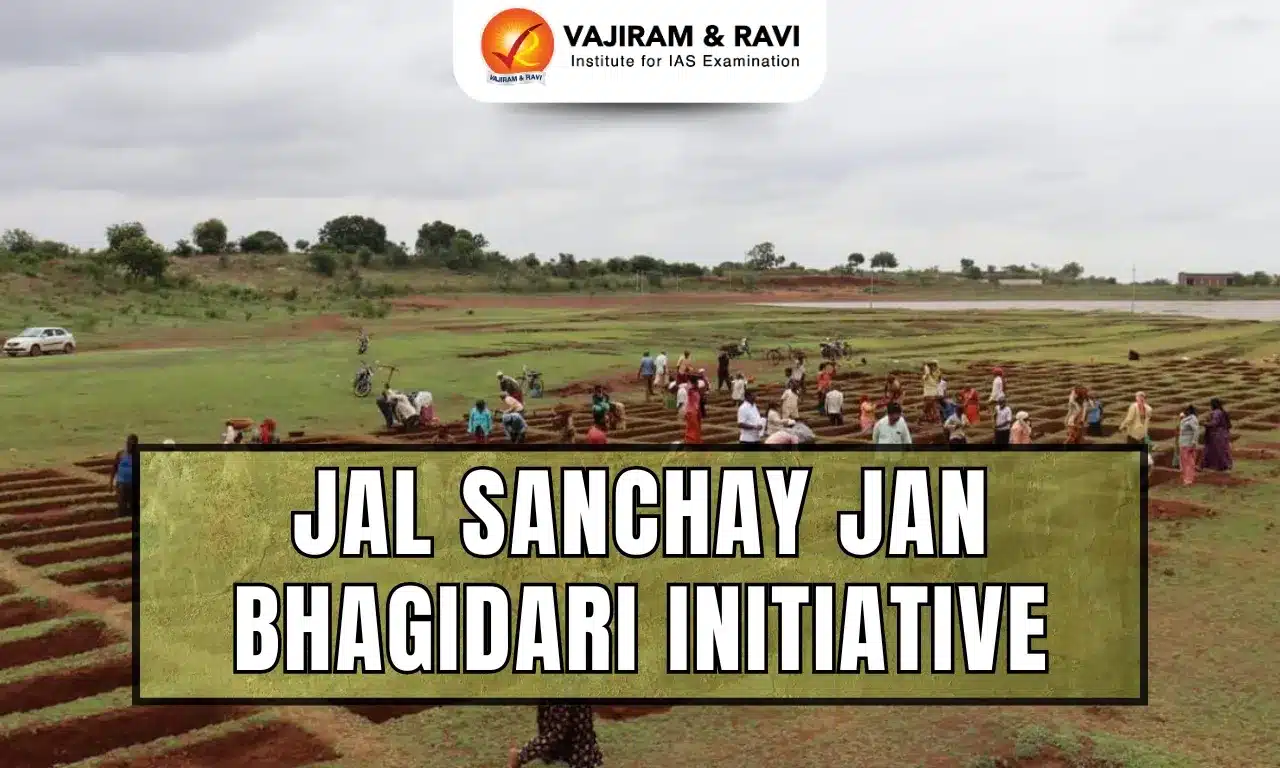
Bidar district of Karnataka has emerged as a winner of the Centre’s Jal Sanchay Jan Bhagidari Award given to top performing districts under the campaign, Jal Shakti Abhiyan: Catch the Rain.

About Jal Sanchay Jan Bhagidari Initiative

  • It was launched in 2024.
  • Aim: The initiative aims to enhance water recharge through rainwater harvesting/aquifer recharge/borewell recharge/ recharge shafts etc.
  • Objective: To ensure that every drop of water is conserved through collective efforts, following a whole-of-society and whole-of-government approach.
  • It is designed to foster active participation from all stakeholders, including government agencies, local communities, industries, NGOs and resident welfare associations.
  • The initiative will ensure
    • Boost in Groundwater Levels: Capture and store rainwater and surface runoff to stabilize and increase groundwater levels,
    • Promotion of Water Conservation Foster a culture of water conservation by engaging communities in local water resource management.
    • Enhancement of Climate Resilience Mitigate the impacts of climate change by developing storage solutions for heavy rainfall and providing a buffer against droughts.
    • Improvement of Water Quality: Utilizing artificial recharge methods to naturally filter water as it percolates through soil layers, reducing salinity and contamination.
  • Nodal Ministry: Ministry of Jal Shakti

Source: TH

Jal Sanchay Jan Bhagidari Initiative FAQs

Q1: When was Jal Shakti Abhiyan launched?

Ans: 2019

Q2: What is the primary objective of Jal Shakti Abhiyan?

Ans: To promote efficient use and conservation of water resources.

Navachar Mantra Initiative

Navachar Mantra Initiative

Navachar Mantra Initiative Latest News

Recently, the Ministry of Skill Development and Entrepreneurship (MSDE), Government of India launched ‘Navachar Mantra’ Initiative. 

About Navachar Mantra Initiative

  • It is a national initiative focused on strengthening grassroots entrepreneurship and expanding opportunities for innovators across emerging India.
  • It is aimed at identifying, nurturing, and amplifying India's most promising grassroots innovators and early-stage entrepreneurs.
  • Nodal Ministry: It is an initiative of the Ministry of Skill Development and Entrepreneurship (MSDE).
  • It is being implemented by the National Institute for Entrepreneurship and Small Business Development (NIESBUD), with Foundation for Innovation and Technology Transfer (FITT), IIT Delhi serving as the Technical Knowledge Partner.

Key Features of Navachar Mantra Initiative

  • Structured ecosystem: It is designed to provide a structured ecosystem of support for innovators working across priority sectors such as Agritech, HealthTech, EdTech and Skilling, Climate and Sustainability, Rural Commerce, and MSME Enablement.
  • Access to Stakeholders: Under this, innovators will gain direct access to policymakers, industry leaders, investors, and domain experts, enabling them to refine their ideas, strengthen business models.
  • Focus on Inclusion: It seeks to create pathways for innovators from Tier-2 and Tier-3 towns, aspirational districts, and underserved geographies to access mentorship, visibility, and growth opportunities.

Source: PIB

Navachar Mantra Initiative FAQs

Q1: Who is the Technical Knowledge Partner for Navachar Mantra Initiative?

Ans: Foundation for Innovation and Technology Transfer (FITT), IIT Delhi

Q2: What key benefit does Navachar Mantra Initiative provide to innovators?

Ans: Enables innovators to refine ideas and strengthen business models through access to stakeholders

Valley of Flowers National Park

Valley of Flowers National park

Valley of Flowers National Park Latest News

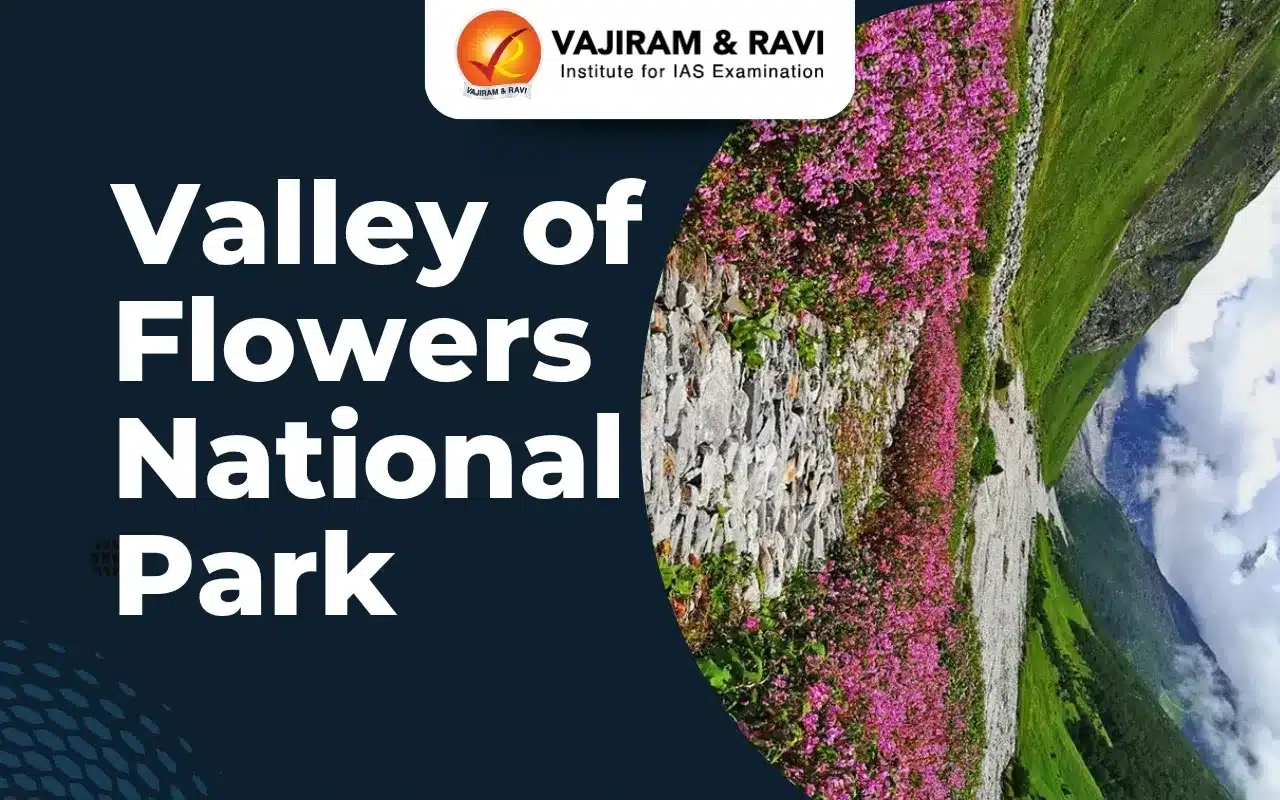
Recently, the Valley of Flowers national park located in Chamoli district of Uttarakhand has been opened to tourists. 

About Valley of Flowers National Park

  • Location: It is located in the Chamoli district of Uttarakhand.
  • Discovery: The valley is believed to have been discovered in 1931, when three British mountaineers – led by Frank S. Smythe.
  • It is a UNESCO World Heritage Site and forms one of the two core zones (the other being the Nanda Devi National Park) of the Nanda Devi Biosphere Reserve.
  • The gentle landscape of the Valley of Flowers National Park complements the rugged mountain wilderness of Nanda Devi National Park. 
  • Together they encompass a unique transition zone between the Zanskar and Great Himalayan ranges.
  • It is famous for its alpine meadows and rich biodiversity.
  • It remains covered with a thick blanket of snow during the winter season.
  • Flora: 
    • Exotic flowers (over 600 species) like orchids, poppies, primulas, marigolds, daisies, and anemones are an eye-catching spectacle. 
    • The valley also abounds in medicinal plants and herbs. 
    • Sub-alpine forests birch and rhododendron cover parts of the park’s area.
  • Fauna: It is home to such rare and amazing wildlife species like the gray langur, the flying squirrel, the Himalayan weasel, black bear, the red fox, the lime butterfly, and the snow leopard.

Source: News On Air

Valley of Flowers National Park FAQs

Q1: Valley of Flowers National Park is famous for which type of vegetation?

Ans: Alpine meadows at 3,200-6,675 m. Famous for endemic alpine flowers like Brahma Kamal, Blue Poppy, Cobra Lily

Q2: Valley of Flowers was discovered by which British mountaineer?

Ans: Frank S. Smythe in 1931 during his Kamet expedition.

Enquire Now