Operation Southern Readiness 26-2

Operation Southern Readiness 26-2

Operation Southern Readiness 26-2 Latest News

The Indian Navy is set to host Operation Southern Readiness 26-2 at the Southern Naval Command, Kochi.

About Operation Southern Readiness 26-2

  • It is a multinational maritime training exercise. 
  • It is hosted by the Indian Navy at the Southern Naval Command, Kochi.
  • The four-day multinational training engagement will be conducted in partnership with the Combined Maritime Forces (CMF) under the aegis of the Indian Navy-led Combined Task Force 154 (CTF 154), CMF’s dedicated Training Task Force. 
  • It brings together personnel from CMF partner nations for professional maritime security training, practical exercises, and the exchange of best practices. 
  • The CMF is a multinational maritime partnership comprising more than 40 nations, with the Indian Navy playing an active role in advancing collaborative maritime security efforts. 
  • The initiative is aimed at strengthening regional capacity building and enhancing collective maritime security through closer cooperation among participating countries. 
  • The training programme will combine classroom instruction, simulator-based training, and practical exposure. 
  • Sessions will cover areas including Maritime Law, Maritime Domain Awareness and Information Sharing, Counter-Narcotics, Force Protection, Asymmetric Threats, and maritime Uncrewed Systems. 
  • Participants will also be trained in Damage Control and Firefighting, maritime communications, Survival at Sea, Boarding procedures, and hands-on training onboard Indian naval ships. 

News: PIB

Operation Southern Readiness 26-2 FAQs

Q1: What is Operation Southern Readiness 26-2?

Ans: It is a multinational maritime training exercise.

Q2: Where is Operation Southern Readiness 26-2 being hosted?

Ans: It is hosted by the Indian Navy at the Southern Naval Command, Kochi.

Q3: In partnership with which organisation is Operation Southern Readiness 26-2 being conducted?

Ans: It is being conducted in partnership with the Combined Maritime Forces (CMF), a multinational maritime partnership comprising more than 40 nations,

Q4: What is the primary objective of Operation Southern Readiness 26-2?

Ans: To provide professional maritime security training, practical exercises, and exchange of best practices.

Cyclosporiasis

Cyclosporiasis

Cyclosporiasis Latest News

According to the U.S. The Centers for Disease Control and Prevention (CDC) has received reports of 1,645 confirmed domestic cases of cyclosporiasis since May 1.  

About Cyclosporiasis

  • It is a type of food poisoning caused by the microscopic parasite, Cyclospora cayetanensis. 
  • Major Sources: Cyclosporiasis outbreaks include contaminated leafy greens, lettuce, spinach, basil, cilantro, parsley, raspberries and snow peas.
  • Transmission: It spreads through the faeco-oral route, which means that food or water contaminated by faeces containing the parasite causes the illness.
  • It does not spread from person to person.
  • Symptoms
    • The main symptom is frequent, explosive, watery diarrhoea.
    • Other symptoms include bloating, loss of appetite, stomach cramps, fatigue and even weight loss.
  • Risk: Anyone can contract the infection. In children, the elderly and those with weak immune symptoms, the infection may be severe. 
  • Treatment: It is easily treatable with a seven- to 10-day course of the antibiotic trimethoprim-sulfamethoxazole, which disrupts the microbe’s ability to produce the folic acid needed to replicate itself. 
    • Hydration is also recommended.

Source: TH

Cyclosporiasis FAQs

Q1: Cyclosporiasis is caused by which type of organism?

Ans: Protozoan parasite - _Cyclospora cayetanensis

Q2: Cyclosporiasis primarily affects which organ system?

Ans: Gastrointestinal tract / Intestines

Lestes Paloti

Lestes Paloti

Lestes Paloti Latest News

A team of odonatologists has discovered a new species of spreadwing damselfly, Lestes paloti, from the Western Ghats in Kerala.  

About Lestes Paloti

  • It is a new species of spreadwing damselfly discovered in Kerala.
  • Lestes paloti is the first new species described in the genus Lestes from India since Lestes garoensis was described by Lahiri in 1987.
  • Habitat: It inhabits scrub vegetation around homesteads and on laterite hillocks, often away from open water bodies.
  • Characteristics: It changes from brown during the dry season to bluish during the monsoon.

What are Damselflies?

  • They are a group of predatory, aerial insects that are in the order Odonata. 
  • Habitat of Damselflies: Damselflies are found mainly near shallow, freshwater habitats and are graceful fliers with slender bodies and long, filmy, net-veined wings.
  • They are generally smaller, more delicate, and fly weakly in comparison with dragonflies.
  • Spreadwing damselflies are easy to identify as they hold their wings in a "V" shape over their abdomens. 

Source: TH

Lestes Paloti FAQs

Q1: Lestes paloti belongs to which family?

Ans: Lestidae

Q2: Lestes paloti was discovered from which state in India?

Ans: Kerala

PARIVARTAN Scheme

PARIVARTAN Scheme

PARIVARTAN Scheme Latest News

Recently, the Ministry of Housing & Urban Affairs (MoHUA) has approved the Guidelines for the PARIVARTAN Scheme. 

About PARIVARTAN Scheme

  • PARIVARTAN (Programme for Accelerated Renewal and Incentivization of Vehicle Assets for Reducing Transport Air Pollution and Network Emissions) was launched by the central government.
  • It is aimed at facilitating the replacement of older, highly polluting trucks and buses operating in the National Capital Region (NCR) with cleaner Bharat Stage (BS)-VI compliant or electric vehicles.
  • Implementing Ministry: It is implemented by the Ministry of Road Transport and Highways (MoRTH).
  • Funding: It is funded by the National Capital Region Planning Board (NCRPB)
  • States Covered: Rajasthan, Haryana, Uttar Pradesh and NCT of Delhi issued notifications granting Motor Vehicle Tax
  • Incentives under the Scheme
    • Motor Vehicle Tax concessions, registration fee waivers,
    • 5% interest subvention on vehicle loans,
    • A minimum 8% OEM discount on eligible new vehicles,
    • Monthly fuel voucher support for eligible diesel and CNG replacement vehicles, and
    • One-time financial assistance for electric replacement vehicles and Certificate of Deposit (CoD) trading.
  • It will be implemented through an integrated digital platform that will seamlessly interface with VAHAN, V-Scrap, DigiELV, the Public Financial Management System (PFMS), participating lenders.

Source: PIB

PARIVARTAN Scheme FAQs

Q1: What is the main environmental goal of PARIVARTAN ?

Ans: Reduce vehicular emissions and improve air quality

Q2: PARIVARTAN contributes to which mission?

Ans: National Clean Air Programme - NCAP and Atmanirbhar Bharat

Border Roads Organisation

Border Roads Organisation

Border Roads Organisation Latest News

Addressing the Border Roads Organisation (BRO) Strategic Infrastructure Conclave in New Delhi recently, Defence Minister underscored the enduring importance of strategic infrastructure in modern warfare.

About Border Roads Organisation

  • BRO is the government of India’s premier border infrastructure agency.  
  • Establishment: It was formed on 7 May 1960 to secure India’s borders and develop infrastructure in remote areas of the north and northeastern states of the country.
  • Since 2015–16, BRO has been functioning fully under the Ministry of Defence. Earlier, it was partially under the Ministry of Road Transport and Highways. 
  • Motto: Shramena Sarvam Sadhyam (everything is achievable through hard work).
  • It develops and maintains road networks in India’s border areas and friendly neighboring countries.
  • This includes infrastructure operations in 19 states and three union territories (including Andaman and Nicobar Islands) and neighboring countries such as Afghanistan, Bhutan, Myanmar, Tajikistan, and Sri Lanka.
  • Over the years, the organisation has diversified into the construction of steel bridges, airfields, townships, tunneling works, and hydroelectric projects. 
  • Beyond building roads, the BRO is often India’s first line of defence against disasters. From the Himalayas to the North East and the Andaman & Nicobar Islands, its teams restore lifelines when calamity strikes. 
  • It has an operational role during national emergencies and the outbreak of hostilities, when it provides direct support to the Army in the maintenance of roads in the forward zones and executes other functions specified by the government.
  • It also provides the workforce for the rehabilitation of certain forward airfields of the Indian Air Force during operations.
  • BRO is also included in the Order of Battle of the Armed Forces, ensuring their support at any time.
  • In order to ensure coordination and expeditious execution of projects, the Government of India set up the Border Roads Development Board (BRDB) with the Prime Minister as Chairman of the Board and the Defence Minister as Deputy Chairman.
  • The executive head of the BRO is the Director General of Border Roads (DGBR), who holds the rank of Lieutenant General. 
  • The BRO is staffed by officers and troops drawn from the Indian Army’s Corps of Engineers, Electrical and Mechanical Engineers, Army Service Corps, Military Police, and army personnel on extra-regimental employment. 
  • Engineering Service and personnel from the General Reserve Engineer Force (GREF) form the parent cadre of the Border Roads Organisation. 
  • BRO also employs more than two lakh (200,000) local workers in the task of ensuring employment in far-flung areas.

News: DDI

Border Roads Organisation FAQs

Q1: What is the Border Roads Organisation (BRO)?

Ans: It is the Government of India's premier border infrastructure agency.

Q2: Why was the Border Roads Organisation established?

Ans: To secure India's borders and develop infrastructure in remote border areas.

Q3: What is the motto of the Border Roads Organisation?

Ans: Shramena Sarvam Sadhyam (Everything is achievable through hard work).

Q4: What does the Border Roads Organisation primarily develop and maintain?

Ans: Road networks in India's border areas and friendly neighbouring countries.

Malvan- Anti-Submarine Warfare Shallow Water Craft

Malwan - Anti-Submarine Warfare Shallow Water Craft

Malvan- Anti-Submarine Warfare Shallow Water Craft Latest News

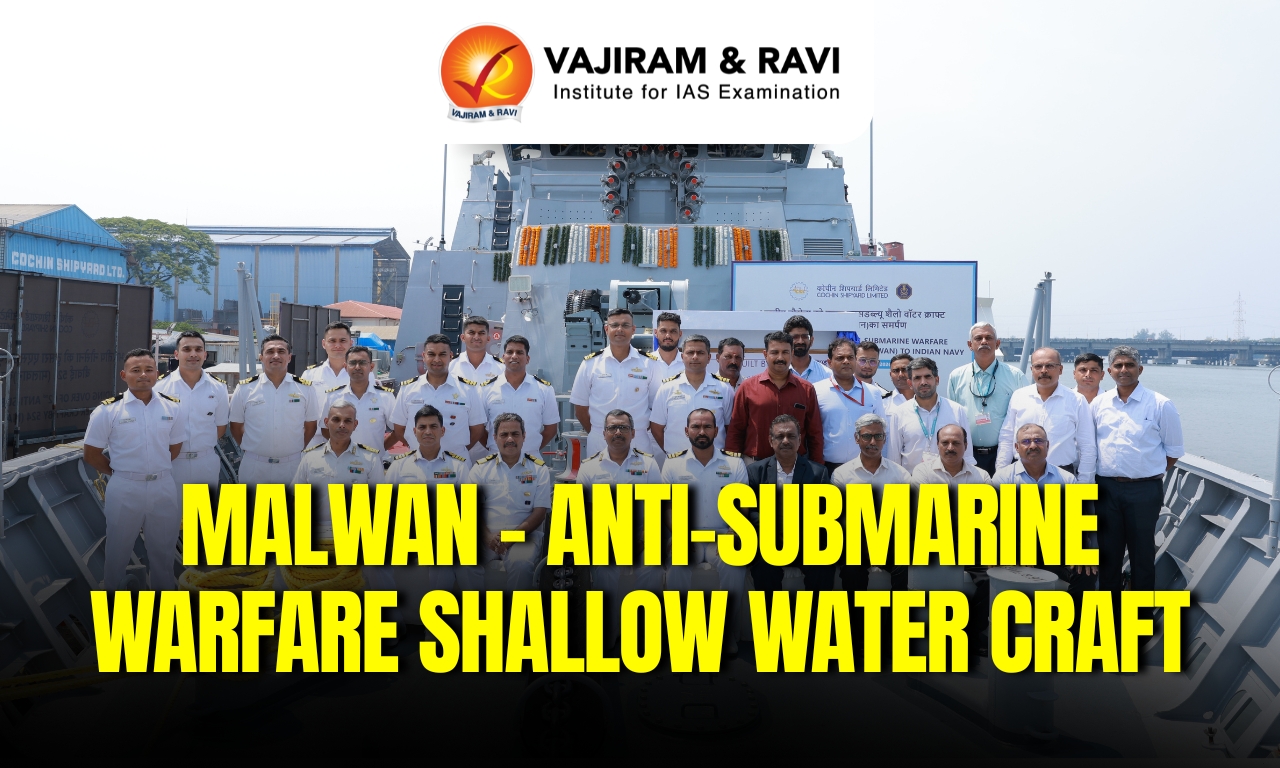
The Indian Navy is set to commission the Malvan Anti-Submarine Warfare Shallow Water Craft (ASW-SWC).  

About Malvan- Anti-Submarine Warfare Shallow Water Craft

  • It is the second of the Mahe-class Anti-Submarine Warfare Shallow Water Craft (ASW-SWC).
  • It has been indigenously designed and constructed by Cochin Shipyard Limited.
  • It draws its name from the historic coastal town of Malwan in Maharashtra,
  • The ship also encapsulates the legacy of the erstwhile INS Malwan, an Indian Naval Minesweeper which remained in service till 2003.

Features of Malwan – Anti-Submarine Warfare Shallow Water Craft

  • Capacity: It has displacing capacity of 1,100 tons.
  • Propulsion: It is Waterjets propelled ASW SWCs
  • Armaments: It is equipped with torpedoes, multifunctional anti-submarine rockets, and state-of-the-art sensors including advanced radars and sonar systems.
  • The ship is equipped for underwater surveillance, Anti-Submarine Warfare (ASW) operations in coastal waters, Low Intensity Maritime Operations (LIMO) along with mine warfare capabilities.
  • It has over 80% indigenous content and marks a milestone in indigenous warship construction and reaffirms the Government of India’s vision of ‘Aatmanirbhar Bharat’.

Source: PIB

Malvan- Anti-Submarine Warfare Shallow Water Craft FAQs

Q1: What is the Primary role of Malvan?

Ans: Anti-submarine operations in coastal waters and Low Intensity Maritime Operations

Q2: The ASW SWC ships are equipped with which weapon?

Ans: Lightweight torpedoes, ASW rockets, 30mm guns

Finland

Key Facts about Finland

Finland Latest News

Recently, India and Finland discussed strengthening economic and financial cooperation, enhancing trade and investment ties, and expanding collaboration in digitalisation and emerging sectors. 

About Finland

  • Location: It is located in Northern Europe.
  • Bordering Countries: Norway (north), Sweden (northwest) and Russia (east).
  • Bordering water bodies: It is bounded by the Gulf of Finland (south), Gulf of Bothnia (southwest) and Baltic Sea.
  • Capital City: Helsinki
  • It is a member of the European Union (EU) and NATO.

Geographical Features of Finland

  • Climate: Finland has a severe climate due to its northern location. Winter is the longest season, with temperatures in the north falling as low as -22 °F (-30 °C). 
  • Terrain: It is heavily forested and contains some 56,000 lakes, numerous rivers, and extensive areas of marshland.
  • It has one of the highest concentrations of lakes of any country in the world. The largest lake of Finland is Lake Saimaa.
  • Highest Point: Mount Halti (1,328 m).
  • Natural Resources: The country consists of copper, iron ore, nickel, cobalt, and chromium.

Source: News On Air

Finland FAQ's

Q1: Finland shares the longest border with which country?

Ans: Russia

Q2: What is the Capital of Finland?

Ans: Helsinki

Enquire Now