Directorate General of Maritime Administration

Directorate General of Maritime Administration

Directorate General of Maritime Administration Latest News

Recently, the Directorate General of Maritime Administration (DGMA) has directed ship-owners to avoid deploying Indian seafarers on vessels undertaking voyages through the Strait of Hormuz until further orders.

About Directorate General of Maritime Administration

  • It is the apex maritime authority of the Government of India which was established in September 1949.
  • Nodal Ministry: It is functioning as an attached office of the Ministry of Ports, Shipping and Waterways.
  • It deals with all executive matters, relating to merchant shipping.
  • Headquarter: Mumbai

Functions of the Directorate General of Maritime Administration

  • The Directorate is responsible for the implementation of national shipping policy and legislation.
  • It is responsible for promotion of maritime education and training in coordination with the International Maritime Organization (IMO).
  •  It extends to the registration, survey and certification of vessels, examination and certification of Merchant Navy Officers.
  • Issuing Licenses and Certifications to Seafarers: DG Shipping issues various important certificates to merchant navy officers, ensuring that they are trained and qualified to work on board ships at sea.
  • Maritime Education and Training: As part of the implementation of its mandate, DG Shipping ensures the continuous development of maritime education and skills training.
  • Protecting Seafarers’ Rights: One of the most important roles of DG Shipping is safeguarding the rights of Indian seafarers.
  • Ship Inspections: DG Shipping ensures that both Indian-flagged ships and foreign vessels operating in Indian waters and ports are compliant with international conventions and regulations. 

Source: News On Air

Directorate General of Maritime Administration FAQs

Q1: Directorate General of Shipping is under which Ministry?

Ans: Ministry of Ports, Shipping and Waterways

Q2: What is the main function of DG Shipping ?

Ans: Regulation of shipping, Seafarer training, Ship safety, Pollution prevention

Narwar Fort

Narwar Fort

Narwar Fort Latest News

A daring overnight theft at Madhya Pradesh's Narwar Fort has left authorities scrambling after a 3,000 kg Scindia-era cannon was recently stolen by an armed gang.

About Narwar Fort

  • It is a historical fort located in the Shivpuri district of Madhya Pradesh
  • It is spread over nearly 8 sq.km. atop the Vindhya ranges and standing about 500 ft above the surrounding plains.
  • Madhav National Park is located a short distance to the west

Narwar Fort History

  • The Narwar town, which lies below the fort, is said to have been the capital of Raja Nala of the Sanskrit epic Mahabharata, and it was called Nalapura until the 12th century. 
  • Constructed by the Kachwaha Rajputs in the 10th century, Narwar Fort has witnessed the rise and fall of various dynasties. 
  • Successively held by the Kachwaha, Parihara, and Tomara Rajputs, it eventually fell under Mughal rule in the 16th century.
  • It was conquered by the Maratha chief Scindia in the early 19th century.  

Narwar Fort Architecture

  • The interior of the fort is divided by cross walls into four sections known as “ahata” and “dholaahata,” 
  • The architecture of the fort and palaces is basically Rajput in style with flat ceilings, fluted columns, and multifold arches. 
  • The inner walls of the palaces have been decorated with bright paint and glass beads.
  • Outside the walled town are memorial pillars of the Tomar chiefs.

News: NDTV

Narwar Fort FAQs

Q1: Where is Narwar Fort located?

Ans: Narwar Fort is located in the Shivpuri district of Madhya Pradesh.

Q2: On which mountain range is Narwar Fort situated?

Ans: It is situated atop the Vindhya Range.

Q3: Who constructed Narwar Fort?

Ans: It was onstructed by the Kachwaha Rajputs in the 10th century.

Q4: Which Rajput dynasties successively ruled Narwar Fort?

Ans: The Kachwaha, Parihara, and Tomara Rajputs.

Q5: Who conquered Narwar Fort in the early 19th century?

Ans: Maratha chief Scindia.

India’s First Immersive Language Museum

India’s First Immersive Language Museum

India’s First Immersive Language Museum Latest News

India's first immersive language museum, the Museum of Word, was recently opened at the National Library.

About India’s First Immersive Language Museum

  • Museum of Word, also known as Shabdalok, at the National Library campus in Kolkata, is India’s first immersive language museum. 
  • It was developed by the National Library under the Union Culture Ministry.
  • It showcases the country’s linguistic heritage and traces the evolution of oral and written traditions through interactive, technology-driven exhibits.  
  • The first phase of the museum chronicles the diversity of Indian languages, scripts, and literature. 
  • Instead of being a conventional repository, it has been designed as an immersive cultural experience with digital displays, holograms, and motion-sensor technology to engage visitors. 
  • The museum has nine galleries that explore different facets of the history of languages and their influence on India’s civilization and culture.  
  • Shabdalok celebrates India’s 22 official languages and traces their journey from oral traditions and ancient manuscripts to printed works and modern electronic texts.
  • One of its key attractions allows visitors to trace the evolution of words over centuries, illustrating how their pronunciation, meaning, and usage have changed over time.

News: ET

India’s First Immersive Language Museum FAQs

Q1: Which is India's first immersive language museum?

Ans: Museum of Word (Shabdalok).

Q2: Where is the Museum of Word (Shabdalok) located?

Ans: It is located at the National Library campus in Kolkata, West Bengal.

Q3: Which institution developed Shabdalok?

Ans: It was developed by the National Library under the Union Culture Ministry.

Q4: What does Shabdalok showcase?

Ans: It showcases India's linguistic heritage.

Q5: How does Shabdalok present India's linguistic heritage?

Ans: Through interactive, technology-driven exhibits.

Aral Sea

Aral Sea

Aral Sea Latest News

Drying of the Aral Sea has released more than 200 teragrams of carbon from exposed lake-bed sediments, turning a once-stable carbon reservoir into an active source of greenhouse gases, according to a new study.

About Aral Sea

  • It is a saline lake in Central Asia straddling the boundary between Uzbekistan and Kazakhstan to the south and north.  
  • It was once a large saltwater lake in Central Asia and the world’s fourth-largest body of inland water.
  • The remnants of it nestle in the climatically inhospitable heart of Central Asia, to the east of the Caspian Sea
  • Formation:
    • The Aral Sea depression was formed toward the end of the Neogene Period (which lasted from about 23 to 2.6 million years ago). 
    • It was made by waters from the Syr Darya and the Amu Darya rivers that were dependent on glacial melt.
  • Climate
    • The Aral Sea is located within the harsh climate region of Central Asia. 
    • The area experiences a desert-continental climate, characterized by hot summers, cold winters, and varying diurnal air temperature.
  • Reason for its Disappearance:
    • The lake once covered 68,000 sq.km. between the Kyzylorda and Aktobe regions in Kazakhstan and the Karakalpakstan region of Uzbekistan. 
    • However, the lake started shrinking in the 1960s, when the Soviet government decided to divert the Syr Darya and the Amu Darya, to irrigate the surrounding desert region.  
    • By the 1980s, the Aral Sea had shed 80% of its volume, resulting in the extinction of native fish species and severe ecological degradation, including the emergence of the Aralkum Desert. 
    • Today it is on the verge of complete disappearance.

News: BIO

Aral Sea FAQs

Q1: Where is the Aral Sea located?

Ans: It is located between Uzbekistan and Kazakhstan in Central Asia.

Q2: What type of water body is the Aral Sea?

Ans: It is a saline (saltwater) lake.

Q3: Which two rivers originally fed the Aral Sea?

Ans: The Syr Darya and the Amu Darya.

Q4: Why did the Aral Sea begin to shrink?

Ans: Because the Soviet government diverted the waters of the Syr Darya and Amu Darya rivers for irrigation.

Electronic Gold Receipts

Electronic Gold Receipts

Electronic Gold Receipts Latest News

The National Stock Exchange of India (NSE) introduced Electronic Gold Receipts (EGRs) which is a new exchange-traded segment for buying and selling gold in electronic form. 

About Electronic Gold Receipts

  • Electronic Gold Receipts (EGRs) are exchange-traded securities representing ownership of physical gold (specified purity) stored in SEBI-regulated vaults.
  • They can be held electronically in a demat account, bought and sold in different denominations on the bourse and converted into physical gold via prescribed process.
  • Buying and Selling of Electronic Gold Receipts
    • Like shares, EGRs follow a T+1 settlement cycle with the receipts credited to the buyer’s demat account the next trading day.
    • Retail investors, jewellers, bullion traders, refiners, institutional investors and other eligible market participants can buy EGRs via registered stockbrokers.
    • Investors need both trading and demat accounts to buy and sell EGRs.
  • The EGRs are available in two purity standards: 999 (99.9% pure gold) and 995 (99.5% pure gold). In each purity category, investors have six different denominations such as 10 mg, 100 mg, 1 g, 10 g, 100 g and 1 kg. 
  • Those who prefer physical gold can convert EGRs into gold whenever needed.
  • Advantage: This offers a transparent and standardised way to own gold while removing concerns over purity and personal storage.

Source: TH

Electronic Gold Receipts FAQs

Q1: Electronic Gold Receipts were launched by?

Ans: SEBI

Q2: What is the main objective of EGR ?

Ans: Bring transparency and standardization in gold trading

Mexico

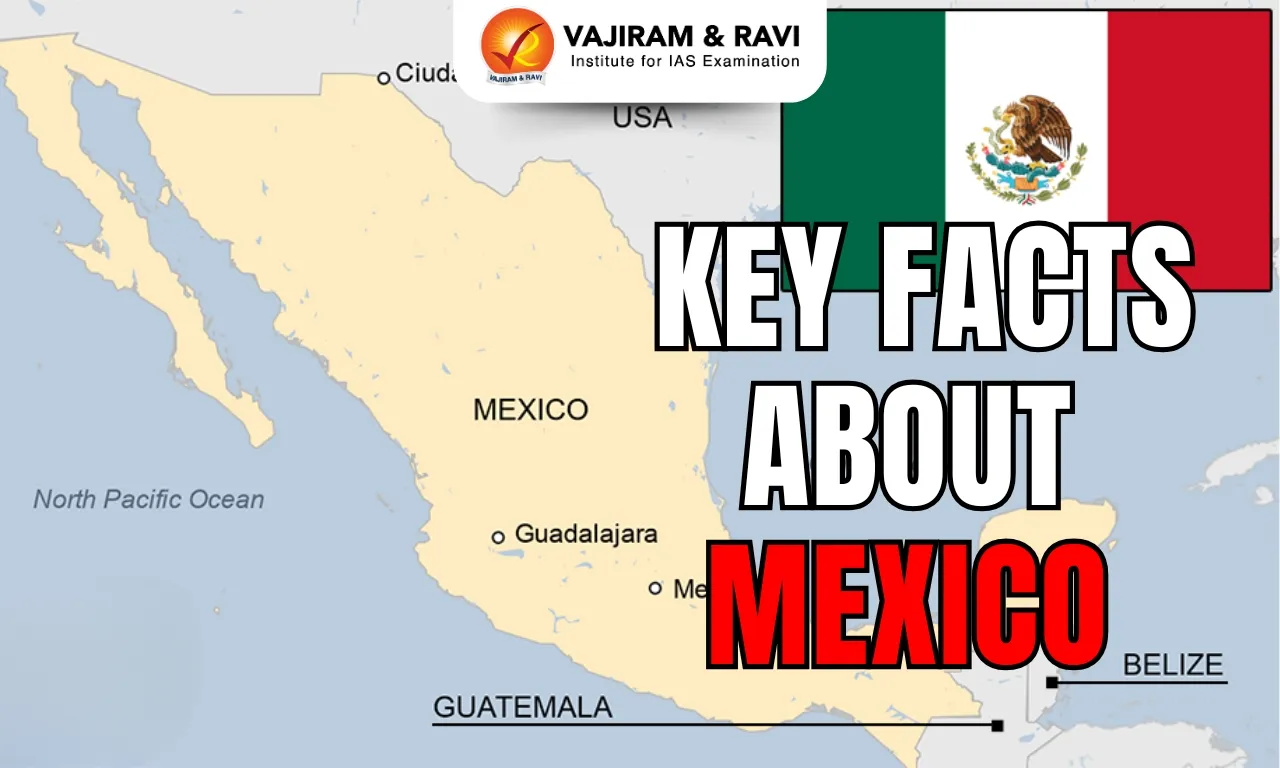
Key Facts about Mexico

Mexico Latest News

A powerful magnitude 7.3 earthquake struck off the coast of southern Mexico triggering a tsunami warning for parts of the Pacific. 

About Mexico

  • Location: It is located in the southern part of North America. 
  • Bordering Countries: It shares its land border with the United States of America to the north and with Guatemala and Belize to the southeast. 
  • Maritime boundaries: It is surrounded by the Pacific Ocean to the south and west; by the Gulf of Mexico and the Caribbean Sea to the east. 
  • Capital City: Mexico City.

Geographical Features of Mexico

  • It is a part of the circum-Pacific “Ring of Fire”—a region of active volcanism and frequent seismic activity. 
  • Peninsulas: It consists of the Baja Peninsula and Yucatan Peninsula.
  • Major Rivers: Rio Grande River and Colorado river (which is shared with US)
  • Lakes: Lake Chapala and Lake Cuitzeo.
  • Major mountain range: Sierra Madre.
  • Natural Resources: Petroleum, silver, Antimony, Copper, Gold, Lead, zinc, natural gas.

Source: BBC

Mexico FAQs

Q1: What are the major water bodies bordering Mexico?

Ans: Pacific Ocean, Gulf of Mexico, Caribbean Sea

Q2: Mexico shares longest border with which country?

Ans: United States of America - USA

Hoollongapar Gibbon Wildlife Sanctuary

Hoollongapar Gibbon Wildlife Sanctuary

Hoollongapar Gibbon Wildlife Sanctuary Latest News

Assam's Hoollongapar Sanctuary, which is home to the endangered western hoolock gibbon, is also one of the richest butterfly habitats in the state where several of the rare winged beauties are found, says a new book.

About Hoollongapar Gibbon Wildlife Sanctuary

  • It is located in the Jorhat district of Assam.
  • It is named after the Hoolock Gibbon, the only ape species found in India. It has the thickest gibbon populations in Assam. 
  • River: The Bhogdoi River creates a waterlogged region dominated by semi-hydrophytic plants along the border of the sanctuary.
  • Vegetation: Most of the vegetation is evergreen in character and is composed of several canopy layers. 
  • Flora: The tall hollong trees form the upper canopy (at around 90 feet), the Nahar trees form the middle canopy (at 30 feet) and the shrubs form the lower canopy. 
  • Fauna
    • It is home to the only nocturnal primate found in the northeast Indian states, the Bengal slow loris. 
    • Other primates include the stump-tailed macaque, northern pig-tailed macaque, eastern Assamese macaque, rhesus macaque, and capped langur. 
    • Also found at the sanctuary are Indian elephants, tigers, leopards, jungle cats, wild boar, three types of civet, four types of squirrel, etc.
    • The sanctuary is home to over 200 species of birds, including several rare and endangered species, such as the white-winged wood duck, the Bengal florican, and the great hornbill.

News: AT

Hoollongapar Gibbon Wildlife Sanctuary FAQs

Q1: Where is Hoollongapar Gibbon Wildlife Sanctuary located?

Ans: It is located in the Jorhat district of Assam.

Q2: After which animal is Hoollongapar Gibbon Wildlife Sanctuary named?

Ans: It is named after the Hoolock Gibbon.

Q3: Which river flows along the border of Hoollongapar Gibbon Wildlife Sanctuary?

Ans: The Bhogdoi River.

Kolleru Wildlife Sanctuary

Kolleru Wildlife Sanctuary

Kolleru Wildlife Sanctuary Latest News

Recently, the Supreme Court-appointed Central Empowered Committee (CEC) is learnt to have issued directions to the Andhra Pradesh government over illegal fish ponds and environmental degradation in the Kolleru Wildlife Sanctuary.

About Kolleru Wildlife Sanctuary

  • Location: It is located in the West Godavari and Krishna districts of Andhra Pradesh.
  • It was established in November 1999, under the Wildlife Protection Act of 1972.
  • The sanctuary covers wetlands and marshes that provide a vital habitat for diverse flora and fauna.
  • The sanctuary protects part of the Kolleru Lake wetland, which gained Ramsar Convention for International importance in 2002.
    • The Lake is fed directly by the seasonal Budameru and Tammileru rivers and is connected to the Krishna and Godavari systems by 67 inflowing drains and channels.
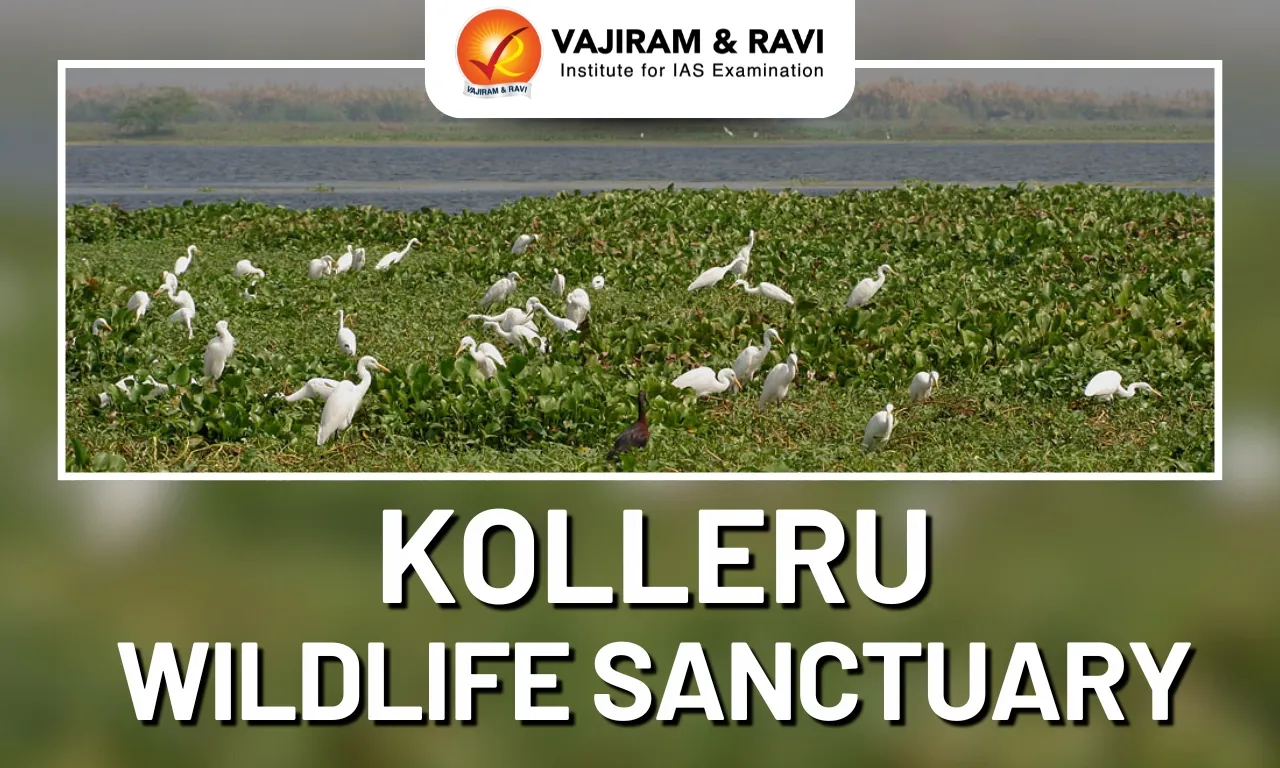
  • It is a crucial wetland ecosystem and serves as a stopover point for migratory birds.
  • Flora: The sanctuary’s flora includes various aquatic plants, submerged macrophytes, and wetland vegetation that provide essential food and shelter for the diverse bird species.
  • Fauna
    • It is home to more than 150 species of resident and migratory birds.
    • Commonly found birds in the sanctuary are: little egret, cattle egret, pied kingfisher, small blue kingfisher, blackcapped kingfisher, pond heron, reef heron, grey heron, night heron, etc.

Source: TH

Kolleru Wildlife Sanctuary FAQs

Q1: Kolleru Wildlife Sanctuary is located in which state?

Ans: Andhra Pradesh

Q2: Kolleru Lake was declared a Ramsar Site in which year?

Ans: 2002

Mangal Pandey

Mangal Pandey

Mangal Pandey Latest News

The Prime Minister recently paid tributes to the great revolutionary Mangal Pandey ji on his birth anniversary.

About Mangal Pandey

  • He was a brave Indian soldier during the pre-independence era. 
  • His attack on British officers on March 29, 1857, was the first major incident of what came to be known as the first war of Independence, also known as the Indian Mutiny/Sepoy mutiny. 
  • He was born on July 19, 1827, Ballia district in Uttar Pradesh.  
  • In 1849, Pandey joined the army of the British East India Company at the age of 22.
  • He served as a sepoy in the 6th Company of the 34th Bengal Native Infantry in Barrackpore.
  • He revolted against the East India Company for introducing cartridges that were greased with animal fat, as it hurt the religious sentiments of the soldiers.
  • Mangal Pandey attacked two British officers on March 29, 1857
  • Following this, he was hanged to death on April 8, 1857, in Barrackpore. He was only 29 years old when he was executed.
  • However, his act of revolt, subsequent arrest, and hanging triggered a nationwide uproar and marked the beginning of the revolt of 1857.  
  • Following this huge mass movement, the British were forced to recognise the trouble and passed new rules through the Government of India Act, 1858.

News: PIB

Mangal Pandey FAQs

Q1: Who was Mangal Pandey?

Ans: He was a brave Indian soldier (sepoy) of the British East India Company who is regarded as one of the earliest heroes of the Revolt of 1857.

Q2: When did Mangal Pandey join the British East India Company's army?

Ans: He joined the army in 1849 at the age of 22.

Q3: Why did Mangal Pandey revolt against the British East India Company?

Ans: He revolted against the introduction of cartridges greased with animal fat, which hurt the religious sentiments of Indian soldiers.

Q4: Which major event was triggered by Mangal Pandey's revolt?

Ans: It marked the beginning of the Revolt of 1857 (First War of Independence/Sepoy Mutiny/Indian Mutiny).

Enquire Now